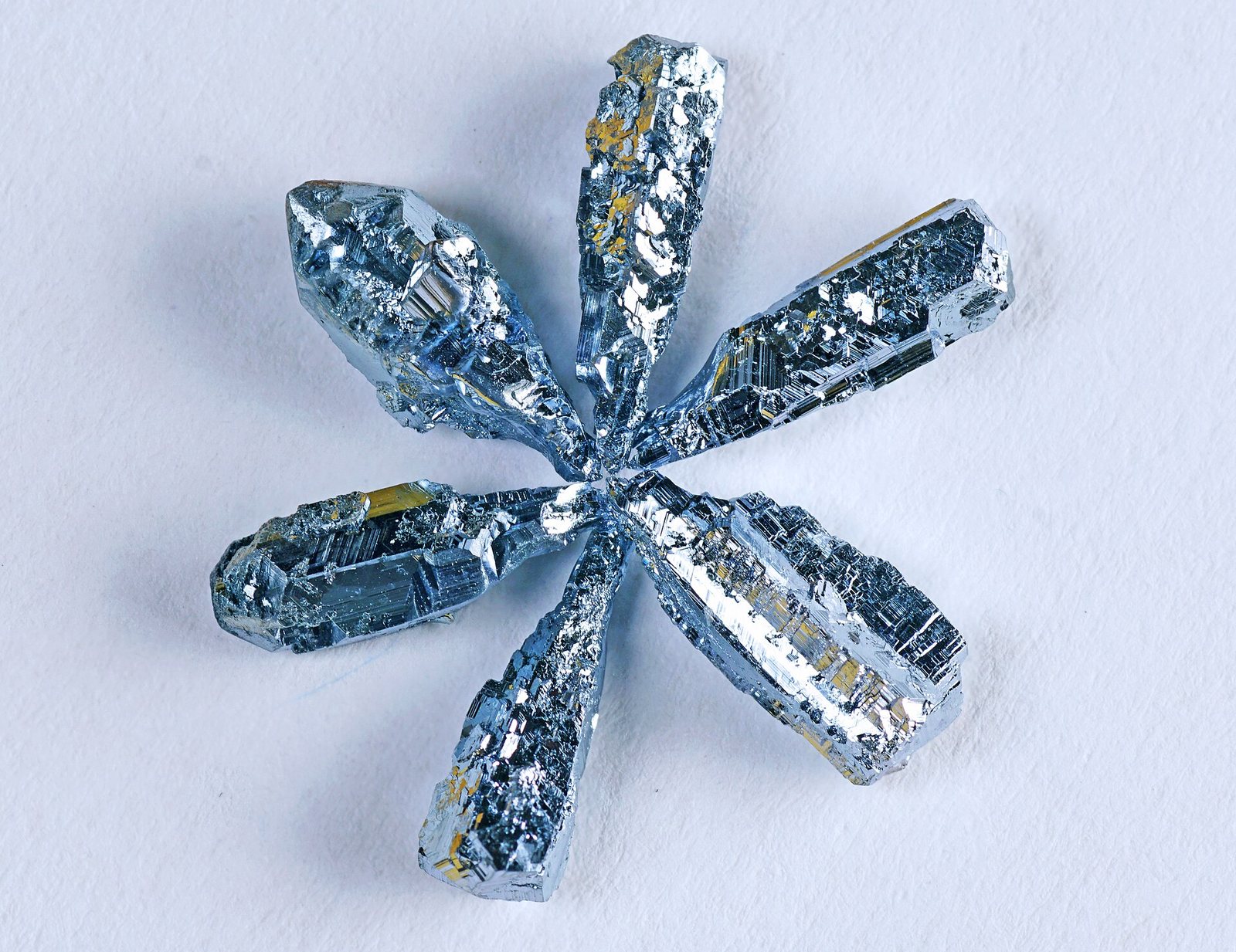
Что это такое?
The densest naturally occurring element, and one of the least used — most of it sits unrefined in platinum-group residues.
Почему это важно?
It completes the platinum group; its main commercial role is in very hard alloy tips and specialist catalysts.
Where it is in the Earth
Osmium belongs to the platinum-group elements (PGEs), a set of six chemically similar metals — platinum, palladium, rhodium, ruthenium, iridium and osmium — that tend to occur together in nature. The geological reason for this is that all six are strongly siderophile, meaning they have a chemical affinity for iron and nickel rather than for silicate rock. Early in Earth's history, when the planet was largely molten, these metals sank with iron toward the core. The PGEs that remain accessible in the crust today are thought to have been delivered later, by meteorite bombardment, or were stranded in rocks that formed through unusual magmatic processes.
The rock type that matters most for PGEs, including osmium, is a layered mafic intrusion — a body of dark, iron- and magnesium-rich igneous rock that crystallised slowly from a magma chamber deep underground. As the magma cooled in stages, sulphide minerals (compounds of sulfur and metals) separated out and settled, concentrating the PGEs into thin, consistent layers. The most famous example of this setting is the Bushveld Complex in South Africa, which hosts the great majority of the world's known PGE resource. The Stillwater Complex in Montana and the Great Dyke in Zimbabwe follow the same geological logic. A second, geologically distinct source is found in placer deposits — river and beach sediments where erosion of PGE-bearing rock has concentrated the denser minerals, including the natural osmium-iridium alloy called osmiridium or iridosmine, in gravels over geological time.
Within these settings, osmium does not form large discrete ore bodies of its own. It is present at trace concentrations, dispersed through the same sulphide minerals that carry platinum and palladium. Its presence is inseparable from theirs, and the scale at which it concentrates is far below what would justify mining for osmium alone. The distribution of osmium across PGE deposits is not uniform; the ratio of osmium to other PGEs varies between deposits and even between layers within the same intrusion, which has practical consequences downstream in refining.
Getting it out
Because osmium occurs only as a trace constituent of PGE-bearing sulphide ore, it is never the target of a mining operation. Every tonne of osmium that eventually reaches a refinery arrives as an incidental passenger in ore that was extracted for its platinum or palladium content. This makes osmium a pure by-product, and the decisions that govern how much ore is mined — which deposits to develop, which reef layers to work, how fast to extract — are made entirely on the economics of the primary PGEs, not osmium.
The physical methods used to mine PGE ore vary by deposit geometry and depth. In the deep, narrow reef layers of South Africa's Bushveld Complex, the ore occurs in seams that may be less than a metre thick but extend laterally for many kilometres. This geometry suits narrow-reef underground mining, where workers or mechanised equipment follow the reef through a network of tunnels, breaking only the ore-bearing layer and as little surrounding waste rock as possible. The ratio of waste to ore — called the stripping ratio in open-pit work or simply dilution in underground settings — directly affects the grade of material reaching the surface and therefore the concentration of osmium in the feed to the concentrator. In shallower or more massive deposits, such as parts of the Stillwater Complex, more mechanised underground methods or, where the deposit is near enough to the surface, open-pit extraction become viable.
Placer deposits containing osmiridium are mined by entirely different means: alluvial dredging or simple hydraulic methods that separate dense minerals from gravel by exploiting the very high density of the osmium-iridium alloy. However, placer sources represent a very small fraction of modern supply and have historically been significant mainly in specific localities in Russia and the Ural region. Whatever the mining method, the point to hold is that the volume of osmium recovered from any operation is a function of the PGE grade of the ore, the efficiency of the concentrating step, and the throughput of the mine — none of which are controlled with osmium in mind.
What pulls on it
Osmium occupies a narrow and specialised corner of material consumption. Its primary established use is in very hard alloy tips — historically used in fountain pen nibs, instrument pivots and compass bearings — where the combination of extreme hardness and resistance to wear makes it perform well in applications that demand a dimensionally stable contact surface. However, the scale of these applications is small, and many traditional uses have declined as alternative materials and designs have been adopted over the decades.
A second area of use is in certain specialist catalysts, where osmium compounds can drive specific chemical reactions, most notably the osmium-catalysed dihydroxylation of alkenes used in pharmaceutical synthesis. This is a well-characterised reaction in organic chemistry but a relatively minor consumer of osmium in tonnage terms, since catalytic applications require small quantities and, in principle, allow for recovery and reuse of the metal. Research interest in osmium-based compounds for other catalytic and biomedical applications exists, but translating laboratory chemistry into industrial consumption requires long development cycles and regulatory acceptance, particularly for anything touching medicine.
The broader question of what would have to change for osmium demand to move sharply in either direction is largely a question about the other platinum-group metals. If PGE refining volumes increase — driven by growing demand for platinum in fuel cells or palladium in catalytic converters — osmium production rises as a consequence, whether or not there is additional demand for osmium itself. Conversely, if PGE refining contracts, osmium availability falls. The metal sits in an unusual position: it is not consumed in any application large enough to be clearly tracked in most national statistics, yet it is produced continuously as an unavoidable accompaniment to metals that are tracked very closely.