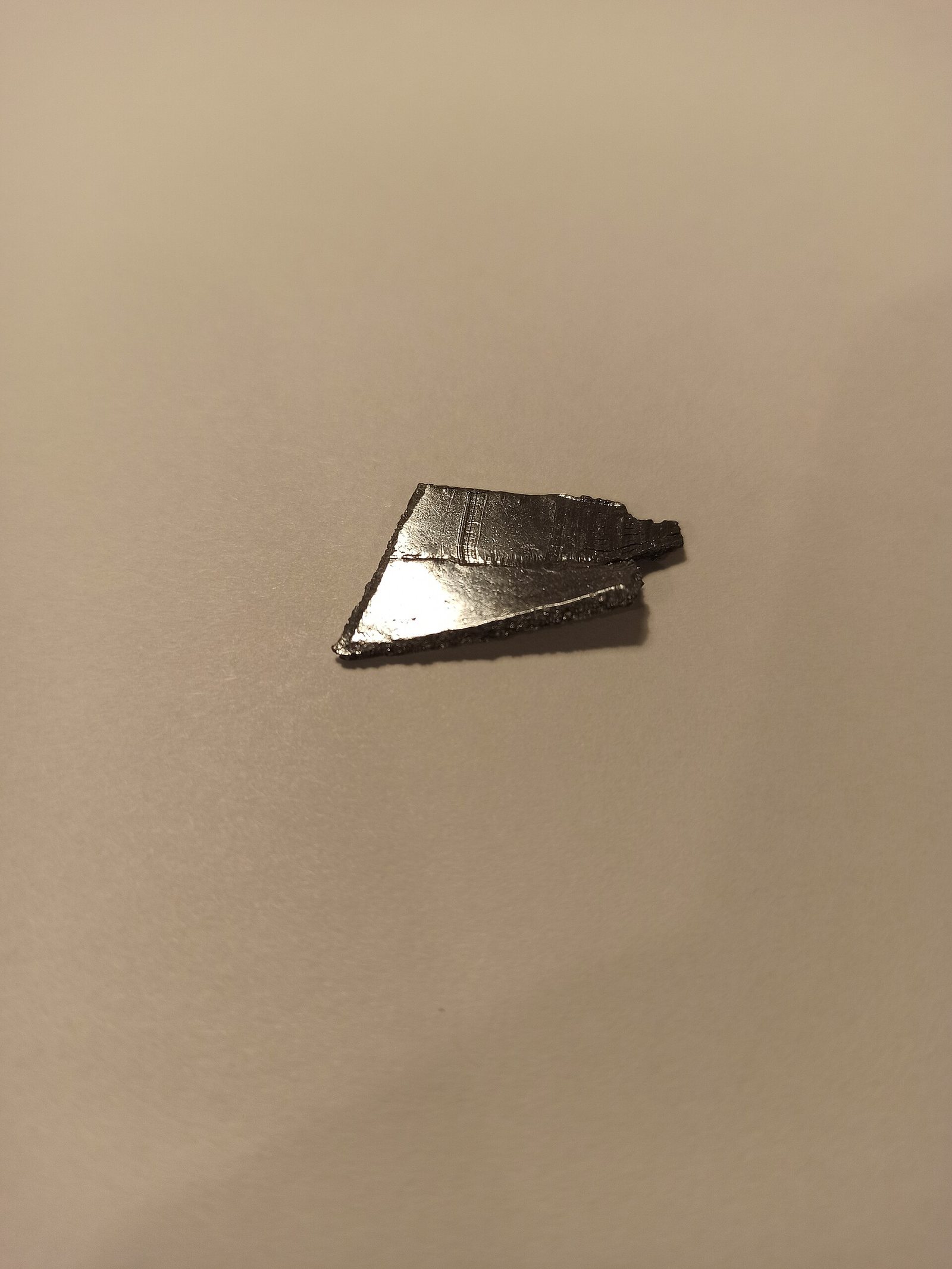
Đây là gì?
One of the rarest metals in the crust, recovered from molybdenum roasting, and the ingredient that lets a jet turbine blade run hotter.
Tại sao điều này quan trọng?
Second- and third-generation single-crystal superalloys contain 3-6% rhenium. Engine efficiency is directly tied to that temperature margin.
Where it is in the Earth
Rhenium is one of the rarest elements in the Earth's crust, and it does not form ore minerals of its own in any commercially meaningful sense. Instead, it occurs in trace amounts within molybdenite (molybdenum disulfide, MoS₂), the principal ore mineral of molybdenum. Molybdenite has a layered crystal structure that can accommodate rhenium atoms substituting for molybdenum, so wherever molybdenite forms in quantity, a small but recoverable fraction of rhenium comes along with it. The concentrations involved are extraordinarily low — far below what would register as a grade in any conventional mining context — yet because molybdenite itself is mined in large volumes, the absolute quantities of rhenium that pass through the system become economically meaningful.
The deposits that carry most of the world's rhenium are porphyry copper-molybdenum systems: large, low-grade bodies of mineralisation formed when metal-rich fluids expelled from cooling granite intrusions percolated outward into the surrounding rock and deposited sulphide minerals over immense volumes. The word porphyry refers to the texture of the host rock, which contains large crystals set in a finer-grained matrix. These systems are geologically young by crustal standards and tend to cluster along continental arcs — the chains of volcanoes thrown up where one tectonic plate dives beneath another. Chile's position along the Andean arc places it above one of the most productive belts of porphyry mineralisation on Earth, which is why Chile holds both the largest reserves and the largest annual output of rhenium. The same arc-related geology recurs in Central Asia, the western United States, and parts of East Asia, explaining the geographic spread of producing countries shown in the table above.
Because rhenium is bound inside molybdenite at the atomic level rather than occurring as a separate mineral phase, it cannot be concentrated by any process that targets rhenium specifically. Its geography is entirely inherited from the geography of molybdenum, and ultimately from the distribution of porphyry copper systems around the world's subduction zones.
Getting it out
Rhenium is never the reason a mine exists. It arrives entirely as a by-product — a secondary recovery from operations whose economics are driven first by copper and, to a lesser degree, by molybdenum. The large porphyry deposits that host it are almost always worked by open-pit mining, a method suited to low-grade, high-volume ore bodies where the mineralisation is too dispersed and too near the surface to justify the cost and complexity of underground workings. In open-pit mining, rock is drilled, blasted, and removed in a descending series of benches, with the ore trucked to a processing plant and the waste rock stacked separately. The ratio of waste to ore moved — the strip ratio — can be high in these operations, meaning that very large quantities of material must be shifted to access each tonne of copper-bearing rock.
The rhenium content of the ore is not a figure that drives any mining decision. Operators measure it, because it determines what they will recover downstream, but the mine plan is set around the copper and molybdenum grades. For a reader trying to understand what the production figures in the table mean in practice, the key point is that rhenium output from any country is essentially a function of how much molybdenite concentrate that country's copper mines are producing in a given year, not of any deliberate choice to produce rhenium. When copper demand falls and mines curtail output or reduce throughput, rhenium supply falls with it, regardless of what the rhenium market is doing.
What pulls on it
The dominant use of rhenium is in the single-crystal nickel superalloys from which the high-pressure turbine blades of jet engines are made. To understand why rhenium matters here, it helps to know what a single-crystal superalloy is. Conventional metal alloys are made up of many small crystalline grains bonded together; at very high temperatures, those grain boundaries weaken and allow the material to creep and deform. Engineers in the mid-twentieth century learned to cast turbine blades as a single uninterrupted crystal, eliminating grain boundaries entirely and dramatically extending the temperature at which the blade remains mechanically sound. Rhenium, added at concentrations of a few percent, further stabilises the crystal structure at extreme temperatures by slowing the diffusion of atoms through the alloy — a phenomenon called creep resistance. Higher operating temperatures mean more efficient combustion and lower fuel consumption for a given thrust, which is why engine manufacturers have strong incentive to use rhenium-bearing alloys in the hottest parts of their turbines.
The civil aviation industry is the largest single source of demand, followed by military aviation and industrial gas turbines used in power generation. Demand in these sectors tracks the production rate of new engines rather than the size of the existing fleet, because rhenium is consumed when an engine is built or its hot-section components are replaced. When new commercial aircraft orders are strong and engine manufacturers are running at high rates, rhenium demand rises accordingly. A prolonged reduction in new aircraft deliveries — whether from an economic downturn, a supply-chain disruption, or a shift in airline ordering — would reduce rhenium consumption materially, because there is no other use of comparable scale to absorb the difference.
Rhenium also appears in reforming catalysts used in petroleum refining to improve the octane rating of gasoline, and in smaller quantities in thermocouples, electrical contacts, and laboratory instruments that exploit its exceptional melting point. However, the superalloy application dwarfs all others, and the trajectory of demand is largely a story about commercial aerospace build rates and the continued preference of engine designers for rhenium-bearing alloy generations over alternatives.
Ai sản xuất nó
Xem trên bản đồ →Mine production
Mine productionkilograms 2025 (ước tính) Tổng toàn cầu 81,000 kilograms
USGS Mineral Commodity Summaries 2026 · Reported in kilograms, not tonnes — annual world output is measured in tens of tonnes. · nguồn ↗
Cuộn bảng sang ngang để xem các cột còn lại.
| Quốc gia | Sản lượng | Tỷ phần thế giới |
|---|---|---|
| Chile | 30,000 | 37.0% |
| China | 20,000 | 24.7% |
| Poland | 10,000 | 12.3% |
| United States | 9,800 | 12.1% |
| Uzbekistan | 7,000 | 8.6% |
| Korea, Republic of | 3,000 | 3.7% |
| Kazakhstan | 1,000 | 1.2% |
| Armenia | 200.0 | 0.2% |
| Russia | Not applicable | — |
| Tổng toàn cầu | 81,000 | 100% |
"Withheld" có nghĩa là USGS đã ẩn số liệu để tránh tiết lộ dữ liệu của một công ty riêng lẻ — không có nghĩa là bằng không. Tổng các hàng theo quốc gia không phải lúc nào cũng bằng tổng toàn cầu vì nguồn làm tròn từng số liệu một cách độc lập và không phải lúc nào cũng tách riêng dòng "các quốc gia khác".
Ai nắm giữ trữ lượng
Reserves
Reserveskilograms 2025
USGS Mineral Commodity Summaries 2026 · nguồn ↗
| Quốc gia | Trữ lượng | Tỷ phần thế giới |
|---|---|---|
| Chile | 1,300,000 | — |
| United States | 400,000 | — |
| Russia | 310,000 | — |
| China | 200,000 | — |
| Kazakhstan | 190,000 | — |
| Armenia | 95,000 | — |
| Korea, Republic of | Not applicable | — |
| Poland | Not applicable | — |
| Uzbekistan | Not applicable | — |
| Tổng toàn cầu | Large | 100% |
Giá
average value, gross weight, dollars per kilogram: Metal, 99.99% pure
Trung bình nămdollars per kilogram
Cơ sở: average value, gross weight, dollars per kilogram: Metal, 99.99% pure. Trung bình năm theo công bố trong USGS Mineral Commodity Summaries 2026 · nguồn ↗. Đây là mức trung bình hàng năm tham khảo, không phải báo giá thị trường trực tiếp.
average value, gross weight, dollars per kilogram: Ammonium perrhenate
Trung bình nămdollars per kilogram
Cơ sở: average value, gross weight, dollars per kilogram: Ammonium perrhenate. Trung bình năm theo công bố trong USGS Mineral Commodity Summaries 2026 · nguồn ↗. Đây là mức trung bình hàng năm tham khảo, không phải báo giá thị trường trực tiếp.
Nơi nó được chế biến và tinh luyện
| Nhà máy | Loại | Giai đoạn | Quốc gia | Vai trò |
|---|---|---|---|---|
| Aero-Engine Turbine Plant, Derby | Nhà máy sản xuất | Sản phẩm | United Kingdom | Đầu vào |
Công dụng của nó
Tất cả thị trường đầu ra →| Thị trường đầu ra | Chức năng của nó ở đó | Tầm quan trọng |
|---|---|---|
| Aerospace & Defence | Single-crystal superalloy | Định nghĩa |
Một công nghệ cần bao nhiêu
| Công nghệ | Đại lượng | Báo giá | Cơ sở |
|---|---|---|---|
| Single-Crystal Turbine Blade A few percent of a metal produced in tens of tonnes a year worldwide. | vết | per blade set | 3-6% of second and third generation superalloys |
Indicative range compiled from published technology studies and chemistry; verify against a manufacturer specification before use. Chạy các con số này ở bất kỳ quy mô nào trong máy tính vật liệu →