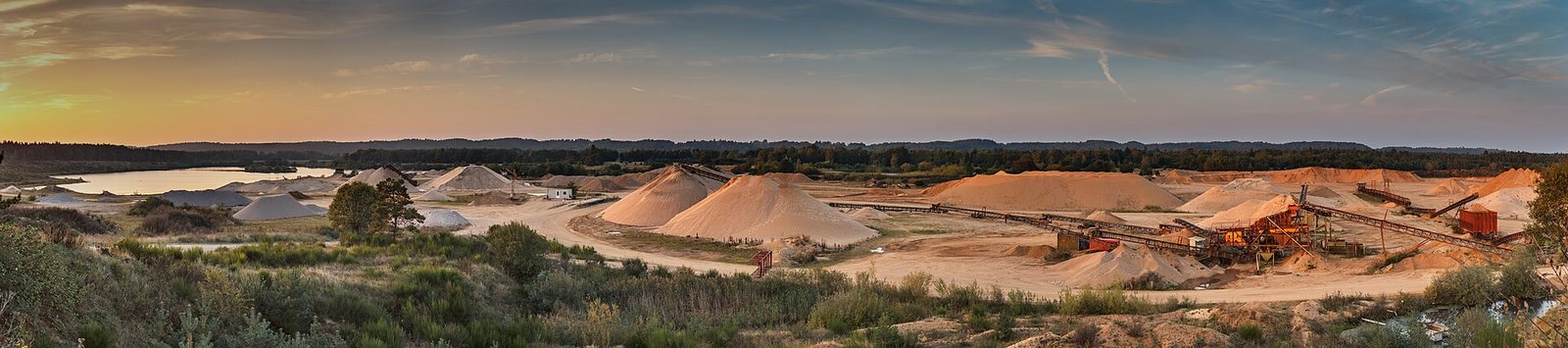
이것은 무엇인가?
The most-mined material on Earth by weight, and the one nobody thinks of as mining.
왜 중요한가?
Concrete is mostly aggregate. Desert sand is too round to use, which is why sand is trucked and shipped despite being 'everywhere'.
Where it is in the Earth
Sand and gravel are not a rock type in the way that granite or limestone are. They are fragments of whatever rocks happened to exist upstream, broken loose by weathering, carried by water or ice, and eventually dropped when the current slowed enough to let them settle. The process is called fluvial sorting when rivers do it, and glaciofluvial sorting when meltwater from ice sheets does it. In both cases, moving water acts as a natural sieve: fast water carries larger, heavier clasts; slower water drops them. The result is deposits where particle size, and to a useful degree particle shape, varies in a predictable way from one part of the deposit to another.
Shape matters enormously, which is why the common observation that sand is everywhere does not translate into sand being available everywhere for construction. Grains that have travelled long distances in water knock against one another and become rounded. Grains that have spent a very long time in desert environments, moved mainly by wind rather than water, become even more rounded and polished. Concrete, however, requires grains with angular faces that interlock and grip the cement paste binding them together. Wind-blown desert sand, however abundant, generally lacks that angularity and so performs poorly in structural concrete. The usable deposits are those shaped by rivers, glaciers, or marine processes in the geologically recent past.
In much of northern Europe and northern North America, the most productive deposits are outwash plains and eskers left behind when the continental ice sheets retreated roughly ten thousand years ago. An esker is a long, sinuous ridge of sand and gravel deposited by a meltwater stream that ran underneath or within the ice. Elsewhere, active river floodplains, terraces cut into valley sides by rivers at earlier, higher stages, and shallow offshore marine deposits are the main sources. The common thread is recent geological activity: these are young, unconsolidated sediments sitting at or close to the surface, which is precisely what makes them practical to mine.
Getting it out
Because usable sand and gravel deposits are unconsolidated — meaning the grains are not cemented together into solid rock — getting them out requires almost none of the drilling and blasting that harder-rock mining demands. The standard approach is an open pit, sometimes called a dry pit when the deposit sits above the water table, where excavators and front-end loaders simply scoop the material and load it onto trucks or conveyors. Where the deposit extends below the water table, a wet pit or pond forms naturally as excavation proceeds, and the material is recovered by floating dredges equipped with suction pumps or bucket-wheel cutters that lift the saturated sediment from the floor of the pond. Marine deposits offshore are worked by trailing-suction hopper dredges, which drag a pipe across the seabed and pump the mixture of sand, gravel, and water into a hull-mounted hopper before sailing to port.
The concept of ore grade, so central to metallic mining, applies differently here. There is no target element whose concentration determines whether a deposit is worth working. Instead, what matters is the proportion of material in each size fraction, the degree of contamination by clay or silt, and the proportion of deleterious particles — soft rock fragments, organic matter, or minerals that react badly with cement — relative to the usable aggregate. A deposit with a high clay content may require extensive washing to be serviceable, raising costs without raising the value of the product much, since construction aggregate is sold at low prices per tonne. Overburden — the soil and material sitting above the deposit — must be stripped first, but because these deposits are shallow and the material itself is the bulk product rather than a refined concentrate, the ratio of waste moved to product sold is far lower than in most other forms of mining.
What pulls on it
Virtually all construction sand and gravel is used as aggregate — the granular filler that makes up the bulk of concrete and asphalt by weight and by volume. In concrete, aggregate is bound together by a cement paste; in asphalt, by a bitumen binder. In both cases the aggregate provides structural strength, resistance to deformation, and dimensional stability. The share of any building, road, or pavement that is actually aggregate is large: a cubic metre of concrete contains considerably more aggregate by weight than it does cement. This means that wherever construction activity rises, demand for aggregate rises with it, and wherever construction slows, so does aggregate consumption. The relationship is direct and durable.
The uses that drive the largest volumes are infrastructure — roads, bridges, drainage systems, coastal defences — and residential and commercial building. These are not discretionary purchases in the way consumer goods are: a road cannot be built without aggregate, and no engineered substitute performs the same structural role at a comparable cost. Demand can slow during recessions or following the completion of major public spending cycles, but it does not disappear, and population growth and urbanisation in many parts of the world represent a sustained underlying pull. The price series in the table illustrates a pattern consistent with steady cost inflation rather than with the sharp commodity cycles seen in metals: the average unit value has risen each year from 2021 through 2025, reaching $14.50 per metric ton in 2025, but the trajectory reflects rising fuel, labour, and land costs more than speculative price swings.
One structural feature worth understanding is that aggregate is heavy and low in value relative to its weight, so transport distance is itself a major constraint on how demand is met. A quarry or pit that is twenty kilometres from a city centre faces very different economics from one that is a hundred kilometres away. This means that local geology, not just global supply patterns, determines whether a given region can source aggregate cheaply. Where good deposits close to population centres have already been exhausted or sterilised by urban development, producers and users must accept either longer haulage distances, marine or riverine transport, or a shift toward recycled materials.
생산 주체
지도에서 보기 →Mine production
Mine productionmillion metric tons 2025 (추정치)
USGS Mineral Commodity Summaries 2026 · US figures only in the MCS; world totals are not compiled. · 출처 ↗
나머지 열을 보려면 표를 옆으로 스크롤하십시오.
| 국가 | 생산 | 세계 비중 |
|---|---|---|
| United States | 870.0 | — |
| Other countries | Not applicable | — |
| 세계 합계 | Not applicable | 100% |
'비공개'는 USGS가 개별 기업의 데이터 노출을 막기 위해 수치를 억제한 것으로, 0을 의미하지 않습니다. 출처가 각 수치를 독립적으로 반올림하고 '기타 국가' 항목을 항상 별도로 구분하지는 않기 때문에, 국가별 합계가 세계 합계와 일치하지 않을 수 있습니다.
가격
average unit value, dollars per metric ton
연간 평균dollars per metric ton
기준: average unit value, dollars per metric ton. 다음 자료에 게재된 연간 평균 USGS Mineral Commodity Summaries 2026 · 출처 ↗. 이 수치는 기준 연간 평균값이며, 실시간 시장 가격이 아니다.
용도
전체 최종 시장 →| 최종 시장 | 거기에서의 기능 | 중요도 |
|---|---|---|
| Construction & Steel | Aggregate in concrete and asphalt | 정의 |