これは何か
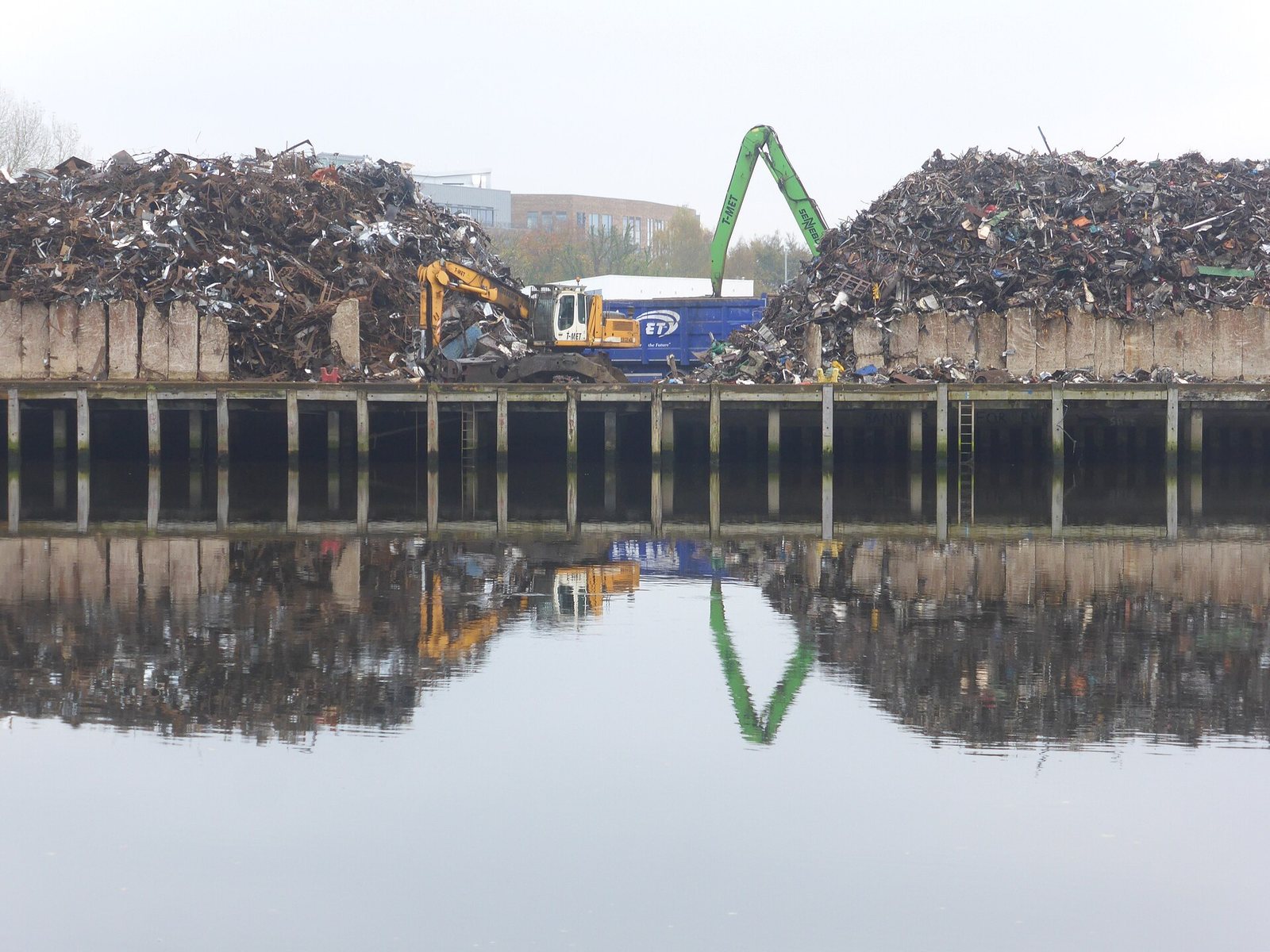
Old steel collected to be melted into new steel — the largest recycling stream on the planet by weight.
なぜ重要なのか
Steel made from scrap in an electric-arc furnace emits a small fraction of what the blast-furnace route emits. How fast steel can decarbonise is largely a question of how much scrap exists.
Where it is in the Earth
Iron and steel scrap is not a geological deposit in the usual sense. It does not form in the Earth's crust through the slow action of heat, pressure, or circulating fluids. Instead, it is an entirely manufactured material — steel that human industry has already produced, used, and discarded or trimmed away. The question of where it comes from is therefore a question about where steel has been used and for how long, rather than about rock types or tectonic settings.
Steel itself originates from iron ore, a genuine geological material. Iron is one of the most abundant elements in the crust, but the ores worth mining are those where geological processes — sedimentary banding in ancient seas, magmatic intrusion, or surface weathering — have concentrated iron-bearing minerals to grades high enough to be worth extracting. Once that ore has been smelted and rolled into products, however, the resulting steel enters the human economy, and it is within that economy that scrap originates. The tables on this page that show ore minerals and reserves describe the primary route; scrap is the secondary route, and its geography is determined by industrialisation history rather than by where iron ore happens to sit.
What this means in practice is that the richest sources of scrap are the oldest industrial economies. Countries that built large quantities of steel infrastructure — railways, ships, buildings, machinery — several decades ago are now generating large volumes of obsolete scrap as those structures reach the end of their service lives. Younger industrial economies produce considerable volumes of prompt scrap, which is the metal trimmed away during manufacturing, but they generate less obsolete scrap because their infrastructure has not yet aged enough to be demolished and discarded.
Getting it out
Scrap is not mined; it is collected. The activity that brings it into the supply chain is closer to logistics and sorting than to extraction. The two broad categories — prompt scrap and obsolete scrap — arrive through quite different channels, and understanding that distinction helps make sense of how the supply can be constrained even when steel is all around us.
Prompt scrap, sometimes called home or new scrap, arises directly from steel fabrication: the offcuts from pressing a car door panel, the turnings from a machined shaft, the edge trim from a rolling mill. It is generally clean, of known composition, and flows back into the steel plant with little processing. Obsolete scrap, by contrast, is steel recovered at the end of a product's life — a demolished building, a scrapped vehicle, a worn-out appliance. This material is far more heterogeneous. It must be collected, transported, shredded or sheared, and sorted before it is usable. The effort and cost involved in that chain explain why not all available steel is actually recovered.
Grading is the equivalent of assaying ore. Because melting cannot remove copper or tin that has become mixed into scrap — from electrical wiring, coatings, or alloy components — buyers classify scrap by its residual levels of these elements. A consignment with low copper content commands a higher price because it can be used in a wider range of steel products. This constraint has no parallel in primary steelmaking, where the chemistry of the input is controlled from the start, and it is one of the central technical limits on how far scrap-based steelmaking can go in producing high-specification flat products.
What pulls on it
Steel scrap is demanded by steelmakers, specifically those operating electric arc furnaces. The share of global steel produced by the EAF route has grown steadily as electricity grids have matured and as the carbon emissions of blast-furnace steelmaking have attracted increasing regulatory attention. Because every tonne of scrap-based steel requires substantially less energy and produces substantially less carbon dioxide than a tonne of blast-furnace steel, any policy or market pressure that puts a cost on carbon emissions tends to improve scrap's competitive position relative to primary iron.
Construction accounts for the largest end use of the steel that scrap eventually becomes, mostly as reinforcing bar and structural sections — products where surface quality requirements are relatively forgiving and where the moderate alloy cleanliness of EAF steel is fully adequate. Automotive and appliance manufacturers have historically demanded higher purity flat products, which the blast-furnace and basic oxygen furnace route has supplied. The boundary between what scrap-intensive and primary-iron-intensive routes can produce has been shifting as steelmakers invest in better scrap sorting and in blending with direct-reduced iron, but it has not dissolved.
Demand would change sharply in either direction under a small number of conditions. A significant acceleration in demolition of older steel-intensive infrastructure — particularly in China, which built at exceptional scale over the past few decades — would increase the supply of obsolete scrap and allow the EAF route to grow further. Conversely, a slowdown in construction activity, which has happened in several markets simultaneously, reduces orders for the rebar and sections that EAF mills predominantly produce. The price data on this page, showing a decline from 2021 through 2024 with a slight recovery in 2025, reflects in part the softening of construction demand in major consuming regions.
価格
average, delivered, No. 1 heavy melting composite price, dollars per metric ton
年間平均dollars per metric ton
基準: average, delivered, No. 1 heavy melting composite price, dollars per metric ton. 以下に公表された年間平均値: USGS Mineral Commodity Summaries 2026 · 出典 ↗. これらは参照用の年間平均値であり、リアルタイムの市況相場ではない。
輸出規制
| 国 | 支配 | 適用対象 |
|---|---|---|
| Laos | Export ban | Raw minerals, including copper, gold, iron, nickel, potassium, silver, and zinc (2024). ↗ |
| Vietnam | Export ban | Raw materials of iron, lead-zinc, chromite, manganese, apatite, and rare earths and deeply processed titanium (2012). ↗ |
USGS Mineral Commodity Summaries 2026, table 4 — controls in effect as of January 2026, excluding controls since lifted.