Từ quặng đến sản phẩm, có truy xuất nguồn gốc
The Materials Atlas
Vật liệu Mỏ & mỏ quặng Chế biến & tinh luyện Các hành trình quyền sở hữu Các chuỗi cung ứng Công ty Quốc gia Tin tức
Vật liệu theo kệ Vật liệu pin Nguyên tố đất hiếm Đồng & Điện Vật liệu bán dẫn Vật liệu hạt nhân Hàng không vũ trụ & Quốc phòng Kim loại quý Thép & Kim loại hợp kim Khoáng vật công nghiệp Khoáng sản nông nghiệp Nguyên liệu thô năng lượng Các khoáng vật quặng Bảng tuần hoàn
Nhu cầu Các thị trường đầu ra Công nghệ Máy tính vật liệu Bản đồ Bộ lọc
Tìm hiểu & công cụ Tìm hiểuBảng thuật ngữ Hỏi dữ liệuTác nhân AI Nghiên cứu & dữ liệuAPI ★ Đã lưu
Giới thiệu Về chúng tôiPhương pháp luận Nguồn dữ liệuLiên hệ Tuyên bố miễn trách nhiệm
Tùy chọn đọc
🧭 Chế độ xem có hướng dẫn Mới với lĩnh vực này — hàm lượng quặng, quặng tinh, tinh luyện, sản phẩm phụ? Chúng tôi giải thích mọi thuật ngữ khi bạn duyệt, bằng ngôn ngữ dễ hiểu. Cùng dữ liệu đó, với phần hỗ trợ được tích hợp sẵn.
⚡ Chế độ xem chuyên gia Bạn đã hiểu ngành. Chỉ cần dữ liệu — rõ ràng, nhanh và gọn, không có giải thích thêm. Đây là chế độ xem mặc định.
Chủ đề
Ngôn ngữ giao diện
Độ sâu Các trang vật liệu được biên soạn ở bốn cấp độ. Chọn một cấp độ trên bất kỳ trang vật liệu nào và lựa chọn đó sẽ được ghi nhớ.
★ Đã lưu Nghiên cứu & dữ liệu
Iron & Steel Scrap

Thép & Kim loại hợp kim

Iron & Steel Scrap

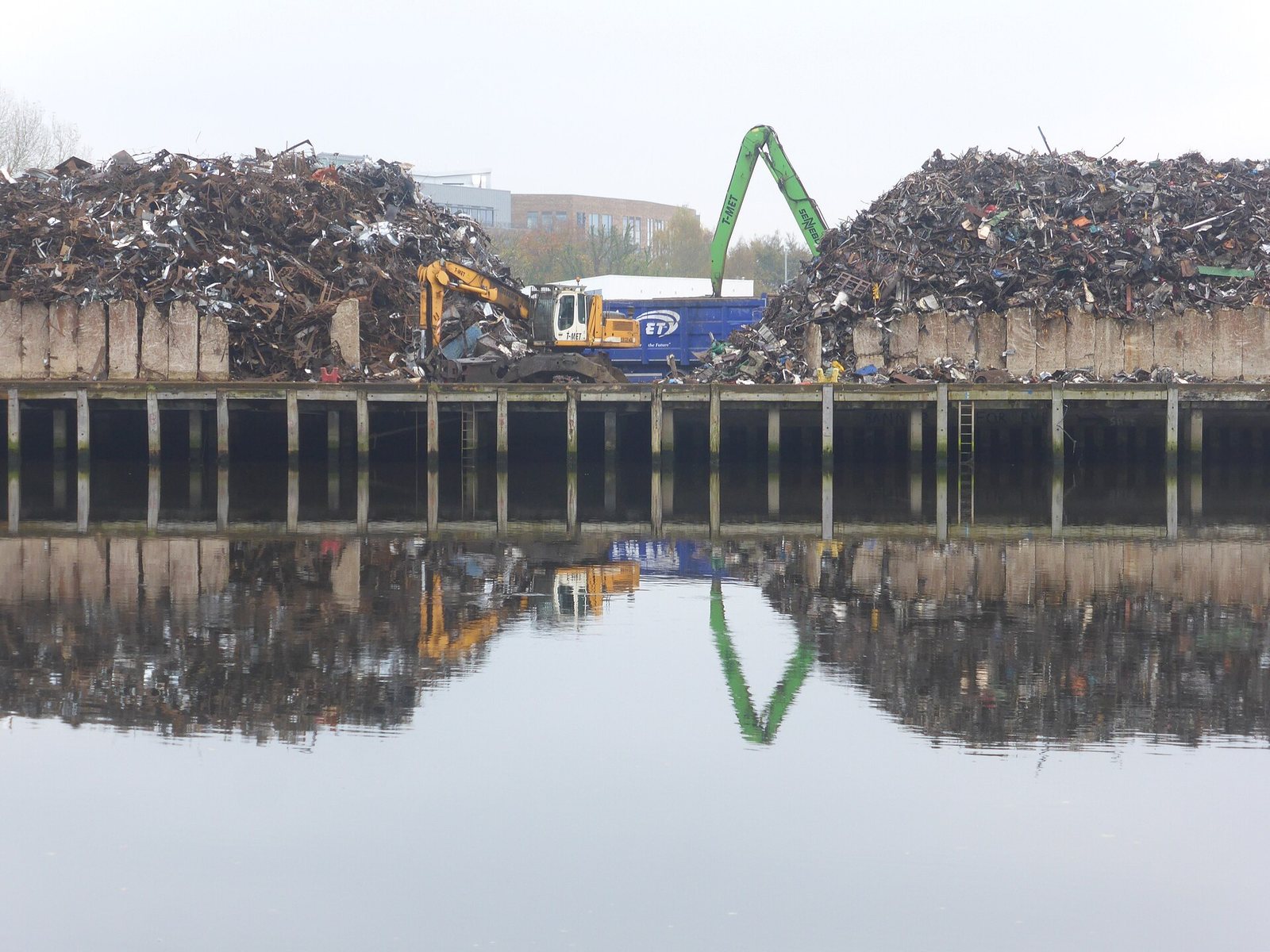
Old steel collected to be melted into new steel — the largest recycling stream on the planet by weight.

Scrap metal yard · Digitura · CC0 · Wikimedia Commons

Đây là gì?

Old steel collected to be melted into new steel — the largest recycling stream on the planet by weight.

Tại sao điều này quan trọng?

Steel made from scrap in an electric-arc furnace emits a small fraction of what the blast-furnace route emits. How fast steel can decarbonise is largely a question of how much scrap exists.

Where it is in the Earth

Iron and steel scrap is not a geological deposit in the usual sense. It does not form in the Earth's crust through the slow action of heat, pressure, or circulating fluids. Instead, it is an entirely manufactured material — steel that human industry has already produced, used, and discarded or trimmed away. The question of where it comes from is therefore a question about where steel has been used and for how long, rather than about rock types or tectonic settings.

Steel itself originates from iron ore, a genuine geological material. Iron is one of the most abundant elements in the crust, but the ores worth mining are those where geological processes — sedimentary banding in ancient seas, magmatic intrusion, or surface weathering — have concentrated iron-bearing minerals to grades high enough to be worth extracting. Once that ore has been smelted and rolled into products, however, the resulting steel enters the human economy, and it is within that economy that scrap originates. The tables on this page that show ore minerals and reserves describe the primary route; scrap is the secondary route, and its geography is determined by industrialisation history rather than by where iron ore happens to sit.

What this means in practice is that the richest sources of scrap are the oldest industrial economies. Countries that built large quantities of steel infrastructure — railways, ships, buildings, machinery — several decades ago are now generating large volumes of obsolete scrap as those structures reach the end of their service lives. Younger industrial economies produce considerable volumes of prompt scrap, which is the metal trimmed away during manufacturing, but they generate less obsolete scrap because their infrastructure has not yet aged enough to be demolished and discarded.

Getting it out

Scrap is not mined; it is collected. The activity that brings it into the supply chain is closer to logistics and sorting than to extraction. The two broad categories — prompt scrap and obsolete scrap — arrive through quite different channels, and understanding that distinction helps make sense of how the supply can be constrained even when steel is all around us.

Prompt scrap, sometimes called home or new scrap, arises directly from steel fabrication: the offcuts from pressing a car door panel, the turnings from a machined shaft, the edge trim from a rolling mill. It is generally clean, of known composition, and flows back into the steel plant with little processing. Obsolete scrap, by contrast, is steel recovered at the end of a product's life — a demolished building, a scrapped vehicle, a worn-out appliance. This material is far more heterogeneous. It must be collected, transported, shredded or sheared, and sorted before it is usable. The effort and cost involved in that chain explain why not all available steel is actually recovered.

Grading is the equivalent of assaying ore. Because melting cannot remove copper or tin that has become mixed into scrap — from electrical wiring, coatings, or alloy components — buyers classify scrap by its residual levels of these elements. A consignment with low copper content commands a higher price because it can be used in a wider range of steel products. This constraint has no parallel in primary steelmaking, where the chemistry of the input is controlled from the start, and it is one of the central technical limits on how far scrap-based steelmaking can go in producing high-specification flat products.

What pulls on it

Steel scrap is demanded by steelmakers, specifically those operating electric arc furnaces. The share of global steel produced by the EAF route has grown steadily as electricity grids have matured and as the carbon emissions of blast-furnace steelmaking have attracted increasing regulatory attention. Because every tonne of scrap-based steel requires substantially less energy and produces substantially less carbon dioxide than a tonne of blast-furnace steel, any policy or market pressure that puts a cost on carbon emissions tends to improve scrap's competitive position relative to primary iron.

Construction accounts for the largest end use of the steel that scrap eventually becomes, mostly as reinforcing bar and structural sections — products where surface quality requirements are relatively forgiving and where the moderate alloy cleanliness of EAF steel is fully adequate. Automotive and appliance manufacturers have historically demanded higher purity flat products, which the blast-furnace and basic oxygen furnace route has supplied. The boundary between what scrap-intensive and primary-iron-intensive routes can produce has been shifting as steelmakers invest in better scrap sorting and in blending with direct-reduced iron, but it has not dissolved.

Demand would change sharply in either direction under a small number of conditions. A significant acceleration in demolition of older steel-intensive infrastructure — particularly in China, which built at exceptional scale over the past few decades — would increase the supply of obsolete scrap and allow the EAF route to grow further. Conversely, a slowdown in construction activity, which has happened in several markets simultaneously, reduces orders for the rebar and sections that EAF mills predominantly produce. The price data on this page, showing a decline from 2021 through 2024 with a slight recovery in 2025, reflects in part the softening of construction demand in major consuming regions.

Turning ore into product Cấp độ 3

When scrap arrives at a steel plant, the first task is size reduction and separation. Large pieces — structural sections, plate, beams — are sheared or torch-cut to the dimensions the furnace can accept. Mixed, contaminated material such as end-of-life vehicles passes through large rotary shredders that break everything into fist-sized fragments. After shredding, magnetic separation pulls the ferrous fraction away from non-ferrous metals, plastics, rubber and other fluff. Eddy-current separators and optical sorters can then divide the non-ferrous fraction further. The ferrous concentrate that emerges from this sequence is what the market calls shredded scrap, and it commands a different price from the heavier, manually sorted grades because its chemistry and density are more predictable.

Melting takes place in an electric arc furnace, known in the industry as an EAF. Powerful graphite electrodes strike an arc that generates enough heat to liquefy a full charge of scrap within roughly an hour. Operators sample the melt and adjust chemistry by adding ferroalloys — manganese, silicon, chromium — in controlled amounts, or by blowing oxygen to burn out excess carbon. Slag, the layer of oxidised impurities floating on the steel, is poured off and typically processed for use as aggregate or cement additive. The refined liquid steel is then cast, usually into billets or slabs, from which rolling mills produce the final product. The losses between scrap input and saleable steel output are relatively modest compared with the primary route, but they are not negligible; some iron is oxidised into the slag, and yield depends on the cleanliness of the feed.

The processing bottleneck that limits quality is the accumulation of tramp elements, particularly copper. Copper raises hardness and can cause surface cracking during hot rolling; once in solution in liquid steel it cannot be oxidised away because copper is more noble than iron. Dilution with low-copper primary iron — either pig iron or direct-reduced iron — is the standard remedy, but it adds cost and partially defeats the carbon advantage of the scrap route. Research into sensor-based sorting capable of distinguishing copper-bearing fragments before they enter the furnace has advanced, but the problem has not been fully solved at industrial scale.

Substitution and recycling Cấp độ 3

The closest substitute for ferrous scrap in an electric arc furnace is direct-reduced iron, often abbreviated DRI and sometimes called sponge iron. DRI is produced by reducing iron ore with a reducing gas — historically natural gas, increasingly hydrogen in newer projects — at temperatures below the melting point of iron, yielding a solid, porous product that is essentially metallic iron with very low levels of tramp elements. Because DRI contains almost no copper or tin, it dilutes the residual contaminants in a scrap charge and allows the production of clean flat-rolled products. The trade-off is cost: DRI production requires a dedicated reduction plant and either a supply of reducing gas or an electrolyser for hydrogen, and the capital and operating costs are substantially higher than collecting and shredding scrap.

Pig iron, produced in a blast furnace, serves a similar dilution function and has the advantage of being a globally traded commodity available at short notice. It is used when scrap quality is poor and the product specification tight, but it carries the carbon footprint of the blast-furnace route, which limits its appeal where emissions matter. Hot briquetted iron, a denser, more stable form of DRI, is increasingly used in international trade because it is less prone to oxidation during shipping than loose DRI.

Recycling rates for steel are already among the highest of any material. The magnetic character of steel makes it relatively straightforward to recover, and the economics of scrap have historically provided sufficient incentive for collection across most markets. The constraint is not willingness to recycle but the time lag inherent in the system: steel used in a building or a bridge may remain in service for several decades before it becomes available as scrap. The stock of steel in use globally is very large, but it turns over slowly. More intensive collection in markets where informal recycling is common, and faster end-of-life cycles for some products, could increase supply at the margin, but no intervention can accelerate the physical ageing of infrastructure already in place.

Where the chain is fragile Cấp độ 4

Unlike most commodity supply chains, the fragility in ferrous scrap does not lie primarily in geological concentration. No single country controls a dominant share of iron ore-equivalent resources in the form of in-use steel stocks; the material is distributed roughly in proportion to where industrialisation has occurred. The risks are instead structural, logistical, and chemical. The most discussed structural risk is the mismatch between where scrap is generated and where steelmaking capacity is located. Countries with large legacy infrastructure stocks — the United States, parts of Western Europe, Japan — export substantial volumes of scrap to regions that need it for their EAF sectors. Export restrictions, which several governments have at various times considered or implemented to keep domestic scrap prices low for domestic mills, can disrupt these flows with little warning and no geological remedy available.

The copper contamination problem described in the processing section is also a supply-chain risk in disguise. As the share of steel produced from scrap rises, and as the average number of recycling cycles a tonne of steel has passed through increases, the background concentration of copper in the circulating stock tends to rise gradually. This is sometimes called the copper dilution problem in reverse: the system becomes progressively less able to produce the clean flat products that automotive and appliance applications require, unless a growing proportion of primary iron is blended in. Reported statistics on scrap composition are inconsistent across sources, partly because grading standards differ by country and partly because the actual chemistry of a load depends heavily on its origin, making aggregate figures unreliable guides to the true trajectory of contamination.

Reporting conventions introduce their own uncertainties. Production figures for scrap are compiled on the basis of purchased scrap — material that has been bought and sold — rather than total material theoretically available. Home scrap recycled internally within an integrated steel plant may not appear in these figures at all, or may appear under different national reporting frameworks. The distinction between obsolete and prompt scrap, which matters greatly for understanding the long-run supply, is not consistently maintained across all national statistical series. Researchers comparing figures across countries or across time should treat apparent precision in aggregate scrap statistics with caution, since the underlying measurement methodology varies enough to make direct comparison unreliable without detailed knowledge of each source's definitions.

Đọc các con số cho đúng. Gross weight of purchased scrap; obsolete and prompt scrap are different supplies. Graded by residual copper and tin content, which cannot be removed by melting.

Giá

average, delivered, No. 1 heavy melting composite price, dollars per metric ton

Trung bình nămdollars per metric ton

2021 · 417.7 cao 417.7 dollars per metric ton 2025 · 319.0

Cơ sở: average, delivered, No. 1 heavy melting composite price, dollars per metric ton. Trung bình năm theo công bố trong USGS Mineral Commodity Summaries 2026 · nguồn ↗. Đây là mức trung bình hàng năm tham khảo, không phải báo giá thị trường trực tiếp.

Kiểm soát xuất khẩu

Quốc giaKiểm soátÁp dụng cho
LaosExport ban Raw minerals, including copper, gold, iron, nickel, potassium, silver, and zinc (2024).
VietnamExport ban Raw materials of iron, lead-zinc, chromite, manganese, apatite, and rare earths and deeply processed titanium (2012).

USGS Mineral Commodity Summaries 2026, table 4 — controls in effect as of January 2026, excluding controls since lifted.

Tin tức mới nhất

Thêm →

China’s biggest lithium mine loses licence

The Northern Miner02 Sep 2026

China’s biggest lithium mine loses licence

MINING.COM02 Sep 2026

BHP commercial chief exits amid China iron ore strain

The Northern Miner02 Sep 2026

BHP commercial chief exits amid China iron ore strain

MINING.COM02 Sep 2026

Appeal Halts Public Lands Data Center in Nevada Before Construction Begins

CleanTechnica01 Sep 2026

California Legislature Approves Bill Easing Access to Clean, Affordable “Balcony Solar”

CleanTechnica27 Aug 2026

Vật liệu

Tất cả vật liệu Khoáng sản thiết yếu Đất hiếm Vật liệu pin Các khoáng vật quặng Bảng tuần hoàn Bộ lọc

Lòng đất

Mỏ & mỏ quặng Chế biến & tinh luyện Quốc gia Bản đồ

Nền kinh tế

Các hành trình quyền sở hữu Các chuỗi cung ứng Các thị trường đầu ra Công nghệ Công ty Máy tính vật liệu

Tìm hiểu

Tìm hiểuBảng thuật ngữ Hỏi dữ liệuTác nhân AI Nghiên cứu & dữ liệuAPI mở Tin tức★ Đã lưu

Về chúng tôi

Về chúng tôiLiên hệ Phương pháp luậnNguồn dữ liệu Chính sách biên tập Chính sách bảo mậtĐiều khoản sử dụng Tuyên bố miễn trách nhiệm