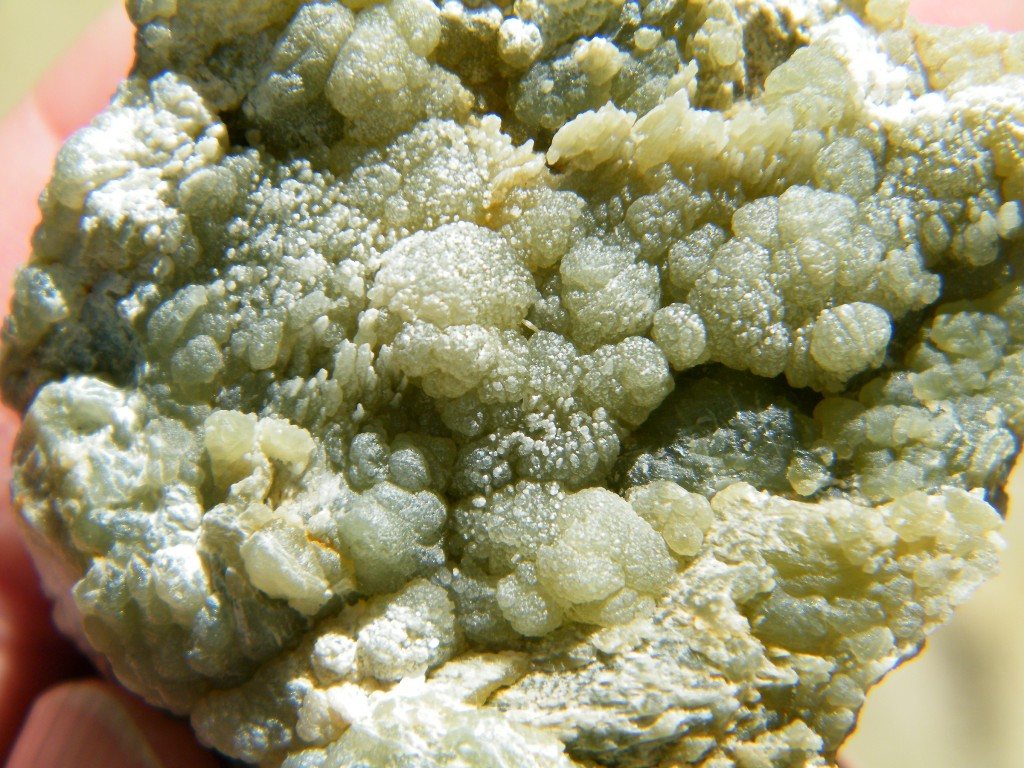
Đây là gì?
The softest mineral there is — a fingernail scratches it — used as a filler that makes plastics stiffer and paper smoother.
Tại sao điều này quan trọng?
Talc is a functional filler by the hundred thousand tonnes: it is in car bumpers, paint, ceramics and roofing far more than in cosmetics.
Where it is in the Earth
Talc and pyrophyllite are both phyllosilicate minerals — sheet silicates whose atoms are arranged in flat, repeating layers, which is what gives them their characteristic slipperiness. Talc is magnesium-rich; pyrophyllite replaces that magnesium with aluminium. Both form by a process called hydrothermal alteration or metamorphism, in which hot, water-rich fluids or heat and pressure from burial transform pre-existing rocks into something chemically and structurally different. Talc most commonly grows when magnesium-bearing rocks — particularly ultramafic rocks such as dunite or serpentinite, which formed originally from the Earth's mantle — are infiltrated by silica-carrying fluids. Those fluids react with the magnesium silicates already present and convert them, over geological time, into talc. Pyrophyllite, by contrast, tends to form where aluminium-rich rocks or hydrothermal systems interact with acidic fluids under moderate temperature and pressure, often in zones associated with ancient volcanic activity.
The deposits that end up large enough to mine tend to share a common feature: a substantial body of the right precursor rock, combined with a plumbing system — faults, fractures, or permeable contacts between rock types — through which reactive fluids could circulate for long enough to transform meaningful volumes. Many of the world's talc deposits follow the traces of ancient mountain belts, where once-deep ultramafic rocks were pushed to the surface by tectonic collision and then exposed to hydrothermal circulation. The Appalachian belt in the eastern United States, the Himalayan foothills of India and Pakistan, the Alpine terranes of France and Italy, and the cratons of southern Africa all fit this picture. Pyrophyllite deposits in East Asia, particularly in Korea and Japan, are more often associated with ancient volcanic arcs where acidic hydrothermal systems altered volcanic and sedimentary rocks over large areas.
The result is that both minerals tend to occur as irregular lenses, pods, or bands within a host rock rather than as uniform, predictable layers. The grade — meaning the proportion of actual talc or pyrophyllite in the material extracted — varies considerably within a single deposit, which has real consequences for how mining is planned and how much of what is dug up can actually be sold.
Getting it out
Most talc and pyrophyllite is mined in open pits, which are essentially large terraced excavations cut into the surface of the ground. Open-pit mining is preferred where the ore body is near enough to the surface that removing the overlying rock — the waste material that must be stripped away before ore can be reached, called overburden — is economically manageable. Because talc deposits are often irregular in shape, the boundary between ore-grade material and waste can shift across short distances, and miners must sample and test the rock as they go to decide what to send to the processing plant and what to leave in the waste pile. Some deeper or narrower deposits are worked underground, using tunnels driven into the ore body, but this is less common.
Talc is the softest mineral on the standard geological hardness scale — the Mohs scale, which runs from one to ten — so the rock containing it is usually not especially hard to break. Drilling and blasting are still used in most operations to fragment the rock mass, but the energy required is modest compared with hard-rock mining for metals. The mineral's softness is also a disadvantage in one respect: it means talc particles are easily generated by any mechanical contact during handling and transport, raising dust-management considerations throughout the operation.
The ratio of waste moved to ore produced varies enormously depending on deposit geometry and where in the pit the operation is working at any given time. In a well-defined, high-grade lens the stripping ratio — tonnes of overburden removed for each tonne of ore extracted — can be low. In irregular deposits it can be considerably higher. Because talc and pyrophyllite are relatively low-value commodities measured per tonne, keeping the stripping ratio under control is a significant part of what makes a deposit economical to work.
What pulls on it
Talc's primary commercial value is as a functional filler — a material added to a product not merely to bulk it out cheaply but because it changes the product's properties in useful ways. In plastics, particularly polypropylene used in car bumpers, dashboards, and appliance housings, talc platelet particles stiffen the material and reduce how much it shrinks or warps during moulding. In paper, a coating of fine talc improves how ink sits on the surface and makes the sheet feel smoother. In ceramics, talc contributes to the flux chemistry of the body, helping it mature at lower firing temperatures. Roofing products, particularly asphalt-based shingles, use talc to prevent sheets sticking together during manufacture and storage. Paints use it to control rheology — the way a paint flows and levels out — and to fill volume without the cost of more expensive white pigments. Cosmetics, despite their visibility in public perception of talc, account for a modest share of total consumption compared with these industrial uses.
Demand tends to track broadly with manufacturing activity in the economies that consume most of it. Growth in automotive production, construction, and paper manufacturing in Asia has supported demand there over recent decades. In Western markets, the long decline in newsprint and publication paper has reduced one traditional end-market, while growth in lightweight automotive components and in plastics-intensive consumer goods has partially offset that. Pyrophyllite, whose aluminium-rich chemistry makes it more suitable for high-temperature ceramics and refractories — materials used to line furnaces and other high-heat industrial equipment — follows a somewhat different demand pattern, tied more closely to steel and glass production.
A meaningful shift in demand in either direction would require a change in the industries that consume it rather than in any property of talc itself. A substantial reduction in internal combustion engine vehicle production, for instance, would remove one of the significant polypropylene-compounding applications. Conversely, growth in lightweight thermoplastic composites in construction or in electric vehicle body components could add demand. Neither shift depends on anything intrinsic to talc — the mineral is a passive participant in those larger industrial transitions.
Turning ore into product Cấp độ 3
Raw talc ore leaving the mine is almost never sold directly; it requires several stages of processing before it becomes a product that industry can use. The first step is comminution — breaking the ore down from blasted rock fragments into progressively smaller particles, typically using jaw crushers followed by roller mills or ball mills. Because talc is so soft, it grinds readily, but controlling the particle size distribution is important because different end markets require very different specifications. Ceramics and roofing applications can tolerate coarser material; paper coatings and pharmaceutical grades require particles ground to a few micrometres or less, a product referred to as micronised talc.
Beneficiation — the removal of gangue minerals, meaning the unwanted rock that accompanies the talc — follows comminution. The approach depends on what contaminants are present. Where the ore contains carbonate minerals such as dolomite or calcite, flotation can be used: air bubbles are introduced into a water-based slurry, and the talc, being naturally hydrophobic (water-repelling), attaches to the bubbles and floats to the surface as a froth while the denser carbonate minerals sink. Where iron-bearing minerals are the main contaminant, magnetic separation may be applied. Optical sorting, in which cameras and automated jets of air reject discoloured fragments, is used at some operations to improve brightness — an important parameter for paper and paint applications, where white or near-white colour is required. Losses occur at each stage, and recovery rates depend heavily on ore variability; a deposit with more consistent mineralogy supports more predictable recoveries than one that varies laterally or with depth.
Drying is an essential final step for most grades, since moisture affects both grindability and the performance of talc as a filler in plastics or paper. Energy consumption in drying is one of the more significant operating costs in talc processing. The distinction between lump, granular, and micronised grades in the traded-form description reflects real differences in processing intensity and therefore in the cost structure of the product; micronised talc requires substantially more milling energy and tighter quality control than coarse grades, which is reflected in price differentials between grades.
Substitution and recycling Cấp độ 3
Several other industrial minerals can perform similar filler functions to talc, and the choice between them is typically made on the basis of cost, local availability, and the specific property profile the end product requires. Calcium carbonate, in both ground and precipitated forms, is the most widely used alternative filler in plastics and paper, and it is generally cheaper per tonne. Kaolin, a clay mineral with a platy particle structure somewhat like talc's, competes in paper coatings and some plastics applications. Wollastonite and mica serve as stiffening fillers in polymers. In each case the substitution carries a performance trade-off: talc's particular combination of platelet geometry, low hardness, and natural hydrophobicity is not exactly replicated by any of these alternatives, so a formulator switching to a substitute typically has to adjust the rest of the recipe — binder levels, processing temperatures, or additive packages — to recover the lost performance.
In ceramics and refractories, pyrophyllite's specific alumina-silica ratio and its low thermal expansion are more difficult to replicate. Calcined kyanite and other aluminosilicate minerals can sometimes substitute, but they are often more expensive or less widely available. Where pyrophyllite is the locally abundant and therefore cheapest source of alumina in a ceramic body, the case for substitution is weak unless a quality specification demands otherwise.
Recycling plays essentially no role in the talc supply chain. Once talc has been incorporated into a plastic, paper, or ceramic product, it cannot be meaningfully recovered from that product at end of life. The plastic matrix may be recycled as a polymer, and the talc within it dilutes the recycled stream rather than being extracted from it. There is no secondary market for talc in the way there is for metals. The absence of recycling reflects both the physical reality of how talc is dispersed through a host material and the economics: the value per tonne is not high enough to justify any plausible separation process.
Ai sản xuất nó
Xem trên bản đồ →Mine production
Mine productionthousand metric tons 2025 (ước tính) Tổng toàn cầu 6,900 thousand metric tons
USGS Mineral Commodity Summaries 2026 · Gross weight; crude and beneficiated grades combined. · nguồn ↗
Cuộn bảng sang ngang để xem các cột còn lại.
| Quốc gia | Sản lượng | Tỷ phần thế giới |
|---|---|---|
| Turkey | 300.0 | 4.3% |
| South Africa | 300.0 | 4.3% |
| Korea, Republic of | 300.0 | 4.3% |
| Finland | 200.0 | 2.9% |
| Afghanistan | 200.0 | 2.9% |
| Japan | 130.0 | 1.9% |
| Tổng toàn cầu | 6,900 | 100% |
Mine production: crude
Mine production: crudethousand metric tons 2025 (ước tính)
USGS Mineral Commodity Summaries 2026 · Gross weight; crude and beneficiated grades combined. · nguồn ↗
Cuộn bảng sang ngang để xem các cột còn lại.
| Quốc gia | Sản lượng | Tỷ phần thế giới |
|---|---|---|
| United States | 490.0 | — |
| France | 300.0 | — |
Mine production: crude and beneficiated
Mine production: crude and beneficiatedthousand metric tons 2025 (ước tính)
USGS Mineral Commodity Summaries 2026 · Gross weight; crude and beneficiated grades combined. · nguồn ↗
Cuộn bảng sang ngang để xem các cột còn lại.
| Quốc gia | Sản lượng | Tỷ phần thế giới |
|---|---|---|
| Brazil | 570.0 | — |
Mine production: includes crude
Mine production: includes crudethousand metric tons 2025 (ước tính)
USGS Mineral Commodity Summaries 2026 · Gross weight; crude and beneficiated grades combined. · nguồn ↗
Cuộn bảng sang ngang để xem các cột còn lại.
| Quốc gia | Sản lượng | Tỷ phần thế giới |
|---|---|---|
| Other countries | 790.0 | — |
Mine production: includes steatite
Mine production: includes steatitethousand metric tons 2025 (ước tính)
USGS Mineral Commodity Summaries 2026 · Gross weight; crude and beneficiated grades combined. · nguồn ↗
Cuộn bảng sang ngang để xem các cột còn lại.
| Quốc gia | Sản lượng | Tỷ phần thế giới |
|---|---|---|
| Italy | 170.0 | — |
Mine production: steatite
Mine production: steatitethousand metric tons 2025 (ước tính)
USGS Mineral Commodity Summaries 2026 · Gross weight; crude and beneficiated grades combined. · nguồn ↗
Cuộn bảng sang ngang để xem các cột còn lại.
Mine production: unspecified minerals
Mine production: unspecified mineralsthousand metric tons 2025 (ước tính)
USGS Mineral Commodity Summaries 2026 · Gross weight; crude and beneficiated grades combined. · nguồn ↗
Cuộn bảng sang ngang để xem các cột còn lại.
"Withheld" có nghĩa là USGS đã ẩn số liệu để tránh tiết lộ dữ liệu của một công ty riêng lẻ — không có nghĩa là bằng không. Tổng các hàng theo quốc gia không phải lúc nào cũng bằng tổng toàn cầu vì nguồn làm tròn từng số liệu một cách độc lập và không phải lúc nào cũng tách riêng dòng "các quốc gia khác".
Ai nắm giữ trữ lượng
Reserves
Reservesthousand metric tons 2025
USGS Mineral Commodity Summaries 2026 · nguồn ↗
| Quốc gia | Trữ lượng | Tỷ phần thế giới |
|---|---|---|
| Japan | 100,000 | — |
| Korea, Republic of | 81,000 | — |
| Turkey | 15,000 | — |
| South Africa | Not applicable | — |
| Afghanistan | Large | — |
| Finland | Large | — |
| Tổng toàn cầu | Large | 100% |
Reserves: crude
Reserves: crudethousand metric tons 2025
USGS Mineral Commodity Summaries 2026 · nguồn ↗
| Quốc gia | Trữ lượng | Tỷ phần thế giới |
|---|---|---|
| United States | 140,000 | — |
| France | Large | — |
Reserves: crude and beneficiated
Reserves: crude and beneficiatedthousand metric tons 2025
USGS Mineral Commodity Summaries 2026 · nguồn ↗
| Quốc gia | Trữ lượng | Tỷ phần thế giới |
|---|---|---|
| Brazil | 48,000 | — |
Reserves: includes crude
Reserves: includes crudethousand metric tons 2025
USGS Mineral Commodity Summaries 2026 · nguồn ↗
| Quốc gia | Trữ lượng | Tỷ phần thế giới |
|---|---|---|
| Other countries | Large | — |
Reserves: includes steatite
Reserves: includes steatitethousand metric tons 2025
USGS Mineral Commodity Summaries 2026 · nguồn ↗
| Quốc gia | Trữ lượng | Tỷ phần thế giới |
|---|---|---|
| Italy | Not applicable | — |
Reserves: steatite
Reserves: steatitethousand metric tons 2025
USGS Mineral Commodity Summaries 2026 · nguồn ↗
Reserves: unspecified minerals
Reserves: unspecified mineralsthousand metric tons 2025
USGS Mineral Commodity Summaries 2026 · nguồn ↗
Giá
average, milled, dollars per metric ton
Trung bình nămdollars per metric ton
Cơ sở: average, milled, dollars per metric ton. Trung bình năm theo công bố trong USGS Mineral Commodity Summaries 2026 · nguồn ↗. Đây là mức trung bình hàng năm tham khảo, không phải báo giá thị trường trực tiếp.