Vom Gestein zum Produkt, nachverfolgt
The Materials Atlas
Materialien Bergwerke & Lagerstätten Aufbereitung & Raffination Verbleibsrouten Lieferketten Unternehmen Länder Nachrichten
Materialien nach Regal Batteriematerialien Seltene-Erden-Elemente Kupfer & Elektro Halbleitermaterialien Nuklearmaterialien Luft- und Raumfahrt & Verteidigung Edelmetalle Stahl & Legierungsmetalle Industrieminerale Agrarmineralien Energierohstoffe Erzminerale Periodensystem
Nachfrage Endmärkte Technologien Materialrechner Karten Screener
Lernen & Werkzeuge LernenGlossar Die Daten befragenKI-Agenten Forschung & DatenAPI ★ Gespeichert
Über Über unsMethodik DatenquellenKontakt Haftungsausschluss
Leseoptionen
🧭 Geführte Ansicht Neu dabei – Erzgehalte, Konzentrat, Raffination, Nebenprodukte? Wir erläutern jeden Begriff beim Stöbern, in verständlicher Sprache. Dieselben Daten, mit integrierter Hilfe.
⚡ Expertenansicht Sie kennen die Branche. Nur die Daten – bereinigt, schnell und kompakt, ohne zusätzliche Erläuterungen. Dies ist die Standardansicht.
Thema
Oberflächensprache
Tiefe Materialseiten sind auf vier Ebenen verfasst. Wählen Sie eine auf einer beliebigen Materialseite aus — sie wird gespeichert.
★ Gespeichert Forschung & Daten
Thallium

Halbleitermaterialien

Thallium Tl · 81

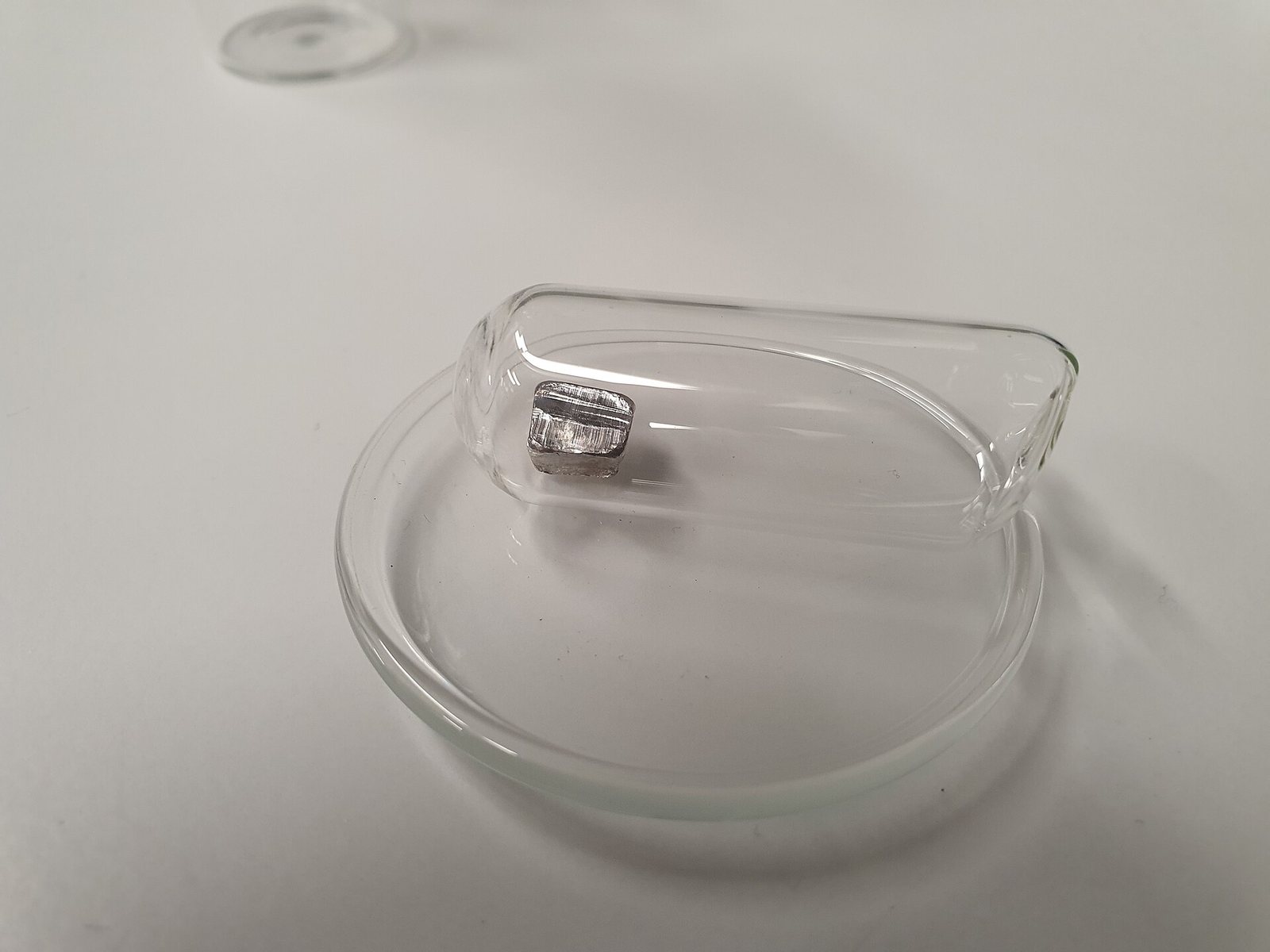
A soft, extremely toxic metal recovered in tiny amounts from smelter dusts.

Thallium prvek · Milda 444 · CC BY-SA 4.0 · Wikimedia Commons

Was ist das?

A soft, extremely toxic metal recovered in tiny amounts from smelter dusts.

Warum ist das wichtig?

Thallium-based crystals detect gamma rays and its compounds go into infrared optics — small uses for an element with no safe alternative handling regime.

What pulls on it

Thallium is consumed in a small number of technically specialised applications, and the end-markets table on this page makes clear how narrow that base is. The best-established use is in radiation detectors: thallium-activated sodium iodide crystals and, more recently, thallium-based semiconductors such as thallium bromide are used to detect gamma rays in medical imaging, nuclear security screening, and scientific instrumentation. In these detectors, thallium serves a precise electronic function — it shifts the energy levels of the crystal in a way that improves the efficiency with which the material converts incoming radiation into a measurable electrical signal. There is no obvious substitute that produces the same result with comparable efficiency.

Infrared optics represent a second area of use. Certain thallium compounds are transparent to infrared wavelengths that ordinary glass blocks, which makes them useful in lenses and windows for thermal imaging systems. Demand from this sector is linked to the production of thermal cameras, military targeting systems, and industrial temperature measurement equipment. Growth in civilian thermal imaging — for building inspection, firefighting, and automotive driver-assistance systems — has expanded the addressable market, though it is worth noting that alternative infrared-transparent materials exist and compete with thallium compounds on cost and ease of handling.

Beyond detectors and optics, thallium appears in small quantities in specialist alloys, mercury substitutes in low-temperature thermometers, and some catalyst applications. None of these uses is large in absolute terms. A sharp increase in demand would require either a significant expansion of the radiation-detector or infrared-optics industries, or the emergence of a new application — neither of which can be predicted with confidence. A sharp decrease could follow if detector manufacturers shifted to alternative scintillator or semiconductor materials that are easier to handle safely.

Where it is in the Earth

Thallium is not a mineral in its own right in any commercial sense — the tables on this page show no ore minerals because thallium does not accumulate into discrete, mineable deposits of its own. Instead, it is a trace constituent that rides along inside the crystal structures of other sulfide minerals, particularly those of zinc and lead. The element belongs to a group of metals that geochemists call chalcophile, meaning it has a chemical affinity for sulfur and tends to travel with sulfur-bearing phases rather than silicate rocks. When hydrothermal fluids — hot, mineral-laden water circulating through fractures in the crust — deposit zinc sulfide (sphalerite) and lead sulfide (galena), thallium substitutes for potassium or lead in the lattice at concentrations that are tiny but consistent.

The deposits that contain the most thallium are therefore the same volcanic-hosted massive sulfide and sedimentary-exhalative zinc-lead deposits that have been mined for those base metals for generations. There are a handful of localities — notably in China's Guizhou province and in parts of Europe — where thallium concentrations in the sulfide ores are measurably higher than the global average, often because local hydrothermal systems were unusually reducing or because particular source rocks contributed thallium-enriched fluids. Some coal seams also carry elevated thallium, and thallium can concentrate in the combustion residues produced when that coal is burned. Neither coal ash nor ordinary sulfide ore is targeted for thallium alone; the element is simply present wherever these geological processes have run their course.

Because thallium substitutes so readily into other minerals rather than forming its own, its geological distribution is inherently dispersed and subordinate. You cannot prospect for it the way you would prospect for copper or gold. Its occurrence is better described as a geochemical shadow of zinc and lead mineralisation than as a resource in the conventional sense.

Getting it out

No mine in the world operates for the purpose of extracting thallium. Every tonne of thallium that enters commerce is a by-product — meaning it is recovered incidentally during the mining and processing of something else, overwhelmingly zinc and, to a lesser extent, lead. The mining methods that matter for thallium are therefore whatever methods are used at the zinc and lead operations that happen to host it: open-pit mining where ore bodies are shallow and large enough, underground mining where they are deeper or narrower. The choice of method is made entirely on the economics of zinc and lead and has nothing to do with thallium.

The concept of grade — the concentration of a target element in the ore — is straightforward for zinc, where it is expressed as a percentage of the rock by weight. For thallium, concentrations in host ores are so low that they are measured in parts per million, a unit that means grams of thallium per tonne of rock. Even at the richer end of the spectrum, the amount of thallium in a tonne of ore is a small fraction of a gram. This means that enormous quantities of base-metal ore must be processed before a commercially meaningful amount of thallium accumulates. The waste generated per unit of thallium product is consequently vast, though that waste exists because of the zinc and lead operation, not because of thallium recovery.

Thallium does not leave the mine as a separate stream. It travels invisibly with the zinc or lead concentrate — the intermediate product produced at or near the mine — and only becomes recoverable later, at the smelter. The mine itself has no awareness of, or economic interest in, the thallium it ships.

Die Zahlen richtig lesen. Production is not separately published by most producers. Metal and compounds, a by-product of zinc and lead smelting.

Preis

metal, dollars per kilogram

Jahresdurchschnittdollars per kilogram

2021 · 8,400 hoch 9,500 dollars per kilogram 2025 · 9,300

Grundlage: metal, dollars per kilogram. Jahresdurchschnitte gemäß Veröffentlichung in USGS Mineral Commodity Summaries 2026 · Quelle ↗. Dies sind jährliche Referenzdurchschnittswerte, kein Live-Marktpreis.

Materialien

Alle Materialien Kritische Mineralien Seltene Erden Batteriematerialien Erzminerale Periodensystem Screener

Das Gestein

Bergwerke & Lagerstätten Aufbereitung & Raffination Länder Karten

Die Wirtschaft

Verbleibsrouten Lieferketten Endmärkte Technologien Unternehmen Materialrechner

Lernen

LernenGlossar Die Daten befragenKI-Agenten Forschung & DatenOffene API Nachrichten★ Gespeichert

Über uns

Über unsKontakt MethodikDatenquellen Redaktionelle Leitlinien DatenschutzrichtlinieNutzungsbedingungen Haftungsausschluss