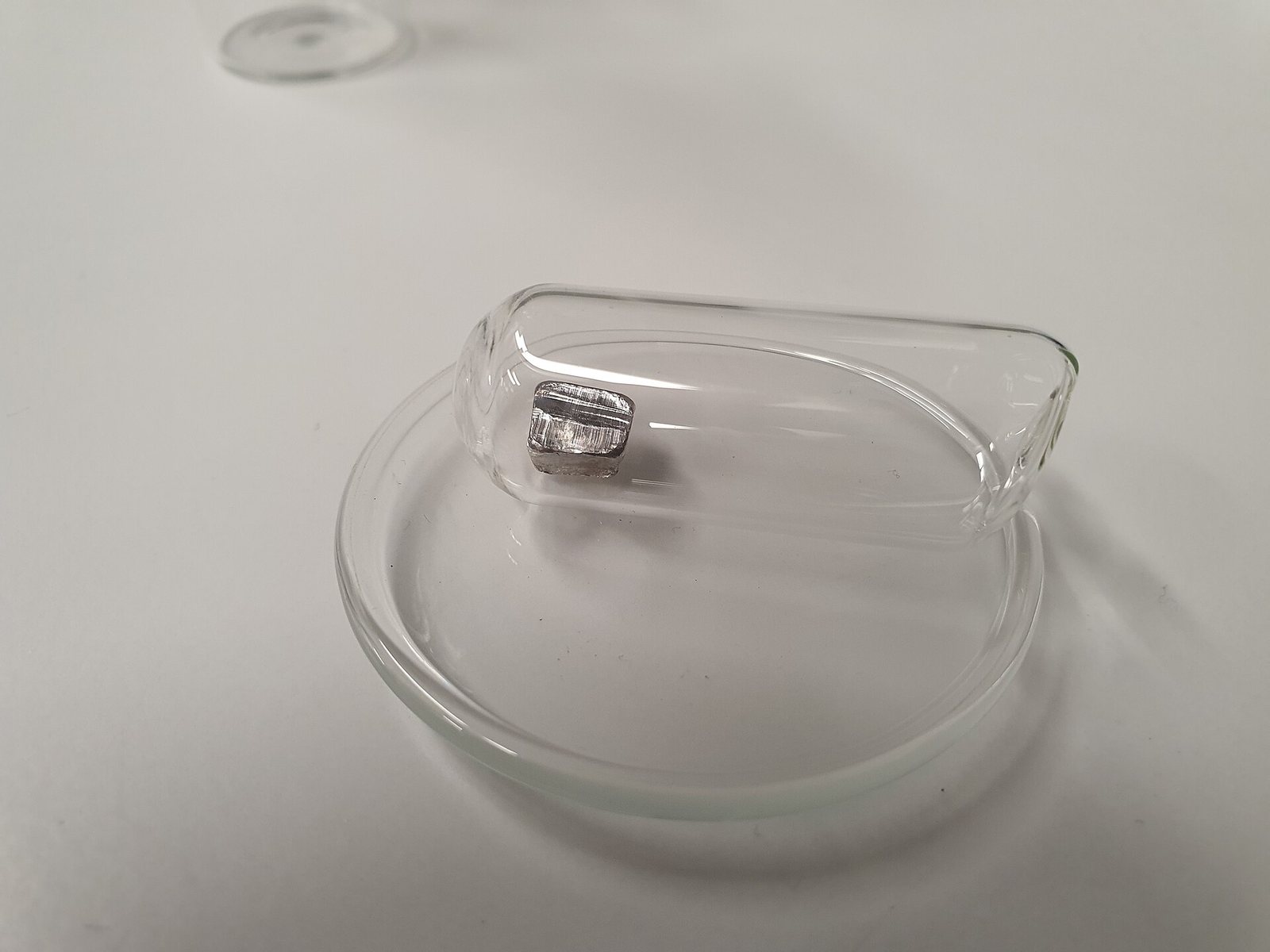
Что это такое?
A soft, extremely toxic metal recovered in tiny amounts from smelter dusts.
Почему это важно?
Thallium-based crystals detect gamma rays and its compounds go into infrared optics — small uses for an element with no safe alternative handling regime.
What pulls on it
Thallium is consumed in a small number of technically specialised applications, and the end-markets table on this page makes clear how narrow that base is. The best-established use is in radiation detectors: thallium-activated sodium iodide crystals and, more recently, thallium-based semiconductors such as thallium bromide are used to detect gamma rays in medical imaging, nuclear security screening, and scientific instrumentation. In these detectors, thallium serves a precise electronic function — it shifts the energy levels of the crystal in a way that improves the efficiency with which the material converts incoming radiation into a measurable electrical signal. There is no obvious substitute that produces the same result with comparable efficiency.
Infrared optics represent a second area of use. Certain thallium compounds are transparent to infrared wavelengths that ordinary glass blocks, which makes them useful in lenses and windows for thermal imaging systems. Demand from this sector is linked to the production of thermal cameras, military targeting systems, and industrial temperature measurement equipment. Growth in civilian thermal imaging — for building inspection, firefighting, and automotive driver-assistance systems — has expanded the addressable market, though it is worth noting that alternative infrared-transparent materials exist and compete with thallium compounds on cost and ease of handling.
Beyond detectors and optics, thallium appears in small quantities in specialist alloys, mercury substitutes in low-temperature thermometers, and some catalyst applications. None of these uses is large in absolute terms. A sharp increase in demand would require either a significant expansion of the radiation-detector or infrared-optics industries, or the emergence of a new application — neither of which can be predicted with confidence. A sharp decrease could follow if detector manufacturers shifted to alternative scintillator or semiconductor materials that are easier to handle safely.
Where it is in the Earth
Thallium is not a mineral in its own right in any commercial sense — the tables on this page show no ore minerals because thallium does not accumulate into discrete, mineable deposits of its own. Instead, it is a trace constituent that rides along inside the crystal structures of other sulfide minerals, particularly those of zinc and lead. The element belongs to a group of metals that geochemists call chalcophile, meaning it has a chemical affinity for sulfur and tends to travel with sulfur-bearing phases rather than silicate rocks. When hydrothermal fluids — hot, mineral-laden water circulating through fractures in the crust — deposit zinc sulfide (sphalerite) and lead sulfide (galena), thallium substitutes for potassium or lead in the lattice at concentrations that are tiny but consistent.
The deposits that contain the most thallium are therefore the same volcanic-hosted massive sulfide and sedimentary-exhalative zinc-lead deposits that have been mined for those base metals for generations. There are a handful of localities — notably in China's Guizhou province and in parts of Europe — where thallium concentrations in the sulfide ores are measurably higher than the global average, often because local hydrothermal systems were unusually reducing or because particular source rocks contributed thallium-enriched fluids. Some coal seams also carry elevated thallium, and thallium can concentrate in the combustion residues produced when that coal is burned. Neither coal ash nor ordinary sulfide ore is targeted for thallium alone; the element is simply present wherever these geological processes have run their course.
Because thallium substitutes so readily into other minerals rather than forming its own, its geological distribution is inherently dispersed and subordinate. You cannot prospect for it the way you would prospect for copper or gold. Its occurrence is better described as a geochemical shadow of zinc and lead mineralisation than as a resource in the conventional sense.
Getting it out
No mine in the world operates for the purpose of extracting thallium. Every tonne of thallium that enters commerce is a by-product — meaning it is recovered incidentally during the mining and processing of something else, overwhelmingly zinc and, to a lesser extent, lead. The mining methods that matter for thallium are therefore whatever methods are used at the zinc and lead operations that happen to host it: open-pit mining where ore bodies are shallow and large enough, underground mining where they are deeper or narrower. The choice of method is made entirely on the economics of zinc and lead and has nothing to do with thallium.
The concept of grade — the concentration of a target element in the ore — is straightforward for zinc, where it is expressed as a percentage of the rock by weight. For thallium, concentrations in host ores are so low that they are measured in parts per million, a unit that means grams of thallium per tonne of rock. Even at the richer end of the spectrum, the amount of thallium in a tonne of ore is a small fraction of a gram. This means that enormous quantities of base-metal ore must be processed before a commercially meaningful amount of thallium accumulates. The waste generated per unit of thallium product is consequently vast, though that waste exists because of the zinc and lead operation, not because of thallium recovery.
Thallium does not leave the mine as a separate stream. It travels invisibly with the zinc or lead concentrate — the intermediate product produced at or near the mine — and only becomes recoverable later, at the smelter. The mine itself has no awareness of, or economic interest in, the thallium it ships.
Turning ore into product Уровень 3
At a zinc or lead smelter, ore concentrates are roasted or smelted at high temperature to drive off sulfur and reduce the metal oxides. Thallium, being volatile at smelting temperatures, behaves much like cadmium or indium: it leaves the molten charge as a vapour and is captured downstream in the flue dusts and gases that are collected for pollution control. This capture step — often a baghouse filter or electrostatic precipitator — is where thallium first becomes a distinct, concentrated stream. The dust is not pure thallium; it is a complex mixture of zinc, lead, cadmium, arsenic, and other volatiles, with thallium as a minor constituent.
Refining thallium from this dust involves hydrometallurgical steps: the dust is leached in an acidic solution to dissolve the metals selectively, then the pregnant leach solution is treated to precipitate or electrodeposit thallium metal. The chemistry relies on thallium's electrochemical behaviour differing sufficiently from the other metals present to allow separation, though in practice co-precipitation and losses to other phases mean that overall recovery from smelter feed to finished thallium metal is far from complete. The refined metal — which the price data on this page quotes in dollars per kilogram — can then be converted into specific compounds such as thallium bromide or thallium sulfide for use in detectors and optics. Compound production adds further processing steps and its own yield losses. Because no producer publishes disaggregated production figures, it is not possible to describe the scale of any individual facility's output from public data.
The economics of thallium processing are almost entirely subordinate to the economics of the host smelter. Thallium recovery only makes sense if the revenue from selling the metal exceeds the marginal cost of the additional hydrometallurgical circuit; where it does not, the thallium-bearing dust may simply be stockpiled, sold for lower-value disposal, or blended back into the process. This makes thallium supply sensitive not just to zinc and lead production volumes but to the internal cost structure and strategic priorities of individual smelting companies.
Substitution and recycling Уровень 3
The substitution picture for thallium differs by application. In scintillator detectors, thallium-activated sodium iodide has a long established record, and replacing it means accepting changes in light yield, energy resolution, or cost. Alternative scintillator materials — certain rare-earth halides, for instance — can match or exceed thallium-based crystals in specific performance metrics, but they come with their own supply constraints and are often more expensive to produce. Thallium bromide as a room-temperature semiconductor detector faces competition from cadmium zinc telluride, which is more mature commercially; however, thallium bromide offers advantages in certain energy ranges and detector geometries, so neither has fully displaced the other.
In infrared optics, the main competitors to thallium-bearing compounds are germanium, zinc selenide, chalcogenide glasses, and certain fluoride crystals. Each has a different transmission window, refractive index, and mechanical property set, and the choice among them depends on the specific wavelength range and environmental conditions of the application. Thallium compounds can be displaced where the infrared window they offer overlaps sufficiently with a cheaper or less hazardous alternative, but there are wavelength ranges where they remain the most practical option.
Recycling of thallium is limited. The quantities used in any single detector or optical element are small, the devices are dispersed across many end-users, and collection infrastructure for thallium-bearing scrap is not established at scale. Thallium's acute toxicity makes informal recycling — the kind that operates for lead or copper at the margins — very unlikely. More thallium probably re-enters the smelting circuit through recycled zinc-bearing materials than is deliberately recovered from spent devices. The result is that secondary supply makes a negligible contribution to the market relative to primary by-product recovery.
Where the chain is fragile Уровень 4
Thallium's supply chain carries a structural fragility that is distinct from most other critical materials: it has no primary production whatsoever. Every unit of supply is contingent on decisions made by zinc and lead smelters whose operating logic is entirely independent of thallium demand. If smelter throughput falls — because zinc prices are low, because a major smelter undergoes a long maintenance shutdown, or because feed concentrate is diverted — thallium output falls with it, regardless of how high the thallium price stands. The price data on this page, which shows the metal trading at several thousand dollars per kilogram, reflects the thinness and inelasticity of supply rather than any shortage that higher prices alone could remedy. A smelter cannot economically build a new thallium recovery circuit on short notice simply because the metal has become more valuable; the circuit depends on the smelter operating at scale in the first place.
Geographic concentration compounds this. Production is not separately published by most producers, as the unit basis note on this page records, so the precise distribution of output across countries cannot be stated with certainty from public data. What is known qualitatively is that a significant share of global zinc smelting — and therefore a significant share of thallium-bearing flue dust — is concentrated in a small number of countries, with China holding a dominant position. A policy change, an export restriction on intermediate products, or a curtailment of smelting capacity in any of the leading producing countries would propagate directly into thallium availability with little possibility of offsetting supply from elsewhere on short notice.
Reporting conventions add a further layer of uncertainty. Because thallium is a by-product recovered at varying efficiencies depending on smelter configuration and market conditions, the figures that do appear in national and industry statistics are inconsistent in their coverage. Some figures reflect metal sold; others reflect metal recovered into dust but not yet refined; others may reflect estimated production imputed from zinc output and an assumed recovery ratio. Researchers working with thallium supply data should treat any single published figure as an approximation and should be attentive to whether a source is reporting refined metal, crude thallium-bearing residues, or something in between. The absence of a futures market and the dominance of long-term bilateral contracts between smelters and specialty chemical producers mean that price discovery is also opaque by the standards of more widely traded metals.
Цена
metal, dollars per kilogram
Среднегодовое значениеdollars per kilogram
Основание: metal, dollars per kilogram. Среднегодовые значения в том виде, в каком опубликованы в USGS Mineral Commodity Summaries 2026 · источник ↗. Приведены справочные годовые средние значения, а не котировки текущего рынка.