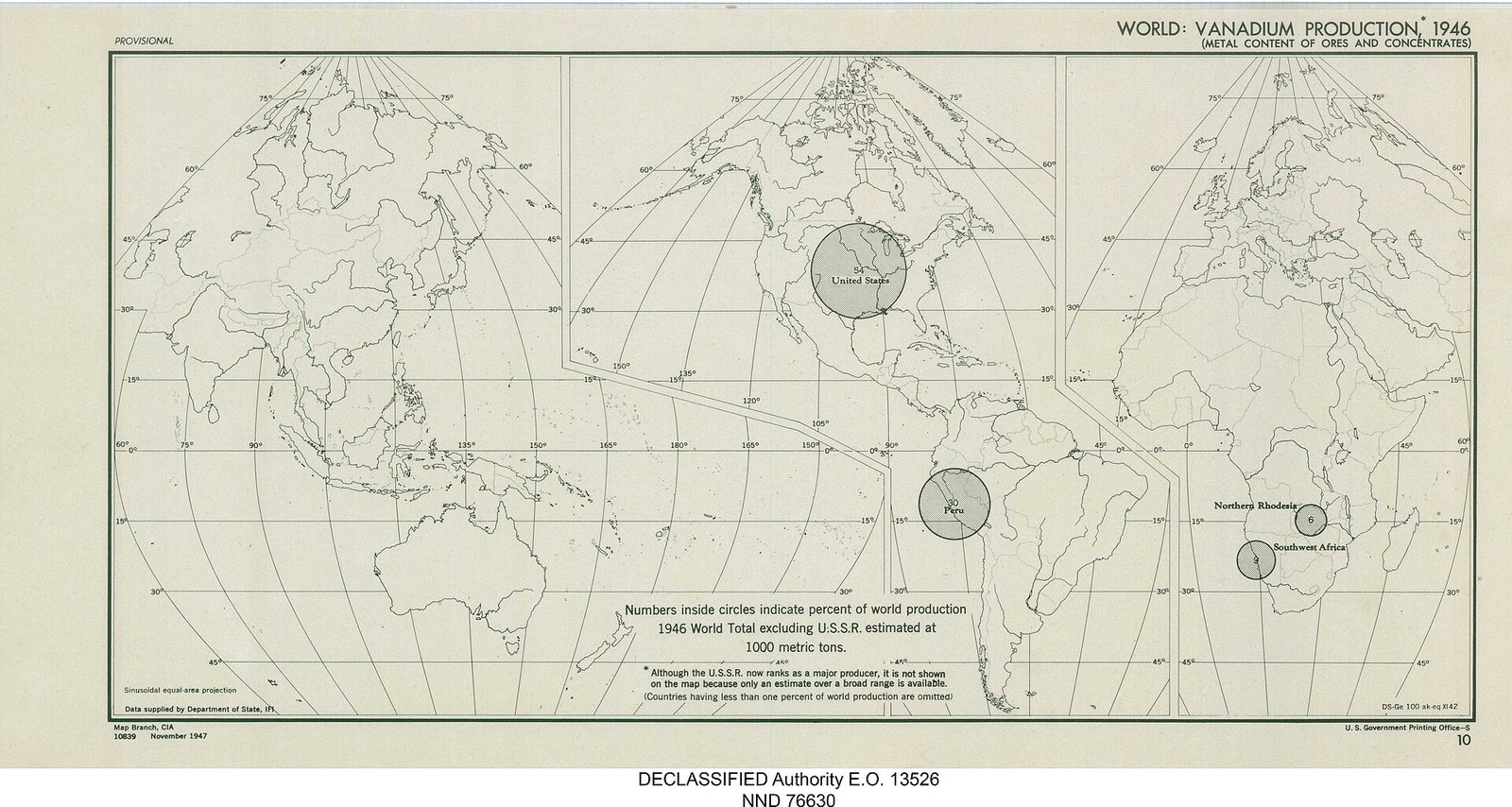
Wat is het?
A metal that makes rebar dramatically stronger in tiny doses, and that can also store electricity dissolved in a tank of liquid.
Waarom is het van belang?
Vanadium redox flow batteries are one of the few chemistries that can cycle daily for decades — a different answer to grid storage than lithium.
Where it is in the Earth
Vanadium is not a rare element in absolute terms — it is moderately abundant in the Earth's crust — but it is rarely concentrated enough in one place to make mining straightforward. The two main geological settings that produce workable deposits are quite different from each other, and understanding both helps explain why the supply map looks the way it does.
The first and more important setting involves ancient, layered igneous rocks called layered mafic intrusions. When magma rich in iron and titanium cools slowly deep in the crust, it crystallises in sequence, and a mineral called titanomagnetite — a mixed iron, titanium and vanadium oxide — settles out in distinct bands. South Africa's Bushveld Complex and the Ural Mountains of Russia formed this way, producing large, relatively low-grade ore bodies that are mined primarily for iron, with vanadium recovered as a co-product. The vanadium is locked inside the magnetite crystal structure rather than forming its own separate mineral.
The second setting is sedimentary. In certain sandstone basins, typically in arid regions, groundwater carrying dissolved uranium and vanadium moved through permeable rock and deposited the mineral carnotite — a bright yellow potassium uranium vanadate — when it encountered chemically reducing conditions. The Colorado Plateau in the American West is the classic example. These deposits tend to be smaller and patchier than the igneous type, but the vanadium grades can be higher. A third, less visible source is petroleum: crude oil from certain fields, particularly in Venezuela and the Middle East, contains vanadium absorbed from ancient organic matter, and this ends up concentrated in the residues left after refining. None of these geological settings is exotic, but each demands a completely different approach to getting the vanadium out.
Getting it out
Because vanadium almost never forms a deposit rich enough to mine for vanadium alone, the method of extraction is largely determined by whatever the primary product happens to be. In the major layered intrusion mines of China, Russia, South Africa and Brazil, miners are effectively operating iron ore or steel plants, and vanadium tags along for the ride. The ore is extracted by open-pit methods — large benches cut into the rock face, with trucks hauling ore and waste — and the sheer scale of these operations means that even a small vanadium content in the ore adds up to a commercially meaningful stream.
Grade, in this context, means the proportion of vanadium pentoxide (V₂O₅, the standard reporting form) contained in the rock. Because vanadium travels with the iron rather than forming its own mineral grains, there is no simple way to separate a rich fraction from a poor one by crushing and floating the way you might with copper or gold. The entire iron-bearing rock has to be processed through a steel furnace before the vanadium can be extracted from the slag — the glassy residue left after iron is reduced to metal. This means the relevant waste-to-product ratio is almost meaningless to state for vanadium in isolation: the waste is defined by the iron operation, not the vanadium one.
The sandstone-hosted deposits of the Colorado Plateau type are typically mined by open-pit or underground methods depending on depth, and because the grades are higher and the mineralogy different, some of these operations have historically extracted vanadium as a primary product. The oil-refinery route is different again: no mine is involved at all. Petroleum coke and other residues accumulate at refineries processing heavy crudes, and these materials are processed specifically to recover vanadium and nickel. This secondary or by-product character of most vanadium supply has important consequences for how the market behaves, which the supply risk section addresses.
What pulls on it
For most of its commercial history, vanadium has been a steelmaking additive. Adding a small quantity of ferrovanadium to steel — particularly to the reinforcing bar, or rebar, used in concrete construction — produces a grain-refining effect in the steel microstructure that raises its strength considerably. The consequence is that less steel by weight is needed to achieve the same structural performance, which matters to builders working to codes that specify strength rather than tonnage. This single application accounts for the large majority of vanadium consumed globally, and it means that demand broadly tracks the pace of construction, especially in China, which accounts for an outsized share of global steel and concrete output.
The second demand stream is newer and structurally different. Vanadium redox flow batteries store energy by holding vanadium ions dissolved in sulfuric acid electrolyte in two large tanks. When the battery charges or discharges, the electrolyte is pumped through a cell stack where electrons are exchanged. Because the electrolyte itself does not degrade the way solid electrodes can, these systems can cycle daily for very long periods without significant capacity loss. They are physically large and expensive per kilowatt-hour compared with lithium-ion cells, but that trade-off becomes more acceptable when what matters is long duration, many cycles, and a predictable capacity over decades — conditions that apply to some grid-scale storage applications. The intensity figures in the table on this page give a sense of how much vanadium pentoxide a given storage capacity requires, and those numbers are large enough that even modest growth in this application would represent a meaningful new demand stream.
What would have to change for demand to shift sharply? On the steel side, a sustained slowdown in construction in China, or a broad adoption of standards allowing thinner rebar, would reduce consumption. On the battery side, the constraint is more one of cost and competition: if vanadium pentoxide prices rise, flow battery economics worsen relative to alternative chemistries, and project developers may choose differently. Conversely, if regulatory frameworks begin to value long-duration storage explicitly — through capacity markets or grid codes — demand for flow batteries could grow faster than the supply chain currently anticipates.
Waar het in het gesteente vandaan komt
Alle ertsmineralen →Dit zijn de mineralen die daadwerkelijk vanadium. Een afzetting is alleen een ertslichaam als een van beide voldoende geconcentreerd is om de winning ervan te bekostigen.
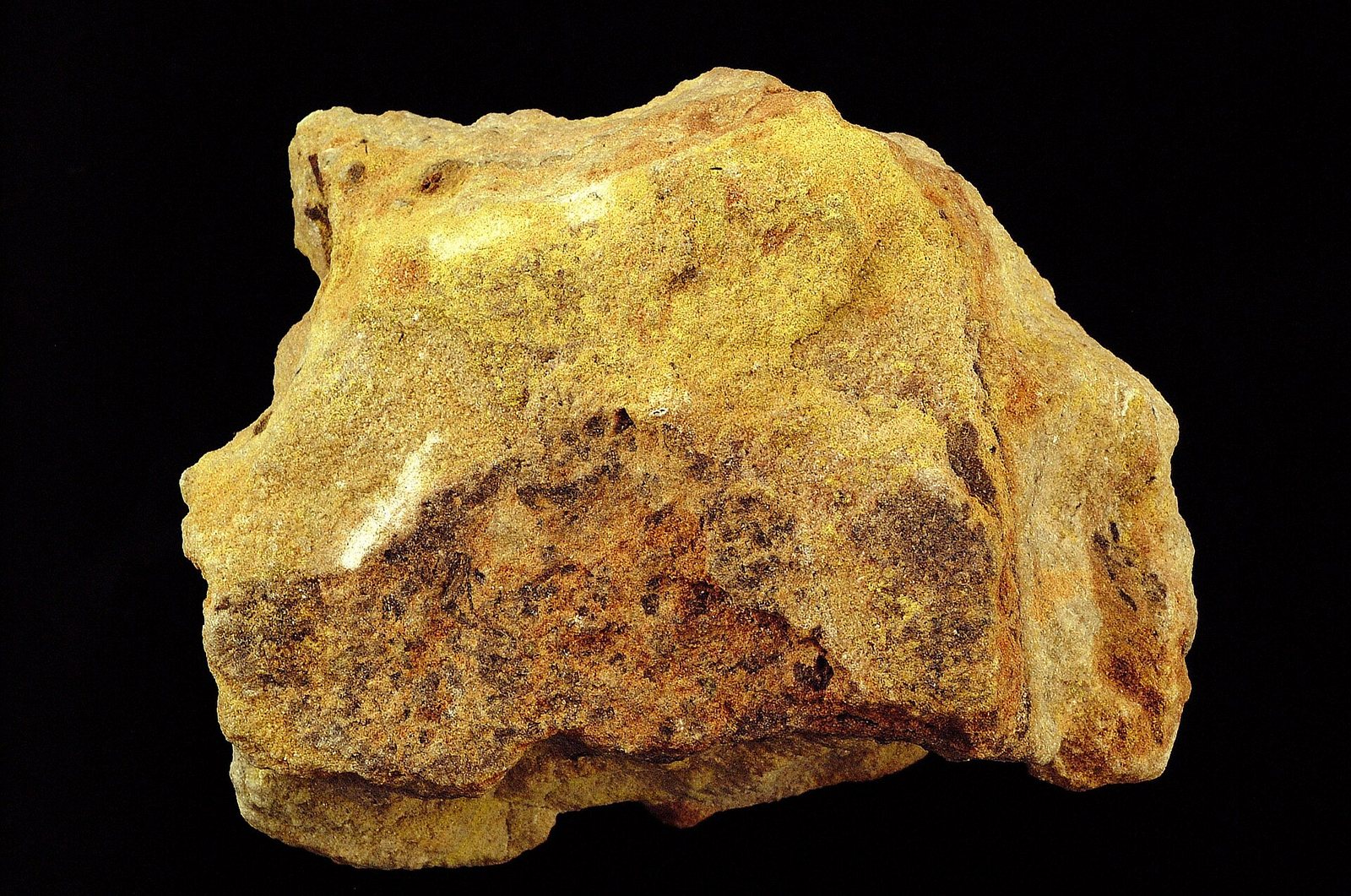
Carnotite
A secondary uranium-vanadium mineral of sandstone deposits; the classic in-situ recovery target.
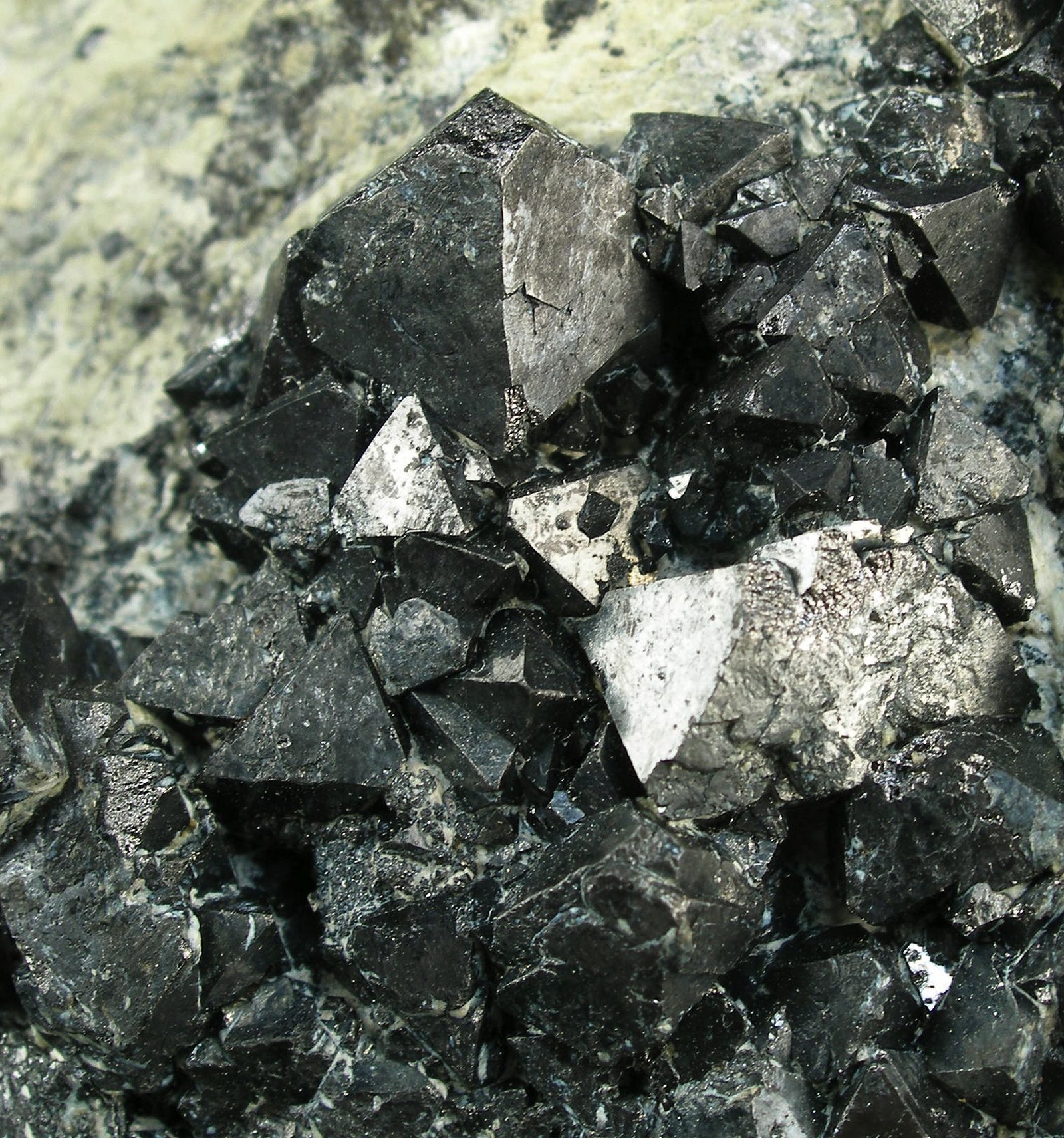
Magnetite
72% iron when pure but usually low grade in the ground; it is upgraded by magnetic separation into high-purity pellet…
Wie het produceert
Bekijk het op een kaart →Mine production
Mine productionmetric tons 2025 (geschat) Wereldtotaal 110,000 metric tons
USGS Mineral Commodity Summaries 2026 · Mine production of contained vanadium; much is recovered from steel slag and from oil residues. · bron ↗
Schuif de tabel zijwaarts voor de overige kolommen.
| Land | Productie | Aandeel van de wereld |
|---|---|---|
| China | 82,000 | 74.5% |
| Russia | 21,000 | 19.1% |
| Brazil | 5,300 | 4.8% |
| South Africa | 5,000 | 4.5% |
| United States | Zero | — |
| Australia | Zero | — |
| Wereldtotaal | 110,000 | 100% |
"Ingehouden" betekent dat de USGS het cijfer heeft onderdrukt om gegevens van een individueel bedrijf niet prijs te geven — het betekent niet nul. Landrijen tellen niet altijd op tot het wereldtotaal, omdat de bron elk cijfer afzonderlijk afrondt en niet altijd een regel "overige landen" uitsplitst.
Wie de reserves bezit
Reserves
Reservesmetric tons 2025
USGS Mineral Commodity Summaries 2026 · bron ↗
| Land | Reserves | Aandeel van de wereld |
|---|---|---|
| Australia | 10,000 | 47.6% |
| China | 5,800 | 27.6% |
| Russia | 5,000 | 23.8% |
| South Africa | 520.0 | 2.5% |
| Brazil | 94.00 | 0.4% |
| United States | 50.00 | 0.2% |
| Wereldtotaal | 21,000 | 100% |
Prijs
average, vanadium pentoxide, dollars per pound
Jaargemiddeldedollars per pound
Grondslag: average, vanadium pentoxide, dollars per pound. Jaargemiddelden zoals gepubliceerd in USGS Mineral Commodity Summaries 2026 · bron ↗. Dit zijn referentiejaargemiddelden, geen live marktkoers.
Waarvoor het wordt gebruikt
Alle eindmarkten →| Eindmarkt | Wat het daar doet | Belang |
|---|---|---|
| Grid Storage | Redox flow electrolyte | Definiëren |
| Construction & Steel | Rebar strengthening | Belangrijk |
| Power Grids | Flow batteries for long-duration storage | Heden |
Hoeveel een technologie ervan nodig heeft
| Technologie | Hoeveelheid | Genoteerd | Grondslag |
|---|---|---|---|
| Vanadium Redox Flow Battery Recoverable at end of life, so it is closer to a rental than a consumable. | 5.00–10.00 t | per MWh of storage | Vanadium pentoxide in electrolyte |
Indicative range compiled from published technology studies and chemistry; verify against a manufacturer specification before use. Voer deze getallen op elke schaal uit in de materiaalcalculator →