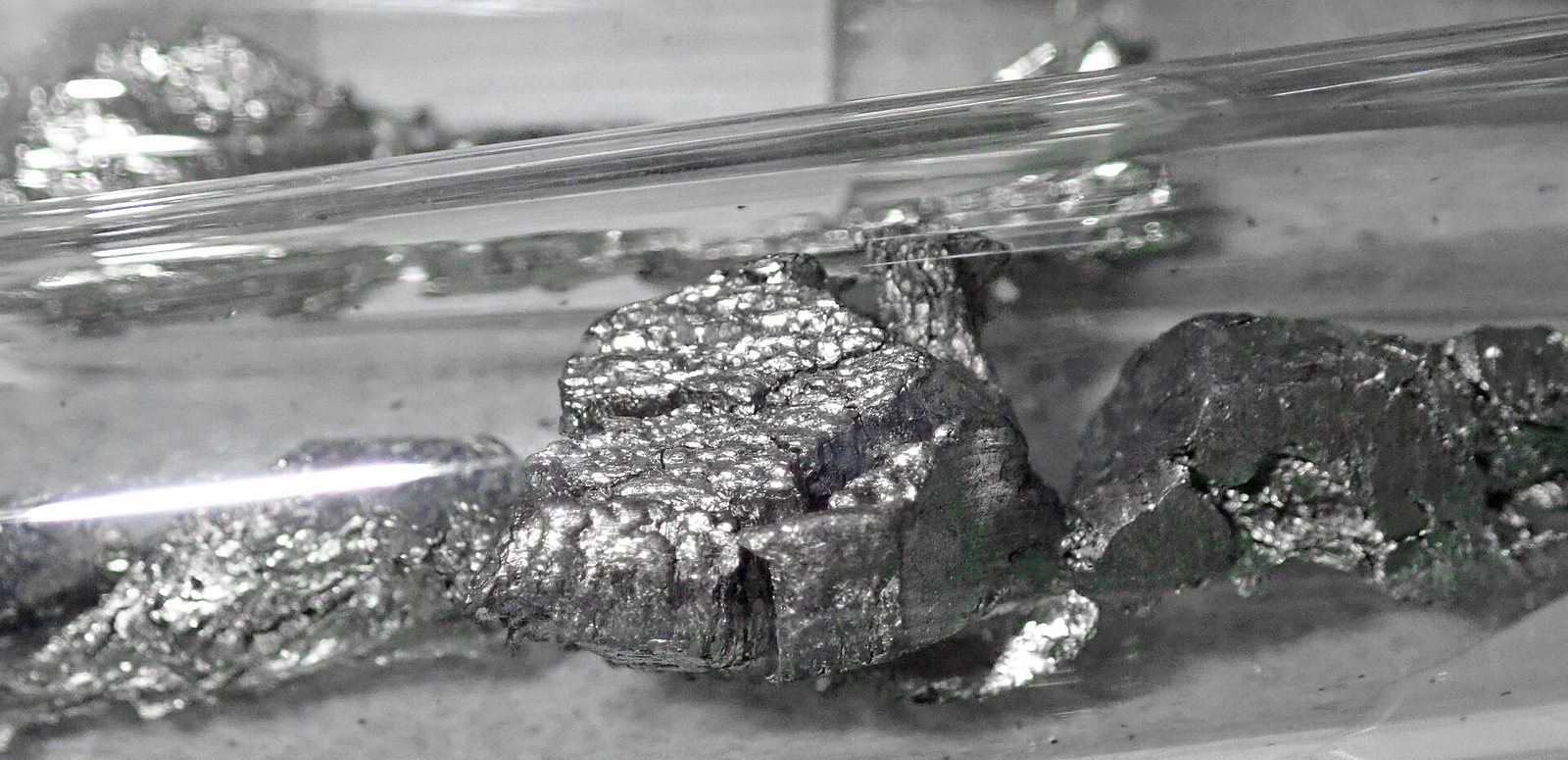
Qu'est-ce que c'est ?
A rare earth used in the fibre lasers that cut steel in factories, and in some of the most accurate atomic clocks ever built.
Pourquoi est-ce important ?
Ytterbium-doped fibre lasers displaced CO2 lasers across industrial cutting and welding in about a decade.
Where it is in the Earth
Ytterbium belongs to the group of elements collectively called the rare earth elements, or REEs. Despite the name, rare earths are not especially scarce in the Earth's crust — ytterbium is roughly as abundant as tin — but they rarely concentrate into deposits that can be mined economically. The reason lies in how the elements behave during the long, slow processes by which rocks form and are altered over millions of years. Ytterbium is one of the heavier rare earths, a grouping determined by the number of electrons in the atom rather than by physical weight, and the heavy REEs behave somewhat differently from their lighter cousins during geological processes.
The two main geological settings that produce workable ytterbium concentrations appear in the ore-mineral table above. The first is xenotime, a phosphate mineral that tends to crystallise inside certain granites and related igneous rocks, as well as in the ancient, wave-sorted beach and river sediments called placer deposits. Because xenotime is relatively resistant to weathering, it survives the erosion of the host rock and can accumulate in stream beds and coastal sands far from where the original granite formed. The second setting, and the one that has dominated production in recent decades, is the ion-adsorption clay deposit. Here, weathering in warm, humid conditions over millions of years has broken down granite, releasing REE ions that are then loosely held on the surface of clay minerals — principally kaolinite — rather than locked into a hard crystalline structure. These deposits are found predominantly in southern China, where the right combination of granitic bedrock, tropical weathering history, and sufficient geological time came together. The heavy REEs, including ytterbium, are proportionally more enriched in ion-adsorption clays than in most other deposit types, which is one reason these clays became so commercially significant.
Carbonatite rocks — igneous rocks unusually rich in carbonate minerals — host the world's largest REE deposits by total tonnage, but they tend to be enriched in the lighter rare earths and carry relatively little ytterbium. This means that ytterbium supply is more closely tied to the clay deposits and to placer xenotime sources than to the famous carbonatite mines that dominate discussions of cerium or lanthanum. Where the ore sits in the Earth thus has a direct bearing on where the supply chain begins and how it is structured.
Getting it out
The method used to mine ytterbium depends entirely on which type of deposit is being worked. Xenotime in hard-rock igneous or metamorphic settings is typically mined by conventional open-pit methods: the overlying rock and soil, collectively called overburden, is stripped away and the ore is blasted, loaded, and hauled to a processing facility. The same mineral in placer deposits is often won by dredging or by hydraulic mining of unconsolidated sands and gravels, techniques that are less energy-intensive because the material is already loose. In either case, xenotime is a minor constituent of the ore, and the ytterbium it contains is a fraction of the xenotime. A great deal of material therefore moves for each unit of ytterbium eventually recovered.
Ion-adsorption clay deposits are mined very differently. Because the clay is soft, loosely consolidated material, no blasting is required. Historically, surface scraping and open excavation sufficed. More recently, a method called in-situ leaching has been applied: a solution — typically a dilute ammonium sulfate or magnesium sulfate solution — is pumped into the clay through injection wells, the solution dissolves the REE ions away from the clay surfaces, and the resulting pregnant liquor is collected at drainage points lower on the hillside. This avoids moving large volumes of material physically. The trade-off is that the leaching solution must be carefully managed to prevent it from migrating into surrounding soils and waterways, and recovery of the injected solution is never complete. The grade of ion-adsorption deposits — that is, the concentration of REEs in the clay — is low by the standards of other metal ores, but the ease of processing the clay can offset this.
Because ytterbium is one of several rare earths present simultaneously in any of these deposits, it is always co-produced alongside other elements. It is not mined for its own sake; it appears as part of a mixed stream of REEs and must be separated from its companions at a later stage. This co-production relationship means that decisions about how much of any given deposit to mine are driven largely by demand for the more abundant or more valuable REEs in the same ore, and ytterbium production follows as a consequence rather than as a primary target.
What pulls on it
Ytterbium has a small number of distinct end uses, and they sit at opposite ends of the technology spectrum. The application that has driven most attention in recent years is the ytterbium-doped fibre laser. In these devices, ytterbium ions are incorporated into a glass fibre, where they absorb pump light of one wavelength and re-emit it at a longer wavelength suitable for cutting, welding, or marking metals and other materials. The proportion of ytterbium in the fibre is small, but it is essential: the specific electronic structure of ytterbium ions produces an emission wavelength and an efficiency that no other readily available dopant replicates at the same cost. Industrial manufacturing — automotive body panels, structural steel, consumer electronics casings — accounts for a large share of the fibre laser market. The USGS notes lasers alongside catalysts, metallurgy, and scintillators as primary applications.
The other application that draws considerable scientific interest is the ytterbium optical lattice clock. These are timekeeping instruments of extraordinary precision, in which ytterbium atoms are trapped in a grid formed by laser beams and their quantum energy transitions are used to define the tick of the clock. The quantities of ytterbium involved are minuscule — measured in micrograms rather than tonnes — but the application matters because it represents a potential future redefinition of the second itself, the base unit of time. Demand from this sector is essentially invisible in tonnage terms but significant in terms of the purity and form of material required.
Metallurgical uses — adding small amounts of ytterbium to certain stainless steels and other alloys to improve high-temperature oxidation resistance — represent a more diffuse demand that is difficult to track precisely. Scintillators, which are materials that emit light when struck by ionising radiation and are used in medical imaging and security screening equipment, represent another modest but persistent source of demand. What would have to change for demand to shift sharply? A significant decline in the adoption of fibre lasers in manufacturing, or the commercialisation of a functionally equivalent dopant, would reduce the largest demand segment. Conversely, broader rollout of precision timing infrastructure — for navigation, telecommunications synchronisation, or fundamental research — could increase demand for the highest-purity forms, though not in quantities that would register against the industrial laser market.
Turning ore into product Niveau 3
Regardless of the ore type, converting ytterbium-bearing material into something a factory can use involves several distinct stages. For hard-rock xenotime ores, the first step is comminution — crushing and grinding the rock until the xenotime mineral grains are liberated from the surrounding waste minerals. Physical separation techniques, particularly froth flotation (where air bubbles selectively carry target mineral particles to the surface of a water-filled tank) or gravity and magnetic separation, are then used to produce a concentrate in which xenotime is far more abundant than it was in the original ore. Losses occur at every separation stage; fine particles and grains that are not fully liberated tend to report to the tailings — the discarded fraction — reducing overall recovery.
The concentrate, or in the case of ion-adsorption clays the pregnant leach solution, then undergoes hydrometallurgical treatment. For xenotime, this typically means digestion in a strong acid — sulfuric acid is common — to dissolve the REE phosphate and produce a solution of mixed rare earth ions. Ion-adsorption leachate arrives already in solution form. From either starting point, the mixed REE solution must be separated into individual elements. The dominant industrial technique is solvent extraction, sometimes called liquid-liquid extraction or SX: the aqueous solution is contacted with an organic solvent containing a selective extractant molecule, which preferentially pulls certain REE ions across the phase boundary. By running many such stages in sequence, with conditions adjusted at each step, it becomes possible to isolate individual rare earths at high purity. The number of stages required and the quantities of reagents consumed are substantially greater for the heavy REEs, including ytterbium, than for light REEs, because the heavy REEs are chemically more similar to one another and therefore harder to pull apart. This is a principal reason why heavy REE separation is concentrated in a small number of facilities with the accumulated process knowledge and infrastructure to do it economically.
The separated ytterbium is precipitated, filtered, and calcined — heated in air — to produce ytterbium oxide (Yb₂O₃), which is the standard traded commodity and the basis on which production figures are reported. Further reduction to metal, or incorporation into doped optical fibre, happens at specialist downstream facilities. The purity specifications for different end uses vary considerably: fibre laser applications typically require very high purity to avoid absorbing the wrong wavelengths of light, while metallurgical uses are more tolerant of impurities. The price data shown above reflects the 99.99% minimum purity grade of the oxide, which represents the demanding end of the market.
Substitution and recycling Niveau 3
Within fibre laser technology, ytterbium has no direct drop-in substitute. Neodymium, another rare earth, is used in a different class of solid-state lasers and was the dominant industrial laser dopant before ytterbium-doped fibre lasers displaced the older CO₂ gas laser technology. Ytterbium's advantage in fibre lasers comes from a combination of its absorption and emission wavelengths, a small quantum defect (meaning little energy is wasted as heat), and compatibility with the silica glass fibres in which it is hosted. No other element combines these properties in the same way within the same fibre architecture. Switching to an alternative would not mean substituting one rare earth for another within the same device; it would mean adopting a different laser technology with different efficiency, beam quality, and cost characteristics. That is a much larger engineering and capital decision for a manufacturer, which makes demand from this sector relatively inelastic to moderate price changes.
For metallurgical additions, the picture is somewhat different. The rare earths used in alloying are partly interchangeable, and a formulator might shift the mix of elements added to achieve a target property. Ytterbium's role here is less specialised than in laser applications, and competing REEs or other minor alloying elements could in principle substitute at some cost in optimisation. Recycling contributes negligibly to ytterbium supply at present. The amounts present in any individual product are small, the products themselves are large and complex — a laser cutting head, a steel component — and end-of-life collection and processing infrastructure for rare earths embedded in manufactured goods is not well developed anywhere. The economics of recovering ytterbium from scrap are unfavourable given the dilute concentrations involved, and this is unlikely to change substantially without either a large rise in the value of the recovered material or a reduction in separation costs.
Where the chain is fragile Niveau 4
Several structural features of the ytterbium supply chain warrant careful attention. The first is geographical concentration. Ion-adsorption clay deposits, which are the predominant source of the heavy rare earths including ytterbium, are located almost entirely in southern China. World production and reserve figures are not provided in the dataset made available for this article — the source withholds them — which itself reflects a broader opacity in REE reporting. Chinese production statistics for individual heavy REEs are typically aggregated or estimated rather than directly measured, and independent verification is difficult. Analysts working from trade data, chemical plant capacities, and oxide pricing generally acknowledge a wide margin of uncertainty around any specific production figure for ytterbium.
The second structural feature is by-product dependence. Ytterbium is not mined to order. Its production volume is a function of how much ion-adsorption clay is processed to recover the more abundant and commercially dominant REEs — particularly the magnet metals terbium and dysprosium, which are also heavy REEs from the same deposits. If demand for those elements rises and processing expands, more ytterbium enters the market as a consequence. If it falls, ytterbium supply contracts regardless of ytterbium-specific demand. This decoupling between ytterbium demand signals and ytterbium production volumes is a fundamental feature of the market, not an anomaly.
Separation capacity for heavy REEs outside China is limited. Several projects in Australia, the United States, and elsewhere have been announced or are at various stages of development, aimed at building separation capability for ion-adsorption-type or xenotime-derived material. The lead times from exploration through permitting, construction, and commissioning to stable production for a rare earth separation facility are measured in years to a decade or more. The reporting convention of expressing production as oxide equivalent, noted in the unit basis field, is consistent across most national and commercial sources, but direct comparability between figures from different producers is constrained by differences in the purity thresholds assumed and by whether toll-processing volumes are attributed to the country of ore origin or the country of separation. These distinctions are rarely flagged in summary statistics.
D'où cela vient dans la roche
Tous les minéraux de minerai →Ce sont les minéraux qui portent réellement ytterbium. Un gisement n'est un corps minéralisé que si l'un d'eux est suffisamment concentré pour rentabiliser son extraction.
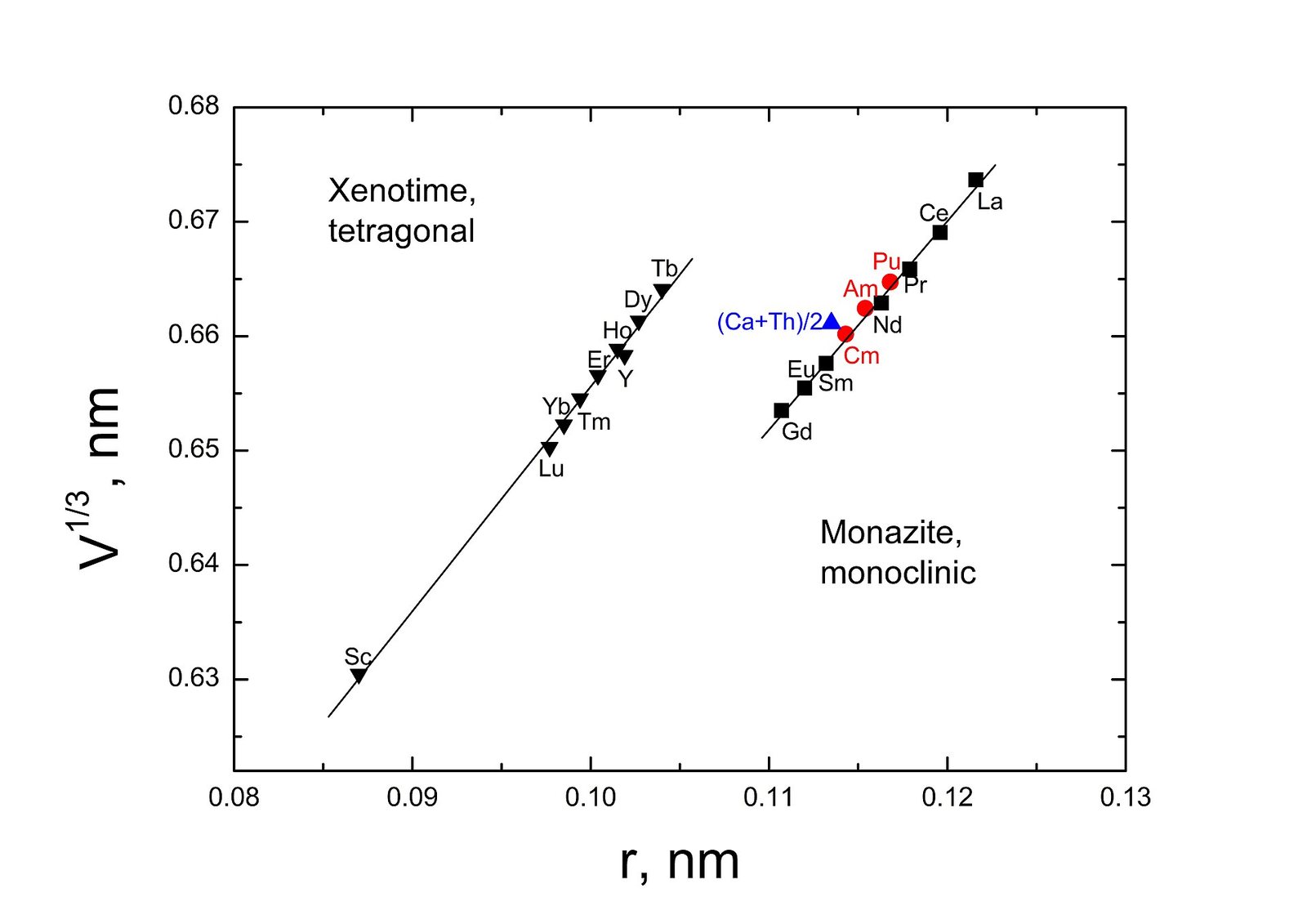
Xenotime
A yttrium phosphate that also carries the heavy rare earths — dysprosium, terbium, erbium — that magnets need.
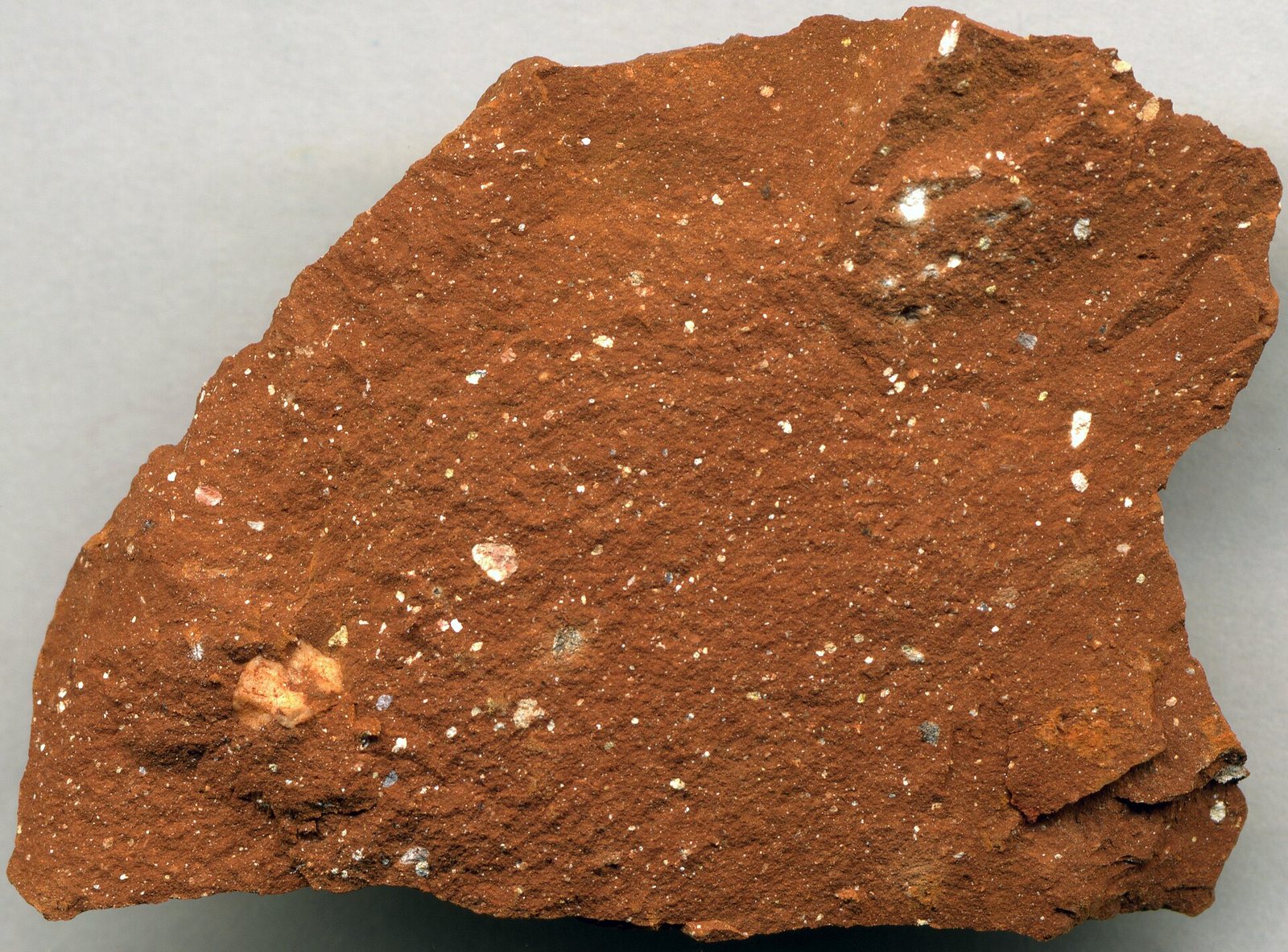
Ion-Adsorption Clay
Weathered granite where rare-earth ions cling loosely to clay surfaces. Grades are very low but the metal washes out…
Prix
average, dollars per kilogram: Ytterbium oxide, 99.99% minimum
Moyenne annuelledollars per kilogram
Base: average, dollars per kilogram: Ytterbium oxide, 99.99% minimum. Moyennes annuelles telles que publiées dans USGS Mineral Commodity Summaries 2026 · source ↗. Il s'agit de moyennes annuelles de référence, et non de cotations de marché en temps réel.