Module 2 · Mining and concentrating
Open pits, block caves, and the scale problem
Level 2 · Working knowledge 10 min read 4 questions
Low grade plus large volume forces a small number of mining methods. Each is a different answer to the same question: how do you move this much rock cheaply?
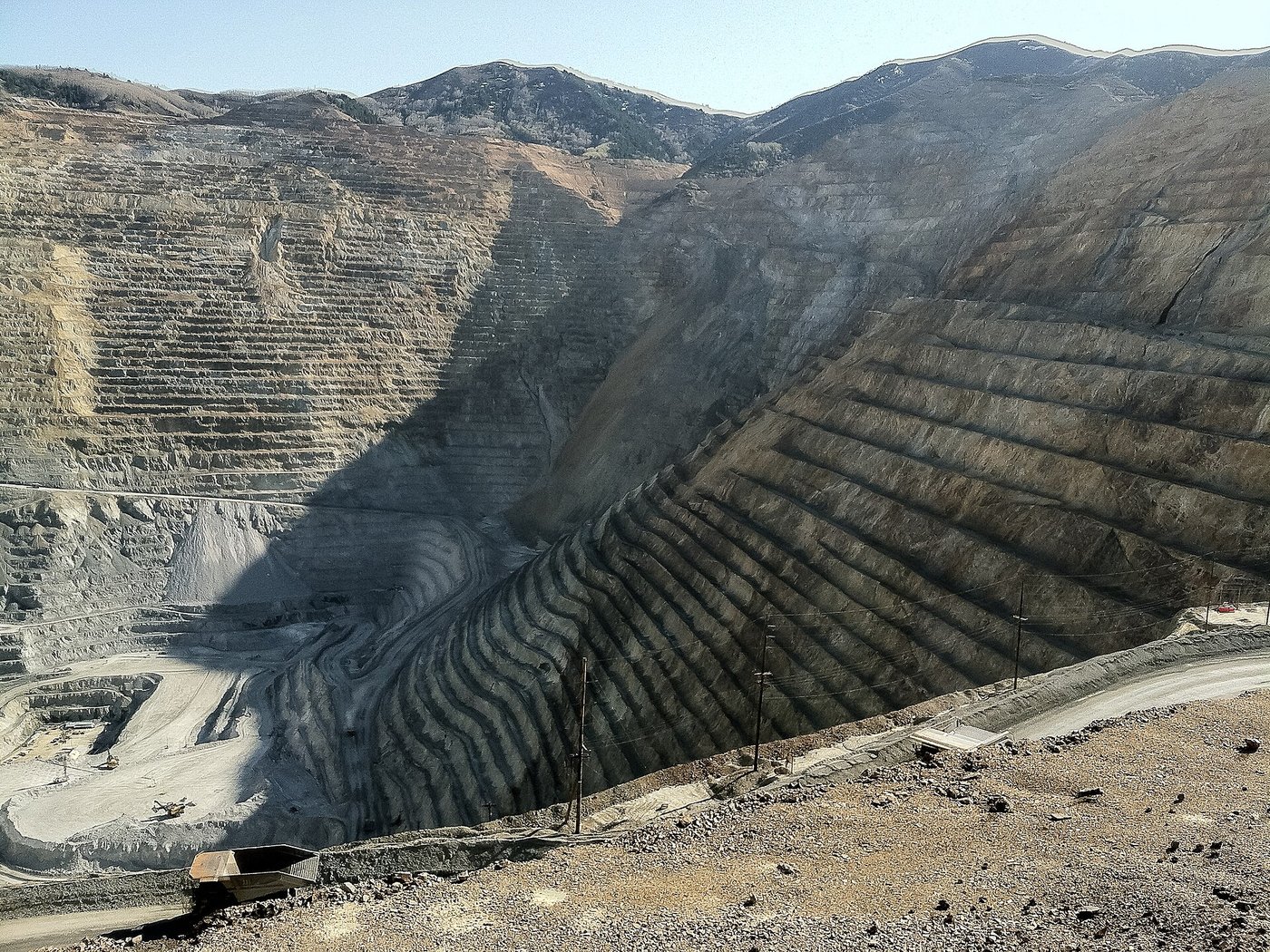
Because porphyry deposits are very large and typically low grade, they are almost always mined by open pit. The pit deepens in benches; rock is drilled, blasted, loaded onto haul trucks or conveyors, and sent either to the concentrator or to a waste dump. The defining feature is the sheer volume of material that is not ore.
Open pit
Open pit mining is cheap per tonne and expensive per tonne of metal, which is exactly the right trade for a low-grade orebody. Its limits are geometric: as the pit deepens, the walls must be set back at a safe angle, so the volume of waste that must be removed to reach the next slice of ore grows. That rising strip ratio eventually makes the next bench cost more than it yields, which is where an open pit ends - not when the copper runs out.
Bingham Canyon is described on this site as the largest excavation made by people, and Chuquicamata as historically the largest open-pit copper mine by excavated volume. Both are the visible consequence of the grade arithmetic in lesson 3.
Underground, and block caving
Underground mining becomes preferable when the orebody is deep, when surface topography makes a pit impractical, or when the ore is rich enough to justify the cost of tunnels and shafts. For a large, low-grade orebody the only underground method with the right economics is block caving: miners undercut a large block of rock, which then collapses under its own weight and is drawn off through tunnels below.
- What block caving gives you
- Very large tonnages at low cost per tonne once established - the only underground method that can compete with an open pit on unit cost.
- What it costs you
- Long lead times to prepare the undercut and draw infrastructure, and very little flexibility once the cave is propagating. It cannot be accelerated to chase a price.
- Where it is used
- El Teniente, the largest underground copper mine in the world by excavated extent; Grasberg, converted from open pit; Oyu Tolgoi in Mongolia.
What constrains a modern copper mine
- Water. Andean mines sit in the driest desert on Earth. Several now run on desalinated seawater pumped uphill thousands of metres, which is a permanent energy cost attached to every tonne of ore.
- Energy. Crushing and grinding is the single largest electricity consumer at most copper mines - see the next lesson.
- Tailings storage. With 99.7% of the rock becoming waste, tailings facilities are among the largest structures a mining company builds and among its largest liabilities. See tailings.
- Permitting and social licence. Routinely the longest item on the critical path for a new mine, and the reason supply responds to price on a decade timescale.
Those four are why copper supply cannot respond quickly to price. A new mine is a ten-to-twenty-year proposition from discovery to full production - the general case is at mine lifecycle - and no amount of demand shortens rock mechanics or permitting.
- Open pits end when the strip ratio makes the next bench uneconomic, not when the ore runs out.
- Block caving is the only underground method with porphyry economics, and it cannot be hurried.
- Water, energy, tailings and permitting are why copper supply responds to price over a decade, not a quarter.
- Bench
- A working level in an open pit.
- Block caving
- Undercutting a block of rock so it collapses under its own weight and is drawn off below.
- Tailings
- The ground rock left after the valuable mineral has been removed.
- El Tenienteon this site
- Escondidaon this site
- Bingham Canyonon this site
- Open pit versus undergroundon this site
- Mine lifecycleon this site
Check yourself
1. An open pit is usually abandoned because:
Pit walls must be set back for stability, so waste removal per tonne of ore grows with depth until the economics close.
2. Block caving is chosen for large low-grade orebodies because it:
It is the only underground method whose unit costs can approach an open pit's - but it has long lead times and little flexibility.
3. Why do several Andean copper mines use desalinated seawater?
The Atacama has almost no water. Desalination plus a kilometres-high pumping lift is a permanent energy cost on every tonne of ore.
4. A large open pit converting to underground block caving typically shows:
The cave has to be prepared and propagated before it produces at rate, and the timing is governed by rock mechanics.