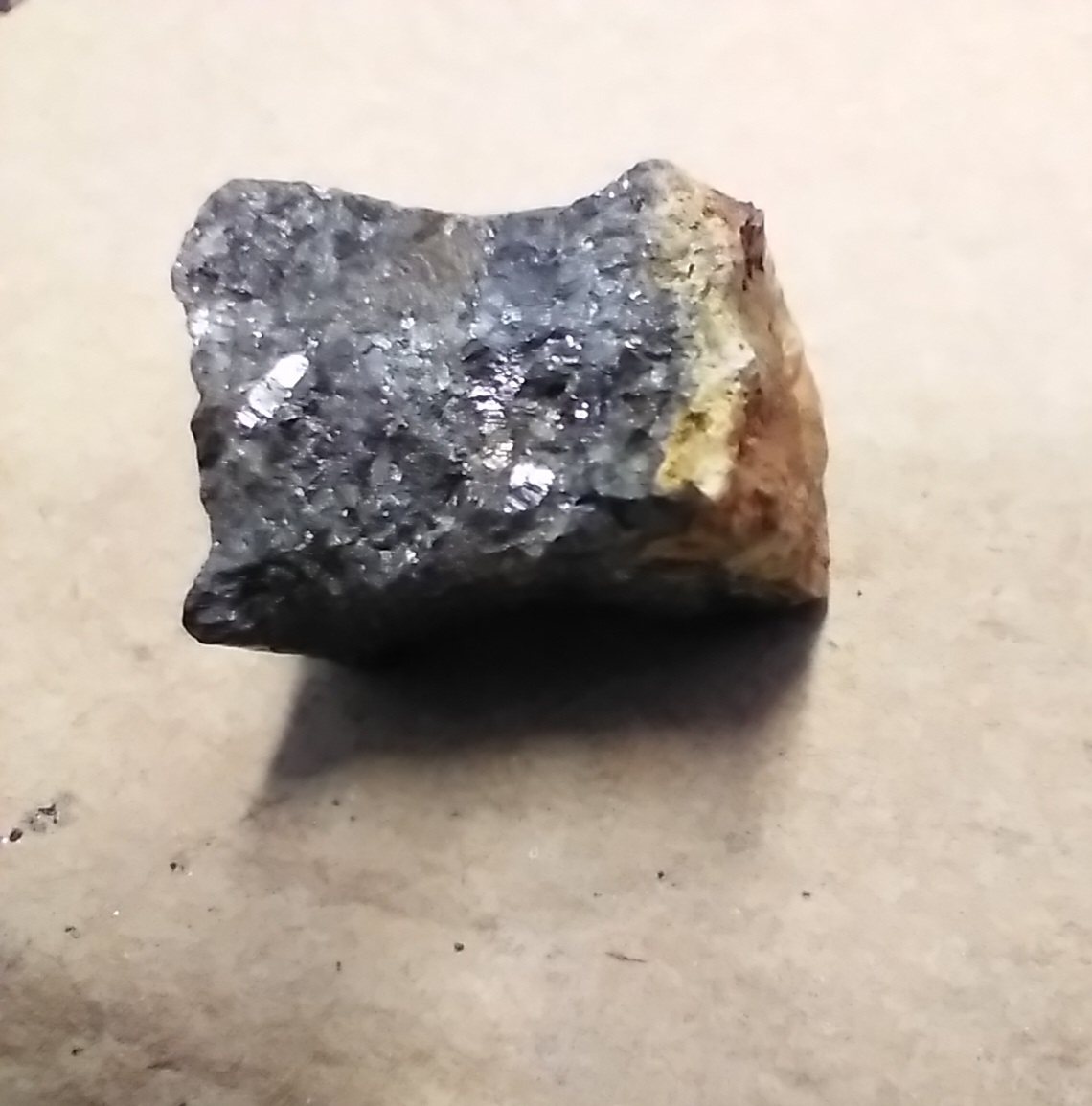
Che cos'è?
A brittle, silvery metalloid used mostly to stop things burning, and in the primers and tracer rounds of ammunition.
Perché è importante?
Antimony trioxide is the workhorse flame retardant in plastics, cables and textiles, and the metal has become a formal export-control subject.
Where it is in the Earth
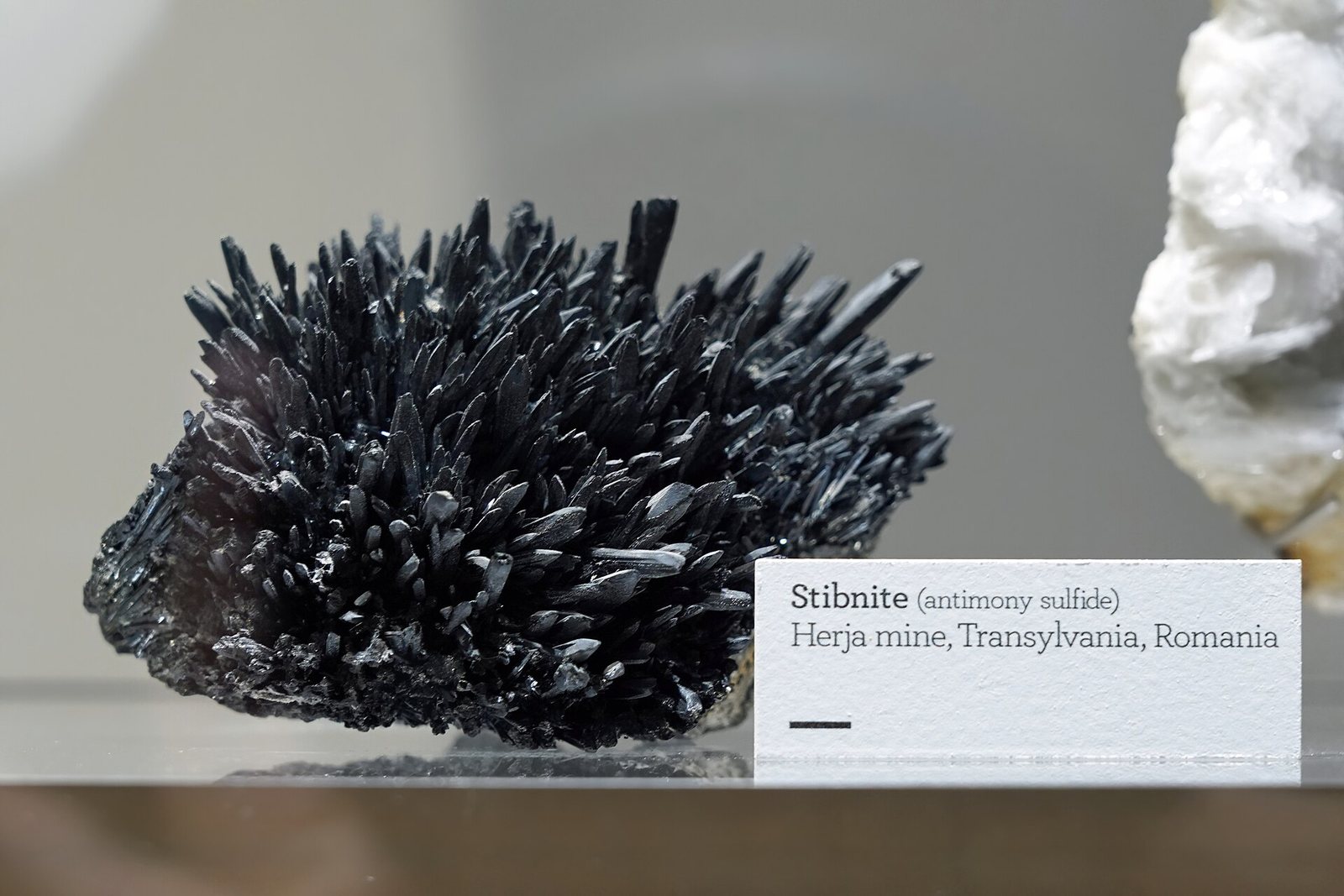
Antimony is a metalloid — a substance with properties partway between a metal and a non-metal — and in the Earth's crust it occurs at very low average concentrations. It becomes mineable only where geological processes have gathered it into discrete bodies of much higher grade. The overwhelming majority of economic deposits form through hydrothermal activity: hot, chemically active water circulates through fractures in the crust, dissolves antimony from surrounding rock over long distances, and then deposits it when temperature or chemistry changes abruptly. The result is stibnite (antimony trisulfide, Sb₂S₃), a lead-grey mineral with a distinctive striated habit that serves as the principal ore of antimony in virtually every producing country.
Most of these hydrothermal deposits fall into two broad families. Vein deposits are narrow, steeply dipping bodies where stibnite crystallised directly in fault or fracture systems; they can be remarkably rich but are geometrically irregular and tend to be small. Stratabound or bedding-parallel deposits, sometimes called replacement bodies, form where hydrothermal fluids moved along the contact between rock types of contrasting chemistry and replaced existing carbonate or sedimentary rock with sulfide minerals across a broader, flatter zone. Xikuangshan in Hunan province, China — by a wide margin the largest antimony district ever worked — is a stratabound deposit of this type, which helps explain both its scale and its longevity.
The geographic distribution of reserves reflects where ancient geological events created the right conditions. China, Russia, Bolivia, Kyrgyzstan and Burma together hold the overwhelming share of known reserves, as the tables on this page show. This clustering is not coincidental: each of these regions contains old orogenic belts — mountain-building zones where deep fluid circulation was intense — associated with the right combination of source rocks, structural pathways and chemical traps. Countries with large landmasses and long histories of active tectonics tend to host more discoveries simply because there were more opportunities for the right conditions to occur.
Getting it out
Because stibnite veins and stratabound bodies are typically found at depth, and because the ore zones are often narrow relative to surrounding waste rock, underground mining dominates antimony production worldwide. Miners sink shafts or drive adits (horizontal tunnels) into hillsides to reach ore that would be impractical to expose from the surface without moving enormous quantities of barren material. At Xikuangshan, centuries of mining have progressively moved deeper underground as shallower ore was exhausted. Where ore bodies are larger and closer to the surface, open-pit methods — essentially a terraced excavation working downward — can be used, though this is less common for primary antimony deposits than for metals like copper or iron.
Grade matters enormously in mining economics. Grade refers to the concentration of the target element in the rock, usually expressed as a percentage. A higher grade means less rock must be mined, crushed and processed to produce each tonne of contained antimony, so costs per unit of output are lower. Antimony ore grades vary considerably between deposits, and because the ore minerals are often irregularly distributed through the host rock, the effective grade reaching the mill can differ from the average grade of the deposit. The ratio of waste rock moved to ore produced — the strip ratio in open pits, or the dilution factor underground — directly drives the cost of each tonne of concentrate and therefore determines whether a deposit can be worked at a profit at any given price.
Antimony is also recovered as a by-product in some lead and gold mining operations, where it occurs as a minor constituent of sulfide ores processed primarily for another metal. In these cases the antimony revenue is essentially incidental: the decision to mine is driven by the primary commodity, and the volume of antimony recovered depends on how much of the primary ore is processed rather than on antimony demand or price. This by-product route matters to the global supply picture in ways the end-use tables on this page do not fully capture.
What pulls on it
Antimony trioxide is, by volume of use, principally a flame retardant. It does not act alone: it works synergistically with halogenated compounds — chemicals containing bromine or chlorine — that are already present in a plastic, textile or cable sheathing. When the material begins to burn, the antimony and halogen react to interrupt the combustion chemistry, slowing or stopping the fire. This combination is embedded in an enormous range of everyday products: the plastic casings of electronics, insulation on electrical cables, upholstered furniture and aircraft interiors. The proportion of antimony trioxide in a finished product is small, but the breadth of applications across construction, transport and consumer goods means that aggregate demand is substantial.
The second significant use is in lead-acid batteries, where antimony is alloyed with lead to harden the battery plates and improve their mechanical performance. This application connects antimony demand to the large and still-active market for lead-acid batteries in vehicles, backup power systems and industrial equipment. Military uses — ammunition primers, tracer compounds and certain pyrotechnic compositions — represent a smaller but strategically weighted share of consumption, which is part of the reason antimony has attracted formal export-control designations in several jurisdictions.
The demand picture has two countervailing pressures. Substitution of halogenated flame retardants by non-halogenated systems — driven partly by environmental regulation — would reduce antimony trioxide consumption in some product categories, because the trioxide is specifically a synergist for halogen-based chemistry. On the other side, any sustained growth in defence procurement, grid-scale power storage using lead-acid technology, or the cable networks required for electrification infrastructure would tend to support or increase demand. Which of these forces dominates will depend on regulatory trajectories and technology choices that are presently contested, so the direction of net demand is genuinely uncertain rather than obviously trending one way.
Turning ore into product Livello 3
Ore leaving an antimony mine is first reduced in size through crushing and grinding, collectively called comminution, to liberate stibnite grains from the surrounding waste minerals. The resulting fine material then passes through froth flotation, the standard concentration technique for sulfide ores: air is bubbled through a slurry of ground ore mixed with selective chemical reagents; stibnite particles attach to the bubbles and float to the surface as a froth that is skimmed off, while gangue (waste minerals) sinks. The product is a concentrate — a material substantially enriched in antimony sulfide — which is the commodity traded between mine operators and smelters. Recoveries in flotation vary with ore type, grain size and the presence of penalty elements, and losses at this stage represent antimony that has already been mined but will never reach a finished product.
Concentrate is then smelted. The two principal pyrometallurgical routes are roasting followed by reduction, and direct volatilisation. In the roasting route, concentrate is oxidised at high temperature to convert stibnite to antimony trioxide (Sb₂O₃), which may be sold directly as the trioxide — the dominant commercial form for flame-retardant applications — or further reduced with carbon to produce crude antimony metal. In the volatilisation route, the sulfide is heated to drive off antimony as a vapour, which condenses and is collected. Refining steps then remove impurities such as arsenic, lead and sulfur to reach the metal purity or trioxide specification that buyers require. Each step involves losses and energy costs, and the choice of route depends on concentrate composition, local energy prices and which product form commands the better net return at the time of processing. The data block for this page lists no processing plants outside the mines themselves, which reflects that smelting capacity is concentrated in a small number of countries and the source withholds plant-level detail.
A notable feature of antimony processing economics is the tight relationship between smelter location and concentrate origin. Because antimony concentrates can carry arsenic and other elements that complicate processing and require careful handling, smelters tend to be built close to established concentrate sources or in jurisdictions with specific regulatory and infrastructure conditions. This geographical stickiness in smelting capacity means that even if new mines were opened in countries currently lacking smelters, concentrate would need to travel to existing capacity or new smelting investment would be required — adding lead time and capital cost that are not visible in mine-level data.
Substitution and recycling Livello 3
In flame retardancy, antimony trioxide can in principle be replaced by alternative synergists or by entirely different flame-retardant chemistries that do not require a synergist at all. Phosphorus-based flame retardants, mineral hydroxides such as aluminium trihydroxide, and intumescent systems — materials that swell and char when heated to form an insulating layer — are the main alternatives. Each involves trade-offs. Mineral hydroxides need to be used in high loadings, which can affect the mechanical properties of the host material. Phosphorus systems work well in some polymers but not others. Intumescent coatings are effective in specific geometries but add processing complexity. The practical consequence is that substitution is feasible across much of the flame retardant market but typically involves reformulation effort, retesting against fire standards, and often some performance penalty, which means it proceeds incrementally rather than rapidly.
In lead-acid batteries, calcium has largely replaced antimony as the hardening additive in most modern sealed batteries, a transition that has already reduced antimony intensity in this end use. Some specialty flooded batteries, particularly those designed for deep-cycle or high-temperature service, still use antimony alloys because of the specific cycling characteristics antimony imparts, but the general direction has been away from antimony in this segment. In ammunition and pyrotechnics, functional substitutes are more limited because antimony compounds have specific ignition and burn characteristics that are not easily replicated, and qualification requirements for military specifications are demanding.
Recycling of antimony is constrained by its dissipative pattern of use. Flame retardants are dispersed through polymer matrices in small concentrations; recovering antimony from end-of-life plastics or textiles is not commercially practised at scale. Lead-acid battery recycling is mature and recovers lead efficiently, but antimony present in older battery alloys is not separately recovered — it follows the lead stream and is diluted or lost in slag. The result is that secondary antimony supply is a relatively small fraction of total supply, and expanding it would require both collection infrastructure and hydrometallurgical processing steps that are not currently economic at prevailing conditions.
Where the chain is fragile Livello 4
The supply concentration visible in the production and reserves tables warrants careful interpretation. China produces 40,000 metric tons per year out of a world total of 110,000 metric tons, which is the dominant single-country share, and holds 830,000 metric tons of reserves — more than any other country. Russia and Tajikistan together account for a further substantial share of current production. This geographic concentration is not simply a statement about where ore bodies happen to exist; it also reflects decades of state investment in mining and smelting infrastructure in those countries, which has made it difficult for higher-cost deposits elsewhere to compete in normal market conditions. The United States holds 60,000 metric tons of reserves but produces negligibly, meaning the reserve figure describes geological endowment rather than active capacity.
The by-product and co-product nature of some antimony supply introduces a second layer of fragility that headline production figures obscure. Where antimony is recovered as a minor product of lead or gold smelting, its availability is determined by decisions about those primary metals rather than by antimony market signals. A slowdown in lead smelting for any reason — regulatory, economic or logistical — would reduce antimony by-product volumes without any corresponding change in antimony demand. This coupling between antimony supply and unrelated commodity markets makes supply harder to model and less responsive to price incentives than the figures alone suggest.
Reporting uncertainty compounds the analytical difficulty. Mine production statistics for antimony are drawn from government submissions, industry surveys and trade data, and these sources often disagree. Countries with significant artisanal or small-scale mining — a category relevant to several producing nations in South and Southeast Asia — may underreport production systematically because small operators are hard to enumerate. The unit basis for this page is contained antimony at the mine, but the conversion between ore mined, concentrate produced and metal equivalent involves assumptions about recovery that vary by source and are not always disclosed. Where figures are described as estimated, as several entries in the production table are, the margin of uncertainty is real and can be large relative to the absolute values involved. Analysts comparing figures from different institutional sources — USGS, the British Geological Survey, national statistical agencies — will routinely encounter discrepancies that cannot be resolved without access to the primary survey data, which is typically not public.
Da dove proviene nella roccia
Tutti i minerali mena →Questi sono i minerali che contengono effettivamente antimony. Un giacimento è un corpo minerario solo se uno di essi è sufficientemente concentrato da giustificare il costo dell'estrazione.
Chi lo produce
Visualizza sulla mappa →Mine production
Mine productionmetric tons 2025 (stimato) Totale mondiale 110,000 metric tons
USGS Mineral Commodity Summaries 2026 · Mine production of contained antimony. · fonte ↗
Scorrere la tabella lateralmente per visualizzare le colonne rimanenti.
| Paese | Produzione | Quota mondiale |
|---|---|---|
| China | 40,000 | 36.4% |
| Russia | 32,000 | 29.1% |
| Tajikistan | 22,000 | 20.0% |
| Bolivia | 5,000 | 4.5% |
| Burma | 4,500 | 4.1% |
| Turkey | 3,000 | 2.7% |
| Australia | 1,300 | 1.2% |
| Kazakhstan | 800.0 | 0.7% |
| Kyrgyzstan | 700.0 | 0.6% |
| Mexico | 600.0 | 0.5% |
| Pakistan | 260.0 | 0.2% |
| Vietnam | 220.0 | 0.2% |
| Laos | 200.0 | 0.2% |
| Iran | 90.00 | 0.1% |
| Guatemala | 50.00 | 0.0% |
| Canada | Zero | — |
| United States | Withheld | — |
| Totale mondiale | 110,000 | 100% |
«Withheld» significa che l'USGS ha soppresso il dato per evitare di divulgare informazioni relative a una singola azienda — non equivale a zero. I valori per paese non sempre sommano al totale mondiale perché la fonte arrotonda ciascun dato in modo indipendente e non sempre disaggrega la voce «altri paesi».
Chi detiene le riserve
Reserves
Reservesmetric tons 2025
USGS Mineral Commodity Summaries 2026 · fonte ↗
| Paese | Riserve | Quota mondiale |
|---|---|---|
| China | 830,000 | 41.5% |
| Russia | 350,000 | 17.5% |
| Bolivia | 310,000 | 15.5% |
| Kyrgyzstan | 260,000 | 13.0% |
| Burma | 140,000 | 7.0% |
| Australia | 110,000 | 5.5% |
| Turkey | 99,000 | 5.0% |
| Canada | 78,000 | 3.9% |
| United States | 60,000 | 3.0% |
| Tajikistan | 60,000 | 3.0% |
| Vietnam | 54,000 | 2.7% |
| Pakistan | 26,000 | 1.3% |
| Mexico | 18,000 | 0.9% |
| Laos | Not applicable | — |
| Iran | Not applicable | — |
| Guatemala | Not applicable | — |
| Kazakhstan | Not applicable | — |
| Totale mondiale | >2,000,000 | 100% |
La fonte pubblica questo totale mondiale come valore limite anziché come valore puntuale; le quote nell'ultima colonna sono pertanto esse stesse valori limite.
Prezzo
metal, average, dollars per pound
Media annualedollars per pound
Base: metal, average, dollars per pound. Medie annuali pubblicate in USGS Mineral Commodity Summaries 2026 · fonte ↗. Queste sono medie annuali di riferimento, non quotazioni di mercato in tempo reale.
Miniere che lo producono
Tutte le miniere →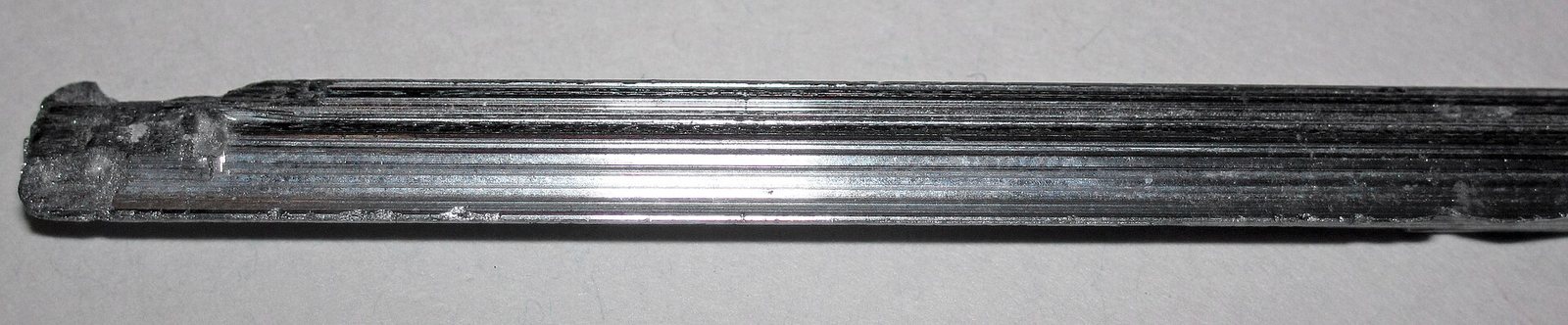
A cosa serve
Tutti i mercati finali →| Mercato finale | Cosa fa lì | Importanza |
|---|---|---|
| Aerospace & Defence | Ammunition primers and flame retardants | Importante |
Controlli all'esportazione
| Paese | Controllo | Si applica a |
|---|---|---|
| China | Export licensing requirement for materials and technologies | Antimony (2024), bismuth (2025), synthesized diamond (2025), gallium (2023), germanium (2023), graphite (2023), indium (2025), magnesium materials (2024), molybdenum (2025), rare earths (2025), silver (2026), tellurium (2025), tungsten (2025), and items related to lithium batteries and artificial graphite anode materials (2025). ↗ |
USGS Mineral Commodity Summaries 2026, table 4 — controls in effect as of January 2026, excluding controls since lifted.