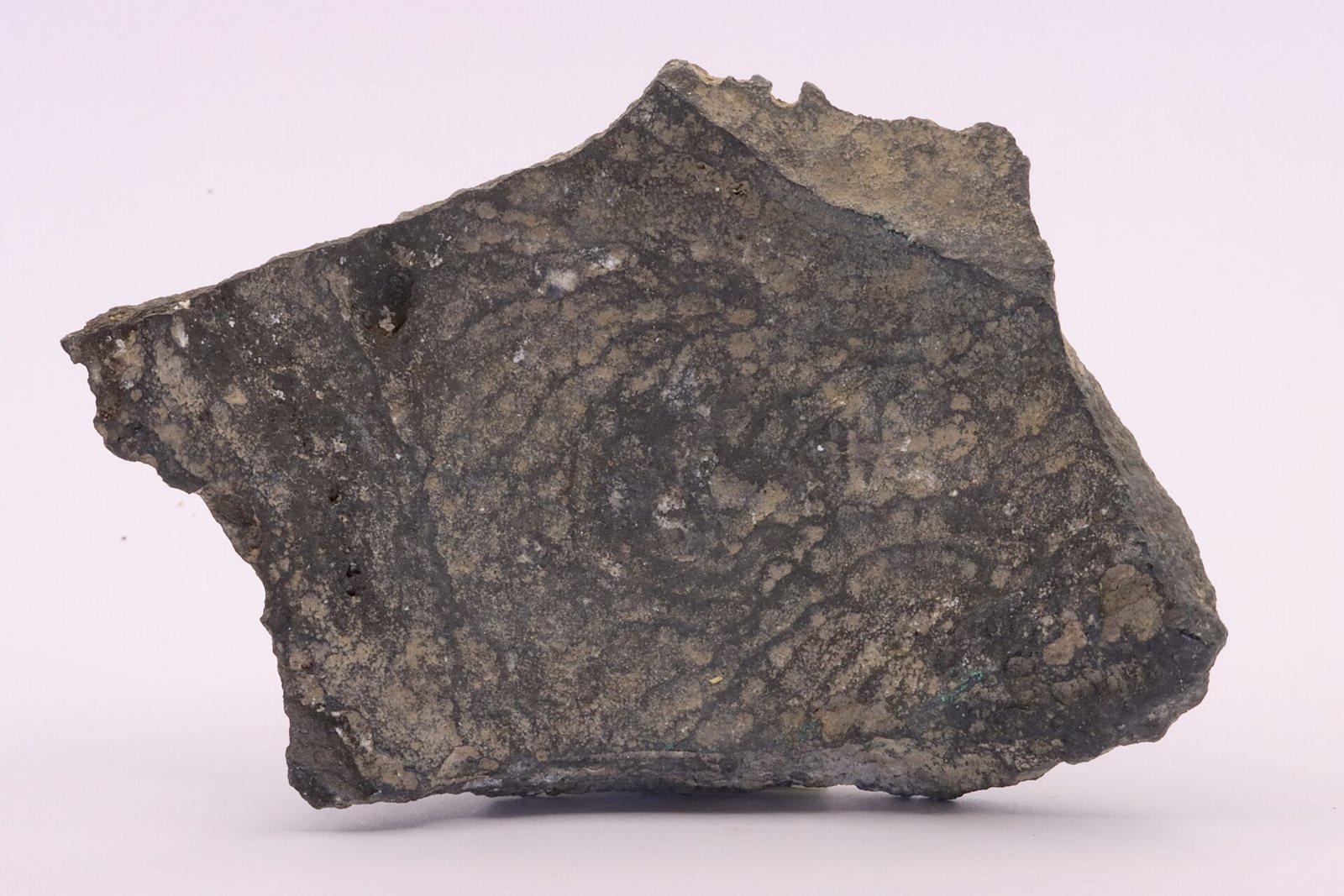
这是什么?
Famous as a poison, but in ultra-pure form it is half of gallium arsenide, the compound behind high-frequency radio chips.
为何重要?
It is also an unavoidable contaminant in many copper and gold ores, which makes arsenic management a real cost of mining.
Where it is in the Earth
Arsenic is not mined from deposits formed primarily around arsenic itself. It is instead concentrated as a secondary mineral within ore systems whose principal metals are copper, gold, lead, or cobalt. The geological process that brings arsenic to workable concentrations is hydrothermal mineralisation: hot, metal-bearing fluids moving through fractures in the crust cool and react with surrounding rock, precipitating sulfide minerals as they go. Arsenic is chemically comfortable in that environment. It substitutes readily into iron sulfide structures, most commonly as arsenopyrite (iron arsenic sulfide) and as enargite and tennantite in copper systems, and it travels with those fluids over long distances before being deposited.
Because arsenic behaves this way, it appears across a wide range of deposit types. Epithermal gold deposits — formed at relatively shallow depths from cooling volcanic fluids — are often strongly arsenical. So are porphyry copper systems, which form when large volumes of magmatic fluid intrude into crustal rock. The great copper and gold belts of the Andes account for much of the arsenic that reaches the market, which is why Peru sits so prominently in the production table. The arsenic is not the target of those mining operations; it is simply there, locked in the same rock as the copper or gold, and must be dealt with regardless.
Where arsenic is notably absent, it usually reflects a different geological history — different fluid chemistry, different host rocks, different temperatures of formation. This geological unevenness means that some ore bodies are almost arsenic-free while adjacent deposits may carry concentrations that substantially complicate processing. Grade, in this context, means not just how much of the target metal is present, but how much arsenic accompanies it.
Getting it out
Because arsenic is a by-product rather than a primary target, the mining method at any given operation is determined entirely by the geometry and depth of the host ore body, not by the arsenic itself. Porphyry copper deposits, which account for a large share of the arsenic that reaches the market, are typically mined by open-pit methods. The ore body is broad and disseminated — meaning the metal is spread thinly through a large volume of rock rather than concentrated in narrow veins — so open-pit mining, which removes material in successive horizontal benches, is the most practical approach. Underground methods are used where the ore is deeper or structurally constrained in a way that makes a surface excavation uneconomical.
Grade, in an open-pit copper or gold mine, describes how many grams or parts per million of the target metal are present in each tonne of rock. The arsenic content is rarely reported as a headline grade figure; it appears instead in metallurgical characterisation studies as a penalty element. The practical meaning is that for every tonne of copper or gold concentrate produced, the miner is also producing a quantity of arsenic that must either be sold, treated, or stored. The ratio of waste rock moved to ore processed — the strip ratio — can be very large in open-pit mining, meaning that the volume of material disturbed greatly exceeds the volume that eventually becomes product.
There is no in-situ recovery of arsenic, no brine operation, and no dedicated arsenic mine operating at commercial scale anywhere in the world. The arsenic supply is entirely downstream of decisions made about copper and gold.
What pulls on it
The two principal end uses for arsenic sit at opposite ends of the material's purity range. Arsenic trioxide, the lower-purity form, goes primarily into chromated copper arsenate (CCA), a wood preservative used to protect timber in outdoor structures from rot and insect damage. This application dominated global arsenic consumption for decades. Regulatory restrictions in many countries on CCA-treated wood in residential settings have reduced that demand meaningfully from its historical peak, though industrial and agricultural timber applications continue. Glass manufacture is a secondary use of the trioxide, where small additions act as a fining agent — a substance that helps remove bubbles from molten glass.
Semiconductor-grade arsenic metal, purified to extremely high levels, is the other principal use. It is one of the two elements in gallium arsenide (GaAs), a compound semiconductor with electronic properties that silicon cannot match at high frequencies. GaAs chips appear in mobile handsets, satellite communications, and radar systems. The quantity of arsenic consumed in this application is small relative to the trioxide market, but the price commanded is much higher. Demand in this segment moves with the production volumes of wireless devices and defence electronics.
For demand to shift sharply upward in aggregate, either the wood preservative market would need to recover substantially in a regulatory environment that has been moving in the other direction, or GaAs semiconductor volumes would need to grow considerably faster than they have. For demand to fall sharply, the compound semiconductor industry would need to find an alternative substrate, or the remaining CCA markets would need to face tighter restrictions.
Turning ore into product 级别 3
Arsenic enters the processing circuit as part of the sulfide concentrate produced when ore is ground and separated by froth flotation. In flotation, finely ground ore is mixed with water and reagents that make certain mineral surfaces water-repellent; air bubbles then carry those minerals to the surface as a froth. Arsenopyrite and copper arsenic sulfides float alongside the valuable minerals, producing a concentrate that carries arsenic at levels that smelters penalise or refuse outright above certain thresholds. The penalty reflects the smelter's cost of managing the arsenic in its own circuits.
At the smelter, arsenic volatilises during roasting or smelting — it converts to arsenic trioxide (As2O3) gas at elevated temperatures and must be captured in gas-cleaning systems, principally baghouse filters and electrostatic precipitators, before the offgas reaches the atmosphere. The collected arsenic trioxide dust is the primary traded form of the commodity, and this is the unit basis on which world production figures are reported. The dust can be sold directly into the wood preservative or glass industries, or it can be further refined: reduction with carbon produces arsenic metal, and further zone-refining or other purification processes yield the seven-nines (99.99999 per cent pure) metal used in compound semiconductor manufacture. Each purification step removes material and adds cost, which is why the price differential between trioxide and semiconductor-grade metal is substantial.
The alternative, where no market exists for the trioxide, is stabilisation and long-term storage, typically as ferric arsenate compounds buried in lined facilities. This represents a cost with no offsetting revenue, and it is the default outcome at many operations. Whether a smelter sells or stores its arsenic trioxide depends on the balance between transport costs, prevailing trioxide prices, and the regulatory regime governing storage.
Substitution and recycling 级别 3
In wood preservation, arsenic-free alternatives exist and have displaced CCA in many regulated markets. Copper azole and alkaline copper quaternary compounds serve broadly similar preservative functions and have been approved in jurisdictions where CCA is restricted for residential use. The performance trade-off is not severe in most structural applications, which is part of why the regulatory transition was commercially viable. The main friction is legacy stock: enormous volumes of CCA-treated timber already exist in service, and these structures will not be replaced before their natural end of life.
In compound semiconductors, substitution is more constrained. Gallium nitride (GaN) has taken market share from GaAs in certain power amplifier applications, particularly at the highest frequencies, because GaN operates at higher voltages and temperatures. However, GaAs retains advantages in specific performance envelopes, and the two materials serve partially overlapping but not identical application spaces. Silicon has never been a viable substitute for GaAs in its core high-frequency applications; the electron mobility simply differs too much. The trajectory is one of gradual market segmentation rather than outright displacement.
Recycling of arsenic is negligible. The trioxide is consumed in durable goods or dispersed in preservation applications in ways that make recovery impractical. Semiconductor-grade arsenic ends up in compound wafers and chips; recovery from end-of-life electronics is not practised at scale. The supply of arsenic is therefore essentially entirely primary, produced as an unavoidable companion to copper and gold smelting, with no meaningful secondary stream to buffer supply disruptions.
Where the chain is fragile 级别 4
The production table makes the concentration risk plain: Peru accounts for 49 per cent of reported world production, and China accounts for most of the remainder, leaving the rest of the world with a very small share. This is a structural condition of the market, not a temporary artefact. It follows from the geography of large arsenical copper and gold deposits and from the location of smelting capacity. The United States reports no production, and the source withholds figures for Japan, indicating either no significant output or data suppression at the source. U.S. net import reliance is reported at 100 per cent, meaning there is no domestic production buffer.
The by-product nature of supply creates a decoupling that analysts sometimes underestimate. Arsenic output is not a function of arsenic demand or arsenic price; it is a function of copper and gold production decisions, which respond to copper and gold prices, ore grades, and operating costs. If arsenic demand rises, there is no mechanism by which producers can increase arsenic output without also increasing output of the primary metal — which they will only do if the primary metal economics justify it. Conversely, a contraction in copper smelting capacity reduces arsenic supply regardless of what is happening in the trioxide or semiconductor markets. This asymmetry means that arsenic supply can diverge from arsenic demand in either direction for sustained periods, with price as the only short-term adjustment mechanism.
A further complication in interpreting published figures is the unit basis: all production data are expressed as arsenic trioxide equivalent, which requires an assumed conversion factor to translate into metal or other forms. Figures from different national statistical agencies may apply different recovery assumptions or include different parts of the production chain, which is one reason that aggregated totals can differ between sources. The withholding of U.S. and Japanese figures introduces additional uncertainty into the world total, which should be read as a lower bound rather than a complete count. Reserve figures for arsenic are not published in the data available here, which reflects the broader industry convention that arsenic reserves are rarely delineated independently of the primary metal resource that hosts them.
生产主体
在地图上查看 →Production (arsenic trioxide, gross weight)
Production (arsenic trioxide, gross weight)metric tons 2025 (估计值) 全球合计 61,000 metric tons
USGS Mineral Commodity Summaries 2026 · Reported as arsenic trioxide equivalent. · 来源 ↗
横向滚动表格以查看其余列。
| 国家/地区 | 产量 | 占全球份额 |
|---|---|---|
| Peru | 30,000 | 49.2% |
| China | 24,000 | 39.3% |
| Morocco | 5,000 | 8.2% |
| Belgium | 1,000 | 1.6% |
| Russia | 500.0 | 0.8% |
| Japan | Zero | — |
| United States | Zero | — |
| 全球合计 | 61,000 | 100% |
"未披露"表示美国地质调查局(USGS)为避免泄露单个企业数据而对该数字进行了保密处理——并不意味着数值为零。各国行数之和不一定等于世界合计,原因在于来源对每个数字单独进行四舍五入处理,且并不总是单独列出"其他国家/地区"一行。
价格
metal, annual average, U.S. warehouse, dollars per pound
年度平均值dollars per pound
基准: metal, annual average, U.S. warehouse, dollars per pound. 年度平均值,来源: USGS Mineral Commodity Summaries 2026 · 来源 ↗. 以下为参考年度均价,非实时市场报价。
其用途
所有终端市场 →| 终端市场 | 其在彼处的用途 | 重要性 |
|---|---|---|
| Semiconductors | Dopant and GaAs | 重要 |