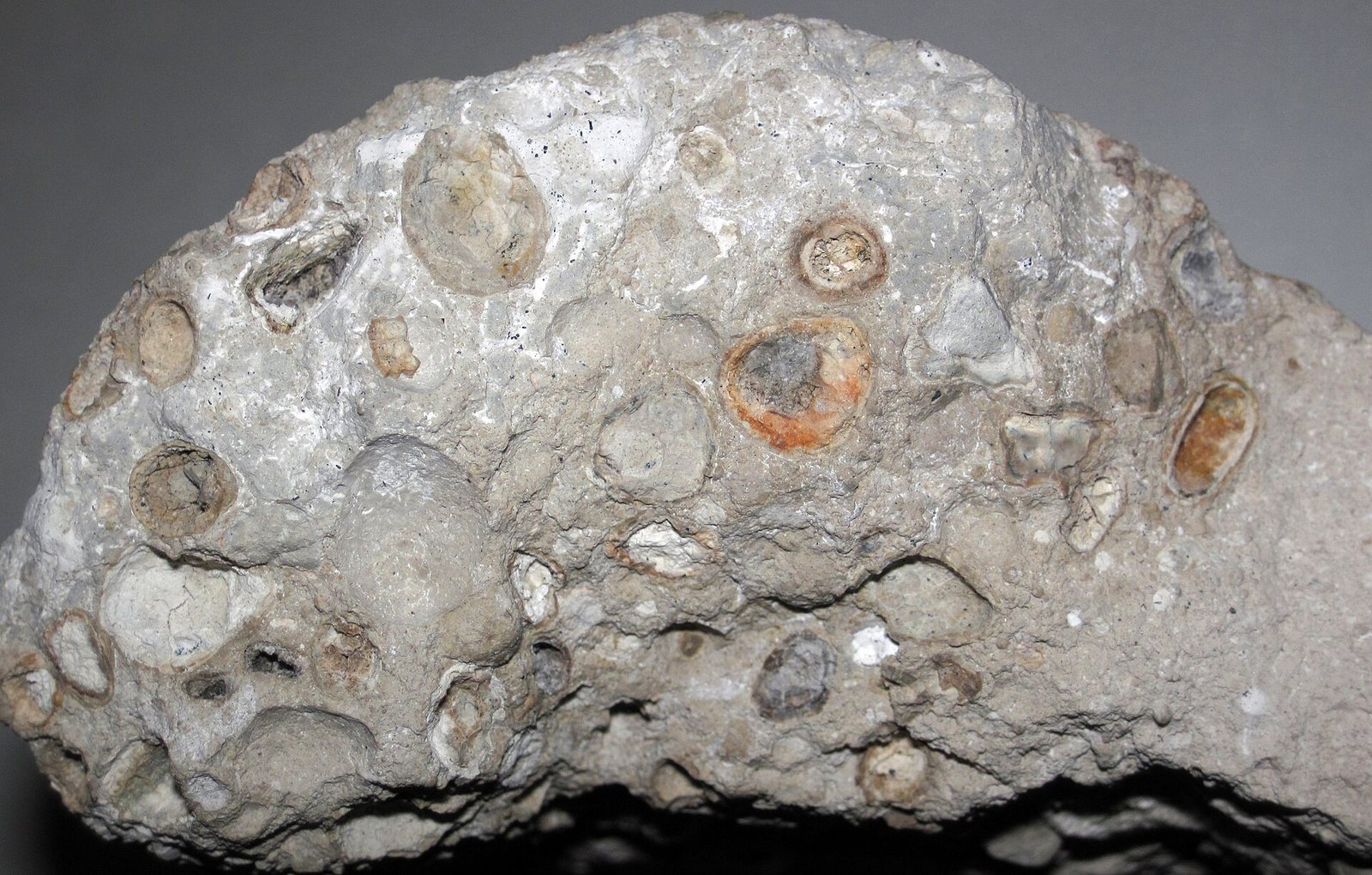
이것은 무엇인가?
A reddish soil-like rock, formed where tropical rain has rotted rock for millions of years, and the only ore aluminium is made from at scale.
왜 중요한가?
Roughly four to five tonnes of bauxite become two tonnes of alumina become one tonne of aluminium. The chain starts in a handful of tropical countries.
Where it is in the Earth
Bauxite is not a single mineral but a mixture of aluminium-bearing hydroxide minerals — principally gibbsite (Al(OH)₃) and boehmite (AlO(OH)) — along with iron oxides, clay minerals, and silica. The rock forms at the surface, not deep underground, through a process called laterisation. In tropical and subtropical climates where rainfall is heavy and the wet season long, slightly acidic rainwater percolates through rock and slowly dissolves away the more soluble elements — silicon, calcium, magnesium — leaving behind aluminium and iron, which are far less mobile in those chemical conditions. Over millions of years, this residual enrichment builds up a layered crust that geologists call a laterite profile. Bauxite is the aluminium-rich upper portion of that profile.
Because the process depends on climate and time, the world's largest deposits sit close to the equator or at latitudes that were tropical during earlier geological periods. Guinea, which holds 7,400,000 thousand metric dry tons of reserves — more than a quarter of the world total of 29,000,000 thousand metric dry tons — sits squarely in the West African humid tropics. Australia's large deposits in the Cape York Peninsula and the Darling Range formed on ancient, deeply weathered cratons that have been stable and wet for long enough to build up thick ore profiles. Vietnam and Indonesia hold substantial reserves for the same reasons. The underlying bedrock matters too: rocks rich in aluminium-bearing silicates, such as granites, syenites, or nepheline syenites, provide more raw material for the weathering process to work on, though bauxite can also form over basalt and other rock types given enough time and rainfall.
The resulting ore body is typically a broad, shallow blanket rather than a deep vein or pipe. Ore zones commonly sit only a few metres below a thin topsoil layer, extending over tens or even hundreds of square kilometres, but rarely reaching more than twenty or thirty metres in depth. This geometry determines almost everything about how bauxite is mined.
Getting it out
The shallow, blanket-like geometry of most bauxite deposits makes open-pit mining the standard approach. Strip mining, a variant where ore is removed in long successive strips across a wide area, is particularly common because the ore horizon is thin and the overburden — the material sitting above it — is relatively modest. Machinery scrapes away the topsoil, which is typically stockpiled separately for later rehabilitation, then removes any soft overburden before excavators and scrapers load the ore directly into trucks. Because bauxite is already soft and friable from the weathering process that created it, blasting is often unnecessary, which reduces both cost and disturbance compared with hard-rock mining.
The grade of bauxite ore is expressed primarily as the available alumina content, often written as available Al₂O₃, alongside a measure of reactive silica. Reactive silica matters because it consumes reagent during processing, so a high silica content raises costs even if aluminium content looks acceptable. The ratio of how much ore must be moved to produce a given unit of alumina at the refinery is therefore not simply a function of aluminium grade but also of silica penalty and moisture content. The data underpinning this page records bauxite on a dry-weight basis, which strips out the moisture that ore can carry in large quantities given its soil-like texture.
After mining, ore is typically crushed and screened at or near the mine, then transported — often by rail or slurry pipeline — to a port for shipment. Some integrated operations process the ore directly at a nearby refinery. The relatively low value per tonne of raw bauxite compared with alumina or aluminium means that freight costs loom large, and most trade moves on long-term contracts rather than through spot markets.
What pulls on it
Aluminium is the end destination for the great majority of bauxite mined, and so the demand picture for bauxite is largely the demand picture for aluminium, filtered back through the conversion ratios in the chain. A smaller but not trivial fraction of bauxite is used without conversion to metal: calcined bauxite finds use as a refractory material (able to withstand very high temperatures) in steelmaking furnaces and kilns, and as an abrasive. These non-metallurgical uses draw on different ore grades and mineralogy, but they remain secondary to the aluminium pathway.
Aluminium's breadth of use — in transport, construction, packaging, electrical conductors, and consumer goods — means that demand for bauxite tracks broad industrial and economic activity rather than any single end market. The transport sector, particularly automotive and aerospace, tends to favour aluminium where light weight is worth paying for. Packaging, especially beverage cans, represents a high-volume, relatively stable use. Construction uses vary considerably with building activity in different regions. The growth of electricity infrastructure, including power cables and, more recently, components related to renewable generation and grid expansion, has kept electrical applications steady or growing in many markets.
A sharp change in bauxite demand would require either a major shift in the rate at which aluminium is used, or a significant change in how much aluminium comes from primary production (new metal from ore) versus secondary production (recycled metal). Both transitions are slow. Aluminium-intensive structures last for years to decades before the metal returns to the recycling stream, so even a rapid expansion of recycling takes considerable time to reduce the call on primary ore. Demand would fall if a sustained economic contraction reduced construction and manufacturing output across multiple large economies simultaneously, or if a material substituting for aluminium across multiple end uses were to become cost-competitive at scale — neither of which can be assumed to happen quickly.
Turning ore into product 수준 3
The conversion of bauxite into aluminium happens in two distinct industrial steps, and understanding each is necessary to read the production chain correctly. The first step is the Bayer process, which turns bauxite into alumina (aluminium oxide, Al₂O₃). Crushed and ground bauxite is digested in a hot concentrated solution of sodium hydroxide under pressure. The hydroxide dissolves the aluminium minerals while leaving most impurities — iron oxides, titanium minerals, residual silicates — behind as a slurry called red mud, or more formally, bauxite residue. The aluminium-rich liquor is then cooled and seeded with fine alumina crystals, causing gibbsite to precipitate out of solution. That precipitate is filtered, washed, and calcined (roasted in a kiln) to drive off water and produce the white powder known as smelter-grade alumina. The Bayer process is well-suited to gibbsite-dominant ores because gibbsite dissolves readily at relatively moderate temperatures. Boehmite requires higher temperature and pressure to digest, which raises energy costs. This distinction is commercially significant because ore mineralogy varies by deposit, and refiners design their plant conditions — digestion temperature, caustic concentration, residence time — around their specific ore supply.
The silica content of the ore causes a particular problem at the digestion stage. Reactive silica combines with sodium hydroxide and alumina to form a solid compound called desilication product (DSP), which is insoluble and must be removed. More importantly, each unit of reactive silica that enters digestion consumes alumina and caustic soda, reducing yield and raising reagent costs. Refiners therefore pay close attention to the silica module of their ore, and ores with very high reactive silica may require pre-washing or blending with lower-silica material. The red mud residue produced by the Bayer process is voluminous — the ratio of residue to alumina produced depends on ore grade and composition — and its safe long-term disposal in lined storage impoundments is one of the major environmental and cost considerations for any refinery. Western Australia hosts some of the world's largest Bayer-process refinery capacity, reflecting the proximity of large, well-characterised ore deposits.
The second step, converting alumina to aluminium metal, is the Hall–Héroult electrolytic smelting process and falls outside the bauxite supply chain proper, though it is worth noting here that the smelting step is enormously electricity-intensive, which is why aluminium smelters are sited near cheap power rather than near ore or refineries. The two steps — Bayer refining and Hall–Héroult smelting — are often owned and operated by different companies in different countries, making the supply chain a series of distinct commercial handoffs rather than one integrated flow.
Substitution and recycling 수준 3
No other ore provides aluminium at anything approaching the scale of bauxite. Alunite, nepheline syenite, and coal fly ash all contain aluminium in chemical forms that can in principle be processed, and several countries without bauxite deposits have investigated these alternatives seriously. The barrier in each case is cost and process complexity: extracting alumina from silicate or sulfate minerals requires different chemistry, more reagent, more energy, or more processing steps than the Bayer process applied to good-quality bauxite. Until bauxite becomes either physically scarce or politically inaccessible at a level that drives prices well above their recent historical range — which the reserve base does not suggest is imminent — these alternatives remain uneconomic at scale.
Within the end uses of aluminium, substitution by other materials is a real and ongoing factor. Steel, plastics, composites, and magnesium alloys all compete with aluminium in transport applications, and the choice between them shifts as relative prices, fuel-efficiency regulations, and manufacturing costs change. In packaging, tinplate and glass retain positions that aluminium has not fully displaced. In electrical conductors, copper is preferred where space is constrained and conductivity per unit volume matters more than weight. However, none of these substitution pressures has historically reduced total aluminium demand in absolute terms; they have at most slowed growth in individual segments while other applications expanded.
Recycled aluminium — secondary metal produced by re-melting scrap — is the most significant functional substitute for primary aluminium, and it uses a small fraction of the energy required to smelt metal from ore. The constraint on recycling is the availability and purity of scrap. Much aluminium is in use in long-lived products, locked out of the recycling stream for years. Mixed alloy scrap is harder to separate and reprocess than single-alloy scrap, and some applications, such as packaging laminates, are practically very difficult to recycle efficiently. The result is that secondary production does reduce bauxite demand relative to what it would otherwise be, but has not displaced primary production, and the two streams continue to grow alongside each other.
Where the chain is fragile 수준 4
The geographic concentration of bauxite production and reserves is the most straightforward structural feature of the supply chain, and it warrants precise reading. Guinea alone holds 7,400,000 thousand metric dry tons of reserves out of a world total of 29,000,000 thousand metric dry tons, and produced 150,000 thousand metric dry tons in 2025 — the largest share of world output of 440,000 thousand metric dry tons. Australia at 97,000 and China at 87,000 thousand metric dry tons are the only other producers above 50,000 thousand metric dry tons. This means that a disruption to Guinean supply, whether from political instability, infrastructure failure, or export policy changes, would not be easily absorbed by rapid expansion elsewhere in the short term. Guinea's reserve dominance also means that the long-run trajectory of the supply chain runs increasingly through a single country's political and regulatory environment.
The processing bottleneck is at least as important as the mining geography. Bauxite exported as ore can only become alumina if refinery capacity exists to receive it, and alumina refinery capacity is itself geographically and commercially concentrated, with major clusters in Australia, China, and a handful of other locations. Indonesia's periodic export bans on unprocessed bauxite — intended to encourage domestic refinery development — illustrate how ore-exporting countries can use trade policy to reshape the chain, creating short-term supply dislocations for refiners dependent on that source. The U.S. position is instructive: net import reliance for bauxite and alumina exceeds 75 percent as of 2025 (estimated), with leading import sources including Jamaica, Turkey, Guyana, and Australia. This means the U.S. aluminium industry's access to feedstock depends on the continued openness of trade with multiple foreign suppliers and the absence of simultaneous disruptions across them.
Figures published for bauxite production and reserves by different agencies frequently diverge, and understanding why requires attention to definitions. Production figures may be reported as gross wet weight, dry weight, or alumina-equivalent, and the moisture content of bauxite can be substantial, so the choice of basis matters greatly in cross-country comparisons. Reserve estimates depend on the assumed cut-off grade and the silica specifications used by the compiling agency; a deposit that is economic at one price level or with one ore specification may not meet the threshold used by another reporting body. The data on this page is expressed on a metric dry ton basis, which removes moisture variability, but comparisons with figures from other sources should always check whether the same basis was used. Lead times for new bauxite mine development — from discovery through permitting, infrastructure construction, and ramp-up — are typically measured in years to over a decade, which means the current reserve and production picture is a slow-moving constraint rather than one that adjusts quickly to changes in demand or price.
암석 내 산출 위치
전체 광석 광물 →실제로 이를 함유하는 광물은 다음과 같다: bauxite. 광체(orebody)란 채굴 비용을 충당할 만큼 특정 광물이 충분히 농집된 광상을 말한다.
생산 주체
지도에서 보기 →Bauxite, mine production
Bauxite, mine productionthousand metric dry tons 2025 (추정치) 세계 합계 440,000 thousand metric dry tons
USGS Mineral Commodity Summaries 2026 · Gross weight of dry bauxite, not alumina or metal content. · 출처 ↗
나머지 열을 보려면 표를 옆으로 스크롤하십시오.
| 국가 | 생산 | 세계 비중 |
|---|---|---|
| Guinea | 150,000 | 34.1% |
| Australia | 97,000 | 22.0% |
| China | 87,000 | 19.8% |
| Brazil | 33,000 | 7.5% |
| India | 25,000 | 5.7% |
| Indonesia | 10,000 | 2.3% |
| Other countries | 8,000 | 1.8% |
| Jamaica | 6,200 | 1.4% |
| Saudi Arabia | 5,700 | 1.3% |
| Russia | 5,700 | 1.3% |
| Kazakhstan | 4,800 | 1.1% |
| Turkey | 3,800 | 0.9% |
| Vietnam | 3,800 | 0.9% |
| Greece | 960.0 | 0.2% |
| Ireland | Zero | — |
| United States | Withheld | — |
| Canada | Zero | — |
| Germany | Zero | — |
| Spain | Zero | — |
| United Arab Emirates | Zero | — |
| 세계 합계 | 440,000 | 100% |
'비공개'는 USGS가 개별 기업의 데이터 노출을 막기 위해 수치를 억제한 것으로, 0을 의미하지 않습니다. 출처가 각 수치를 독립적으로 반올림하고 '기타 국가' 항목을 항상 별도로 구분하지는 않기 때문에, 국가별 합계가 세계 합계와 일치하지 않을 수 있습니다.
매장량 보유 주체
Bauxite reserves
Bauxite reservesthousand metric dry tons 2025
USGS Mineral Commodity Summaries 2026 · 출처 ↗
| 국가 | 매장량 | 세계 비중 |
|---|---|---|
| Guinea | 7,400,000 | 25.5% |
| Other countries | 5,300,000 | 18.3% |
| Australia | 3,700,000 | 12.8% |
| Vietnam | 3,100,000 | 10.7% |
| Indonesia | 2,900,000 | 10.0% |
| Jamaica | 2,000,000 | 6.9% |
| Brazil | 1,700,000 | 5.9% |
| China | 710,000 | 2.4% |
| Russia | 650,000 | 2.2% |
| India | 650,000 | 2.2% |
| Saudi Arabia | 180,000 | 0.6% |
| Kazakhstan | 160,000 | 0.6% |
| Turkey | 69,000 | 0.2% |
| United States | 20,000 | 0.1% |
| Ireland | Zero | — |
| Canada | Zero | — |
| Germany | Zero | — |
| Greece | Zero | — |
| Spain | Zero | — |
| United Arab Emirates | Zero | — |
| 세계 합계 | 29,000,000 | 100% |
가격
average unit value of imports, free alongside ship (f.a.s.), dollars per metric ton
연간 평균dollars per metric ton
기준: average unit value of imports, free alongside ship (f.a.s.), dollars per metric ton. 다음 자료에 게재된 연간 평균 USGS Mineral Commodity Summaries 2026 · 출처 ↗. 이 수치는 기준 연간 평균값이며, 실시간 시장 가격이 아니다.
처리·정련 지점
| 시설 | 종류 | 단계 | 국가 | 역할 |
|---|---|---|---|---|
| Bayer-Process Alumina Refineries, Western Australia | 정련소 | 가공 | Australia | 투입물 |
| Port of Rotterdam Bulk Terminals | 항구 | 가공 | Netherlands | 투입물 |
수출 통제
| 국가 | 지배력 | 적용 대상 |
|---|---|---|
| Indonesia | Export ban | Bauxite (2023), copper concentrates (2023), and nickel ore (2020). ↗ |
| Venezuela | Export ban | Bauxite, cassiterite, columbite-tantalite, copper, gold, rhodium, silver, and thorium (2024). ↗ |
USGS Mineral Commodity Summaries 2026, table 4 — controls in effect as of January 2026, excluding controls since lifted.
국경을 따라 추적하기
모든 여정 →이 소재의 화물이 실제로 가는 곳 — 모든 나라, 모든 보관자, 그리고 각 단계에서 남는 것.
Guinean bauxite to an aluminium window frame Four tonnes of tropical soil, two tonnes of white powder, one tonne of metal — and the metal is made wherever the power is…