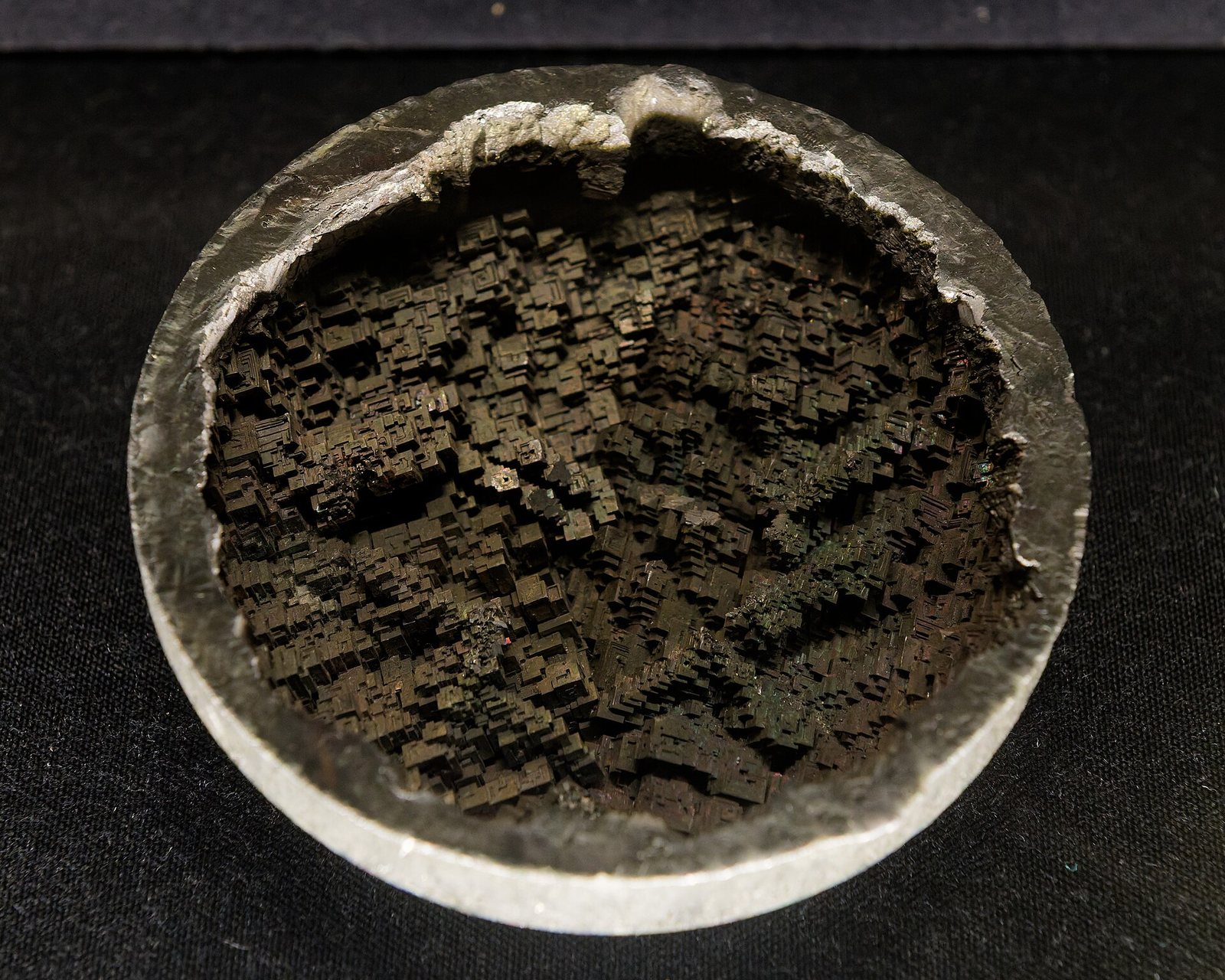
What is it?
A heavy metal that is, unusually, not very toxic — which is why it replaces lead in solders, plumbing brass and stomach medicine.
Why does it matter?
Bismuth demand grows every time a regulator restricts lead somewhere new.
Where it is in the Earth
Bismuth is a heavy metal — meaning it has a high atomic mass and correspondingly high density — that does not form large ore deposits of its own. Instead, it occurs as a minor constituent scattered through deposits that formed primarily around lead, copper, tin, tungsten and silver. The geological environments that concentrate it are hydrothermal veins: fractures in the crust through which hot, mineral-laden water once moved, depositing metals as it cooled. Bismuth sulfide minerals, most commonly bismuthinite, crystallise in these veins alongside galena (the main lead mineral) and various sulfosalts. At the temperatures and pressures where these veins form, bismuth behaves chemically like lead and arsenic, which is why the three tend to travel together.
Skarn deposits — zones where hot igneous fluids have reacted with carbonate rocks such as limestone — are another setting where bismuth concentrates. China's dominant position in world supply reflects the abundance of skarn and hydrothermal tin-tungsten systems in Hunan, Jiangxi and neighbouring provinces, where bismuth arrives as an incidental but recoverable companion to the target metals. Bolivia's Cerro Tasna and similar Andean deposits show a comparable association with silver-lead-tin mineralisation. The key point is that bismuth rarely justifies a mine on its own merits; a high local concentration of bismuth means very little unless the surrounding rock is already worth mining for something else.
Because bismuth does not form its own substantial ore bodies, the global reserve picture is correspondingly thin and imprecisely known. Most figures represent estimates of the bismuth content likely to be recovered as a by-product from known lead and copper reserves, not from dedicated bismuth ore. This matters when interpreting any reserve table: the numbers describe a dependent quantity, not a primary resource.
Getting it out
Bismuth is not mined in the way that iron or copper are mined — that is, by digging up ground specifically because it contains bismuth. With very few exceptions, the metal reaches refineries only because it was present in ore extracted for lead, copper, tin or tungsten. The mining method is therefore determined entirely by the host deposit. Polymetallic vein deposits are typically worked underground, using drilling and blasting to follow narrow, steeply dipping ore bodies. Skarn deposits at surface or shallow depth may be worked as open pits. In either case, the miners are making decisions based on the grade and geometry of the primary metal; bismuth content is noted and recovered if economics permit, but it does not drive the mine plan.
Grade, in this context, means the concentration of metal in the rock, usually expressed in grams per tonne. Because bismuth is a trace constituent of lead or copper ores, its grade is low and the ratio of waste rock moved to bismuth eventually recovered is very high. A tonne of refined bismuth metal may represent the processing of a very large quantity of ore, most of which was handled for the sake of another metal. This structure of production — where the economics are set by something else — defines essentially everything about bismuth supply, including why it is listed by several governments as a critical mineral despite the absence of any major dedicated bismuth mining operation.
What pulls on it
Bismuth is used in three broad areas: medicine, metallurgy and a collection of specialised industrial applications. The medical use is the oldest and most familiar — bismuth subsalicylate is the active ingredient in widely sold remedies for digestive complaints, and bismuth compounds appear in some treatments for gastric ulcers caused by the bacterium Helicobacter pylori. This demand is stable and relatively price-insensitive, since the quantity of bismuth per dose is small and the product sells on its therapeutic function rather than on material cost.
Metallurgical uses account for the largest and fastest-changing share of demand. Bismuth is added in small quantities to free-machining steels and brasses — alloys designed to be cut and shaped on automatic lathes — where it performs the same function as lead, improving the way the metal breaks into chips rather than tearing. This is one of the applications that has grown as regulations in the European Union, the United States and elsewhere have restricted or discouraged lead in plumbing fittings, electronics and other products. Bismuth-tin and bismuth-silver solders replace lead-tin solders in electronics assembly where lead is prohibited under directives such as the EU's RoHS legislation. The growth in these applications is directly tied to the pace of lead substitution, which is in turn driven by regulatory pressure rather than by any inherent cost or performance advantage of bismuth.
For demand to change sharply in either direction, a relatively small number of conditions would have to shift. A broad international tightening of lead restrictions would draw more bismuth into metallurgical uses. Conversely, if a substitute material became available at acceptable cost in any of the major applications — particularly free-machining alloys — that stream of demand could contract. The medical segment is unlikely to change quickly in either direction. The specialised uses, including certain catalysts, pigments and atomic research applications, are individually small enough that they do not drive the overall balance.
Who produces it
See it on a map →Refinery production
Refinery productionmetric tons 2025 (estimated) World total 16,000 metric tons
USGS Mineral Commodity Summaries 2026 · Refinery production; a by-product of lead and copper smelting. · source ↗
Scroll the table sideways for the remaining columns.
| Country | Production | Share of world |
|---|---|---|
| China | 14,000 | 87.5% |
| Korea, Republic of | 1,000 | 6.2% |
| Laos | 500.0 | 3.1% |
| Japan | 500.0 | 3.1% |
| Kazakhstan | 180.0 | 1.1% |
| Bolivia | 50.00 | 0.3% |
| Bulgaria | 50.00 | 0.3% |
| United States | Zero | — |
| World total | 16,000 | 100% |
“Withheld” means the USGS suppressed the figure to avoid disclosing an individual company's data — it does not mean zero. Country rows do not always sum to the world total because the source rounds each figure independently and does not always break out an “other countries” line.
Price
average, dollars per pound
Annual averagedollars per pound
Basis: average, dollars per pound. Annual averages as published in USGS Mineral Commodity Summaries 2026 · source ↗. These are reference annual averages, not a live market quote.
Export controls
| Country | Control | Applies to |
|---|---|---|
| China | Export licensing requirement for materials and technologies | Antimony (2024), bismuth (2025), synthesized diamond (2025), gallium (2023), germanium (2023), graphite (2023), indium (2025), magnesium materials (2024), molybdenum (2025), rare earths (2025), silver (2026), tellurium (2025), tungsten (2025), and items related to lithium batteries and artificial graphite anode materials (2025). ↗ |
USGS Mineral Commodity Summaries 2026, table 4 — controls in effect as of January 2026, excluding controls since lifted.