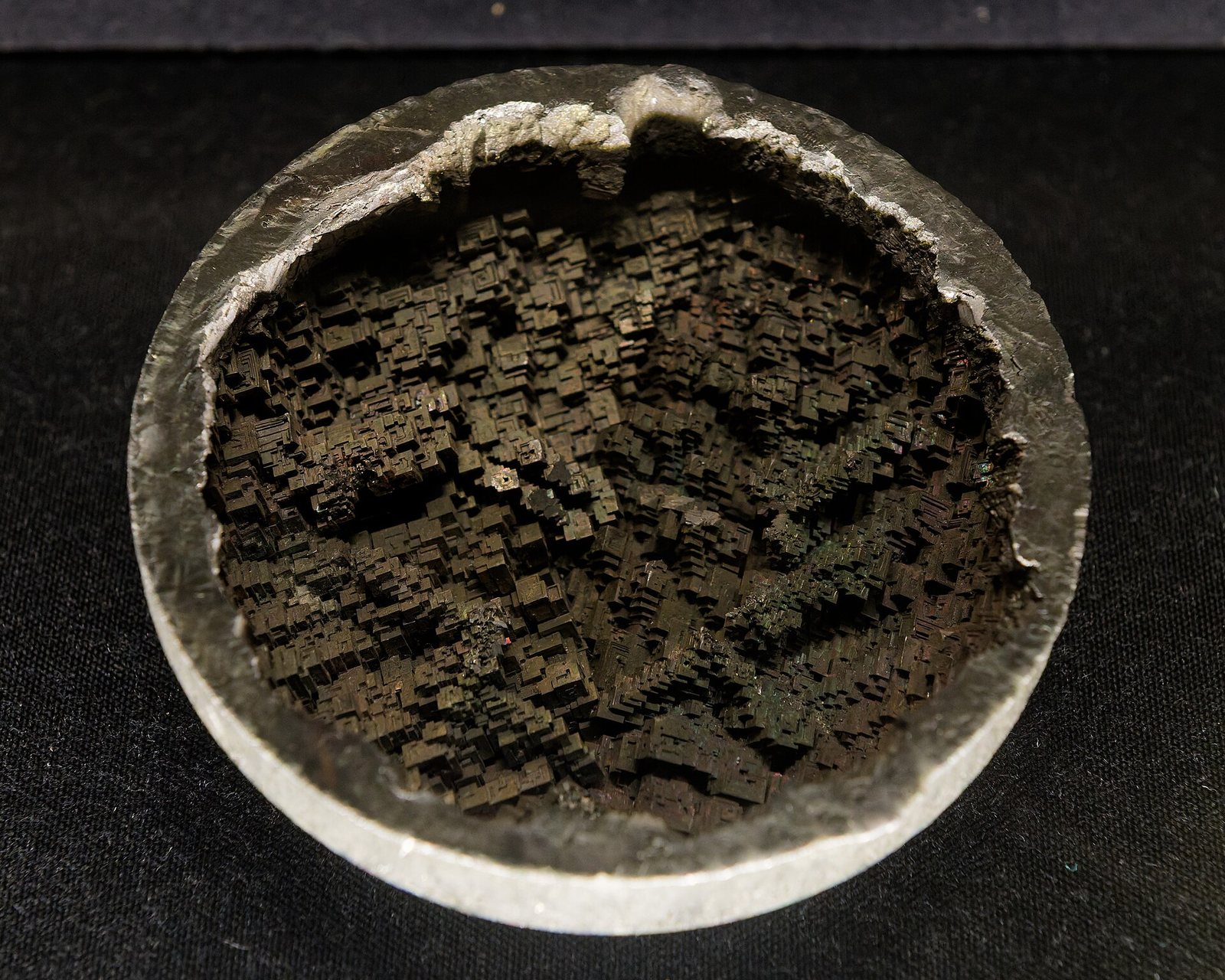
Bu nedir?
A heavy metal that is, unusually, not very toxic — which is why it replaces lead in solders, plumbing brass and stomach medicine.
Neden önemli?
Bismuth demand grows every time a regulator restricts lead somewhere new.
Where it is in the Earth
Bismuth is a heavy metal — meaning it has a high atomic mass and correspondingly high density — that does not form large ore deposits of its own. Instead, it occurs as a minor constituent scattered through deposits that formed primarily around lead, copper, tin, tungsten and silver. The geological environments that concentrate it are hydrothermal veins: fractures in the crust through which hot, mineral-laden water once moved, depositing metals as it cooled. Bismuth sulfide minerals, most commonly bismuthinite, crystallise in these veins alongside galena (the main lead mineral) and various sulfosalts. At the temperatures and pressures where these veins form, bismuth behaves chemically like lead and arsenic, which is why the three tend to travel together.
Skarn deposits — zones where hot igneous fluids have reacted with carbonate rocks such as limestone — are another setting where bismuth concentrates. China's dominant position in world supply reflects the abundance of skarn and hydrothermal tin-tungsten systems in Hunan, Jiangxi and neighbouring provinces, where bismuth arrives as an incidental but recoverable companion to the target metals. Bolivia's Cerro Tasna and similar Andean deposits show a comparable association with silver-lead-tin mineralisation. The key point is that bismuth rarely justifies a mine on its own merits; a high local concentration of bismuth means very little unless the surrounding rock is already worth mining for something else.
Because bismuth does not form its own substantial ore bodies, the global reserve picture is correspondingly thin and imprecisely known. Most figures represent estimates of the bismuth content likely to be recovered as a by-product from known lead and copper reserves, not from dedicated bismuth ore. This matters when interpreting any reserve table: the numbers describe a dependent quantity, not a primary resource.
Getting it out
Bismuth is not mined in the way that iron or copper are mined — that is, by digging up ground specifically because it contains bismuth. With very few exceptions, the metal reaches refineries only because it was present in ore extracted for lead, copper, tin or tungsten. The mining method is therefore determined entirely by the host deposit. Polymetallic vein deposits are typically worked underground, using drilling and blasting to follow narrow, steeply dipping ore bodies. Skarn deposits at surface or shallow depth may be worked as open pits. In either case, the miners are making decisions based on the grade and geometry of the primary metal; bismuth content is noted and recovered if economics permit, but it does not drive the mine plan.
Grade, in this context, means the concentration of metal in the rock, usually expressed in grams per tonne. Because bismuth is a trace constituent of lead or copper ores, its grade is low and the ratio of waste rock moved to bismuth eventually recovered is very high. A tonne of refined bismuth metal may represent the processing of a very large quantity of ore, most of which was handled for the sake of another metal. This structure of production — where the economics are set by something else — defines essentially everything about bismuth supply, including why it is listed by several governments as a critical mineral despite the absence of any major dedicated bismuth mining operation.
What pulls on it
Bismuth is used in three broad areas: medicine, metallurgy and a collection of specialised industrial applications. The medical use is the oldest and most familiar — bismuth subsalicylate is the active ingredient in widely sold remedies for digestive complaints, and bismuth compounds appear in some treatments for gastric ulcers caused by the bacterium Helicobacter pylori. This demand is stable and relatively price-insensitive, since the quantity of bismuth per dose is small and the product sells on its therapeutic function rather than on material cost.
Metallurgical uses account for the largest and fastest-changing share of demand. Bismuth is added in small quantities to free-machining steels and brasses — alloys designed to be cut and shaped on automatic lathes — where it performs the same function as lead, improving the way the metal breaks into chips rather than tearing. This is one of the applications that has grown as regulations in the European Union, the United States and elsewhere have restricted or discouraged lead in plumbing fittings, electronics and other products. Bismuth-tin and bismuth-silver solders replace lead-tin solders in electronics assembly where lead is prohibited under directives such as the EU's RoHS legislation. The growth in these applications is directly tied to the pace of lead substitution, which is in turn driven by regulatory pressure rather than by any inherent cost or performance advantage of bismuth.
For demand to change sharply in either direction, a relatively small number of conditions would have to shift. A broad international tightening of lead restrictions would draw more bismuth into metallurgical uses. Conversely, if a substitute material became available at acceptable cost in any of the major applications — particularly free-machining alloys — that stream of demand could contract. The medical segment is unlikely to change quickly in either direction. The specialised uses, including certain catalysts, pigments and atomic research applications, are individually small enough that they do not drive the overall balance.
Turning ore into product Seviye 3
The path from ore to refined bismuth runs through the smelter of whatever primary metal the ore was mined for. In lead smelting — the most common source — crushed and concentrated ore is smelted at high temperature to produce a crude lead bullion. Bismuth, because it is chemically similar to lead and also siderophilic (tending to associate with metallic rather than slag phases), concentrates into this bullion rather than reporting to the slag or off-gas. The bullion then undergoes pyrometallurgical refining, a sequence of controlled heating and chemical additions designed to remove impurities one at a time. Bismuth is selectively removed in a step called the Kroll-Betterton process, in which calcium and magnesium are added to the molten lead; these react preferentially with bismuth to form an intermetallic dross — a solid or semi-solid crust — that floats and is skimmed off. This dross is the bismuth-rich intermediate that feeds subsequent refining.
The bismuth dross is then processed separately, typically by oxidising smelting followed by reduction, to yield crude bismuth metal. Further electrolytic or pyrometallurgical refining removes residual lead, copper, silver and tellurium to reach commercial purity grades, which are commonly quoted as 99.99% or 99.999% (the latter called five-nines). Each refining step recovers only a fraction of the input, and losses accumulate across the flowsheet; overall recovery of bismuth from ore to refined metal is meaningfully lower than for the primary lead or copper. The cost of bismuth production is almost entirely absorbed by the lead or copper smelting operation, which means the marginal cost of producing more bismuth is low — but production cannot be increased independently, because it is constrained by the throughput of the host smelter and the bismuth grade of the feed.
Copper smelting offers a parallel route. Bismuth reporting to copper anodes is removed during electrolytic copper refining, accumulating in the anode slimes — the insoluble residue that falls from the dissolving copper anode. These slimes are rich in several minor metals including bismuth, selenium, tellurium and precious metals, and are processed in dedicated anode-slime circuits. The economics of recovery depend on the collective value of all the minor metals present, not on bismuth alone.
Substitution and recycling Seviye 3
The substitutes for bismuth depend entirely on which application is being considered. In free-machining brasses and steels, the alternatives include tin, selenium, tellurium and, in some cases, re-engineered alloys that rely on microstructural control rather than an additive to achieve machinability. Each involves a trade-off: selenium and tellurium improve machinability but introduce different toxicity concerns and come with their own supply constraints; tin is less effective at the same addition level. In lead-free solder, bismuth competes mainly with tin-silver-copper alloys, which have become the dominant choice in consumer electronics precisely because they do not rely on a minor by-product metal. Bismuth-containing solders offer lower melting points — useful in certain assemblies — but the field is fragmented and no single formulation has displaced the others broadly.
In medical applications, bismuth is harder to replace because its low systemic toxicity is the point. Alternatives exist for some indications, but regulatory approval of new drug formulations is slow and costly, which means incumbent bismuth compounds retain their position even when chemistry might suggest alternatives. This is a case where the barrier to substitution is institutional rather than technical.
Recycling of bismuth is limited. The metal is dispersed in small quantities across a wide variety of products — a fraction of a percent in an alloy, a small fraction of a tablet — and the infrastructure to collect and separate it at end of life does not exist at meaningful scale for most applications. Some recovery occurs within smelters that process bismuth-bearing scrap alloys, but this is secondary to the primary by-product stream. The fundamental constraint is that bismuth enters products in dilute form and leaves them in a state where recovery is not economic. This is structurally similar to other dispersive minor metals and is unlikely to change without either a significant price increase or a policy framework that requires collection.
Where the chain is fragile Seviye 4
The supply picture for bismuth concentrates risk in a way that is unusual even among critical minerals. The data show that China accounted for 14,000 of the 16,000 metric tonnes of refinery production recorded for 2025 — approximately 88% of world output, a figure confirmed in the U.S. statistics table. No other single country comes close; the next largest producers, the Republic of Korea and Japan, are themselves refining operations that process imported concentrates or by-product streams, not primary mining nations. This means that the geographic concentration of production is even higher than the refinery figures suggest, because much of what Korea and Japan refine originates in feed material derived from Chinese or other Asian mining operations.
The by-product character of bismuth production introduces a second layer of fragility that is distinct from geographic concentration. Because bismuth output is a function of lead and copper smelter throughput, it cannot respond to price signals in the way that a primary metal's production can. A rise in bismuth prices does not, by itself, cause more bismuth to be mined; it causes smelter operators to be more diligent about capturing bismuth already present in their feed, and may make some lower-grade dross processing economic, but the ceiling is set by the volume and composition of ore being processed for other reasons. The price data in the table show a substantial increase from 2024 to 2025, which is consistent with a market where supply cannot respond elastically, but this analysis should not be read as a price forecast.
Published production figures for bismuth carry significant uncertainty that researchers should account for. The unit basis noted in the database is refinery production, which sounds precise but conceals several difficulties. China does not disaggregate bismuth output in the same way that, say, copper cathode output is reported, and many estimates rely on trade statistics and industry surveys rather than primary regulatory disclosure. The absence of a U.S. production figure — withheld in the source data — reflects the standard practice of suppressing statistics when so few producers operate that disclosure would reveal individual company data. Reserve figures are not shown in the data block at all, which itself signals the thinness of formal reserve reporting: bismuth reserves are generally estimated as a fraction of lead and copper reserves rather than assessed through dedicated resource drilling. Reconciling figures from different national geological surveys and commodity analysts will therefore produce apparent disagreements that reflect differences in methodology and data access, not factual inconsistencies about the physical resource.
Kim üretiyor
Haritada gör →Refinery production
Refinery productionmetric tons 2025 (tahmini) Dünya toplamı 16,000 metric tons
USGS Mineral Commodity Summaries 2026 · Refinery production; a by-product of lead and copper smelting. · kaynak ↗
Kalan sütunlar için tabloyu yatay kaydırın.
| Ülke | Üretim | Dünya payı |
|---|---|---|
| China | 14,000 | 87.5% |
| Korea, Republic of | 1,000 | 6.2% |
| Laos | 500.0 | 3.1% |
| Japan | 500.0 | 3.1% |
| Kazakhstan | 180.0 | 1.1% |
| Bolivia | 50.00 | 0.3% |
| Bulgaria | 50.00 | 0.3% |
| United States | Zero | — |
| Dünya toplamı | 16,000 | 100% |
"Gizli tutulmuş", USGS'nin tek bir şirketin verisini ifşa etmekten kaçınmak amacıyla rakamı yayımlamadığı anlamına gelir; sıfır anlamına gelmez. Kaynak her rakamı bağımsız olarak yuvarladığı ve her zaman "diğer ülkeler" satırını ayrıştırmadığı için ülke satırları her zaman dünya toplamına eşit olmayabilir.
Fiyat
average, dollars per pound
Yıllık ortalamadollars per pound
Dayanak: average, dollars per pound. Şurada yayımlanan yıllık ortalamalar: USGS Mineral Commodity Summaries 2026 · kaynak ↗. Bunlar referans yıllık ortalamalar olup canlı piyasa fiyatı değildir.
İhracat kontrolleri
| Ülke | Kontrol | Uygulandığı kapsam |
|---|---|---|
| China | Export licensing requirement for materials and technologies | Antimony (2024), bismuth (2025), synthesized diamond (2025), gallium (2023), germanium (2023), graphite (2023), indium (2025), magnesium materials (2024), molybdenum (2025), rare earths (2025), silver (2026), tellurium (2025), tungsten (2025), and items related to lithium batteries and artificial graphite anode materials (2025). ↗ |
USGS Mineral Commodity Summaries 2026, table 4 — controls in effect as of January 2026, excluding controls since lifted.