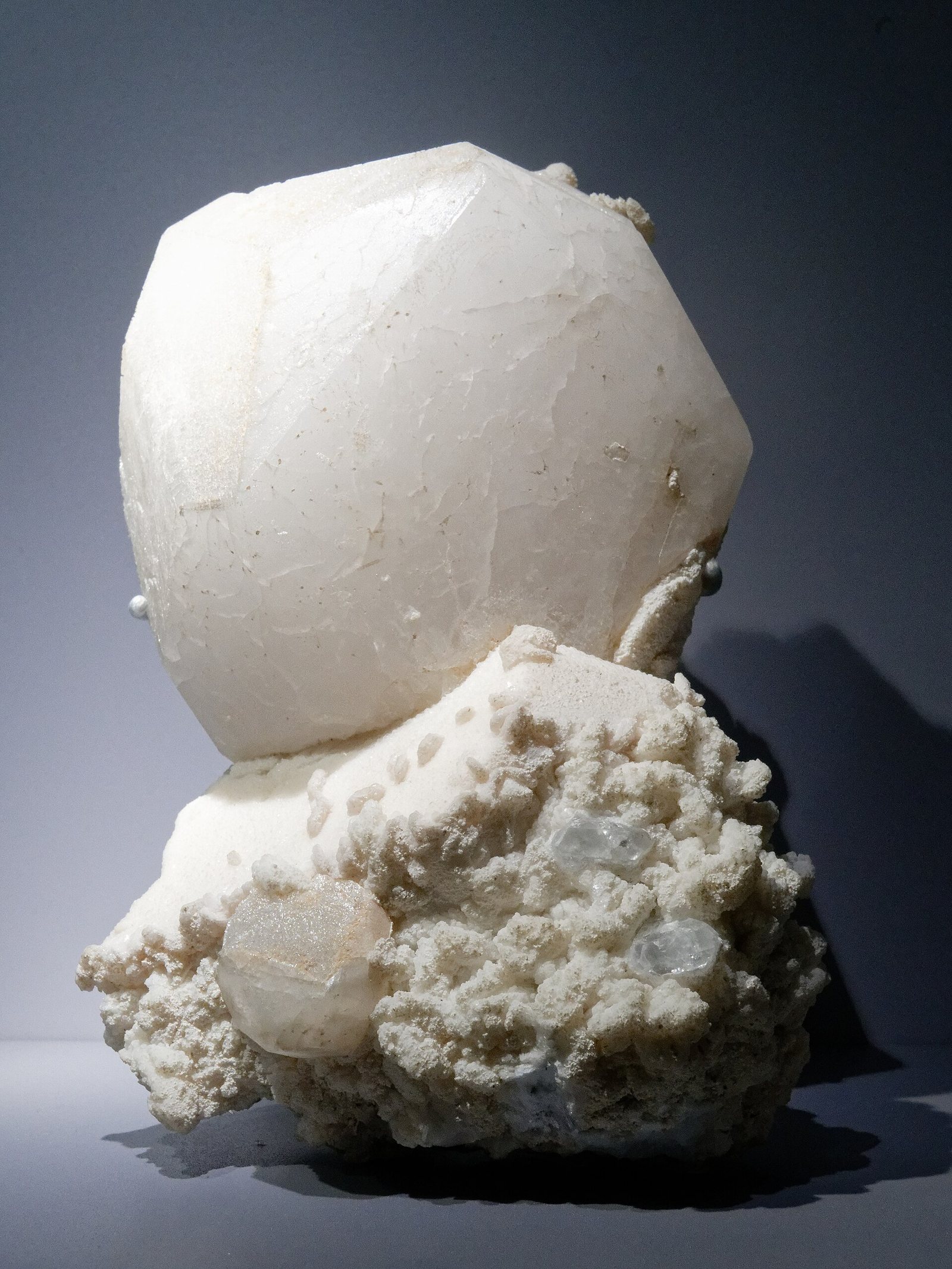
Che cos'è?
The softest metal, liquid on a warm day, and the element that defines the second.
Perché è importante?
The international definition of a second is a count of caesium-133 transitions, so GPS, financial timestamps and the internet's clocks all trace back to this element.
Where it is in the Earth
Caesium is one of the alkali metals, a family of elements that share a strong tendency to bond with other substances rather than sit alone in the ground. Because it is so reactive, caesium is never found as a free metal in nature; instead it is locked inside silicate minerals, most importantly one called pollucite. Pollucite belongs to a mineral group known as zeolites, which have an open, cage-like crystal structure capable of accommodating large atoms. Caesium, being an unusually large atom for a metal, fits neatly into those cages in a way that smaller elements cannot, and so it becomes trapped there as the mineral crystallises.
The rock bodies that contain economically meaningful concentrations of pollucite are called granitic pegmatites. A pegmatite is an igneous rock — one that solidified from molten material — but it cooled extraordinarily slowly and in the presence of water and other volatile compounds. This slow, wet crystallisation allows ions to migrate over long distances and accumulate, which is why pegmatites tend to concentrate elements that are otherwise dispersed too thinly to recover. Caesium, lithium, rubidium, tantalum and beryllium are all characteristic pegmatite passengers. The geological term for elements that tend to concentrate in the last, most evolved fraction of a cooling magma is incompatible, meaning that they do not fit easily into the common rock-forming minerals that crystallise first, and so they are progressively enriched in the remaining melt.
Only a very small number of pegmatite bodies worldwide have ever produced pollucite in quantities worth mining. The deposit type is rare not because caesium is vanishingly scarce in the Earth's crust — it is actually more abundant than several metals in everyday use — but because the particular combination of geological conditions needed to concentrate it into mineable pollucite seldom occurs. Known world reserves, as reported by the USGS, are estimated at less than 200,000 tons in total across all countries, a figure that underscores how tightly the supply base is geographically confined.
Getting it out
Because caesium occurs in hard-rock pegmatite bodies rather than in sedimentary layers or brines, the mining methods used are those suited to solid crystalline rock. Where a pollucite-bearing pegmatite is close to the surface and the overlying material is not too thick, open-pit mining — removing rock in a series of stepped benches cut downward from the surface — is practical. Where the orebody is deeper or the geometry favours it, underground methods are used instead, with tunnels driven to follow the pegmatite. In either case the objective is the same: selectively extract the pollucite-rich zones without diluting them excessively with barren host rock.
The concept of grade matters here. Grade refers to the concentration of the element of interest in the ore — the raw rock that is actually mined. In caesium's case the relevant figure is the proportion of pollucite in the pegmatite, and the caesium content of that pollucite. Higher-grade zones require less rock to be processed for the same output, which directly affects operating costs. Pollucite is visually distinctive enough — it tends to be pale, almost glassy — that experienced miners and geologists can identify it in the pit or tunnel face, allowing some degree of hand-sorting or selective blasting to separate richer material from waste.
One important practical feature of caesium mining is that it often occurs alongside, or as a consequence of, mining for lithium or tantalum from the same pegmatite. In those cases caesium is a by-product, meaning that the economics of extracting it depend partly on what the primary operation is doing. If the mine is running primarily for lithium, the decision to also process pollucite depends on whether the additional revenue justifies the additional handling. This by-product relationship means that caesium supply is not entirely independent: it is linked to decisions made in adjacent commodity markets.
What pulls on it
The two largest uses of caesium sit in quite different parts of the economy and pull on the material in different ways. Caesium formate is used as a drilling fluid in the oil and gas industry. A drilling fluid circulates down the borehole during drilling, carrying rock cuttings back to the surface and maintaining pressure in the well to prevent blowouts. The usefulness of caesium formate in this role comes from its exceptionally high density when dissolved in water: a very dense fluid can balance the pressures found in deep, high-temperature, high-pressure reservoirs without requiring the addition of solid particles that could damage the formation. Demand from this sector tracks activity in deep and ultra-deep oil and gas drilling, and caesium formate has the additional commercial advantage of being recoverable and recyclable at the wellsite, so the same fluid can be reused across multiple jobs.
Caesium metal and its compounds serve a much smaller but technically exacting market in atomic timekeeping. An atomic clock works by counting the frequency of a specific quantum transition — a jump between two energy states — in caesium-133 atoms. That transition has a defined frequency, and it is this definition that makes caesium the basis for the international standard of time, the second. The clocks themselves are used in GPS satellites and ground receivers, in telecommunications infrastructure where timing accuracy prevents data collisions, and in scientific metrology. The quantities of caesium involved per clock are small, but the applications are ones where no acceptable substitute currently exists at the required performance level.
A change in demand would require either a significant shift in drilling activity, particularly for the deep wells where caesium formate is most cost-effective, or a technological transition in atomic timekeeping. Research into optical atomic clocks based on other elements — strontium, ytterbium and others — is active, and these newer designs can outperform caesium clocks in precision. Whether and when they displace caesium in operational infrastructure depends on cost, regulatory redefinition of the second, and the pace at which network operators replace existing equipment, none of which is imminent at the time of writing.
Turning ore into product Livello 3
Once pollucite has been separated from waste rock, the path to a usable caesium product involves dissolving the mineral and then isolating caesium from the other elements present. The mineral is first crushed and ground — a stage called comminution — to increase the surface area available for chemical attack. It is then leached, meaning treated with an acid or other reagent that breaks down the crystal structure and releases caesium ions into solution. Sulfuric acid is one reagent used for this purpose. The resulting solution contains not only caesium but also rubidium, aluminium, silicon and other species that must be separated out.
Separation is achieved through a sequence of precipitation, ion-exchange and solvent-extraction steps, each designed to remove specific impurities or to selectively concentrate caesium. Ion exchange uses a resin that preferentially binds caesium ions, allowing them to be stripped off later in a purer solution. Solvent extraction passes the aqueous solution against an organic solvent that selectively carries caesium across the phase boundary. Each step introduces a potential loss: no separation is perfectly efficient, and caesium that goes with the wrong stream at any stage is either lost to tailings or requires additional processing to recover. The cumulative effect of these losses means that the overall recovery rate — the fraction of caesium in the feed that ends up in the final product — is a significant determinant of unit cost.
The two principal commercial forms in which caesium reaches end users reflect quite different processing endpoints. Caesium formate, a salt dissolved in water to make a dense drilling fluid, requires processing to a moderately high purity but does not need the final reduction to metal. Caesium metal itself, used in atomic clock tubes and certain specialist applications, requires an additional reduction step — typically reacting a caesium compound with a reactive metal at elevated temperature under vacuum — to strip away the last chemically bound oxygen or halide and yield the free element. Metal-grade production demands very high purity, and the purification steps needed to achieve it are correspondingly demanding and costly.
Substitution and recycling Livello 3
In drilling fluids, the alternatives to caesium formate are other high-density brines — notably those based on zinc bromide or calcium bromide — and weighted muds that use finely ground solid minerals such as barite to increase density. Each alternative involves trade-offs. Bromide-based fluids can be corrosive and raise environmental handling concerns. Solid-weighted muds can cause formation damage in the sensitive reservoir rocks where caesium formate is typically preferred. Caesium formate is also unusual in being genuinely recoverable: the fluid is collected after use, cleaned, and returned to circulation, which improves its economics over a project's life and reduces the net demand for virgin caesium. This closed-loop characteristic makes substitution less straightforward than it might appear, because the comparison must account for the ongoing cost of replacement fluid as well as the initial cost.
In atomic clocks, substitution means replacing the caesium-133 transition with a different physical reference. As noted above, optical clocks using strontium or ytterbium already achieve higher precision in laboratory settings. However, the infrastructure of GPS, telecommunications and scientific timekeeping is built around caesium-referenced standards, and migrating that infrastructure requires coordinated international agreement as well as hardware replacement across large installed bases. The practical barrier to substitution is therefore not primarily technical but institutional and logistical. Recycling of caesium from spent atomic clock tubes does occur at a small scale, but the quantities of metal in each device are modest, the devices have long operational lives, and the collection infrastructure is limited, so recycling contributes little to primary supply at present.
Where the chain is fragile Livello 4
The supply picture for caesium is unusual even by the standards of critical minerals because production figures are not publicly reported. The USGS and equivalent agencies in other countries do not publish annual output data, which means that the statistical foundation normally used to assess supply concentration — market share by producer, reserve-to-production ratio, import dependence — is largely absent for this element. The U.S. net import reliance is reported as 100 percent, meaning the United States produces no caesium domestically and relies entirely on imports, with China and Germany identified as the leading sources for the period 2021 to 2024. That Germany appears as a source reflects its role as a processor and re-exporter rather than a mine-producing country, a distinction that matters when tracing where physical control over supply actually sits.
The geological concentration of minable pollucite in very few deposits, combined with the by-product relationship with lithium and tantalum mining at some of those deposits, creates a supply chain with limited redundancy. If the primary operation at a hosting mine curtails or closes for reasons unrelated to caesium — commodity price movements for lithium, regulatory events, infrastructure problems — caesium output at that site is affected regardless of caesium market conditions. This coupling of caesium supply to the economics of other minerals is a structural fragility that is not easily addressed without developing additional primary pollucite sources, which requires lead times measured in years from discovery through permitting, feasibility and construction.
A further source of uncertainty lies in the recovery and reuse loop for caesium formate. Because the fluid is recirculated, the relationship between the stock of fluid in service and the flow of new caesium into the market is non-linear and sensitive to how well operators manage recovery. A period of intensive new drilling could draw down inventories of recirculated fluid and increase demand for virgin caesium more sharply than activity levels alone would suggest. Conversely, improved recovery practices reduce replacement demand. Neither the size of the fluid inventory in circulation nor the average recovery rate is publicly reported, so the demand side of the caesium market carries its own layer of opacity to match that on the supply side.
Chi detiene le riserve
Australia, Canada, China, and Namibia were estimated to have reserves totaling less than 200,000 tons
Australia, Canada, China, and Namibia were estimated to have reserves totaling less than 200,000 tonstons 2025
USGS Mineral Commodity Summaries 2026 · fonte ↗
| Paese | Riserve | Quota mondiale |
|---|---|---|
| Other countries | <200,000 | — |