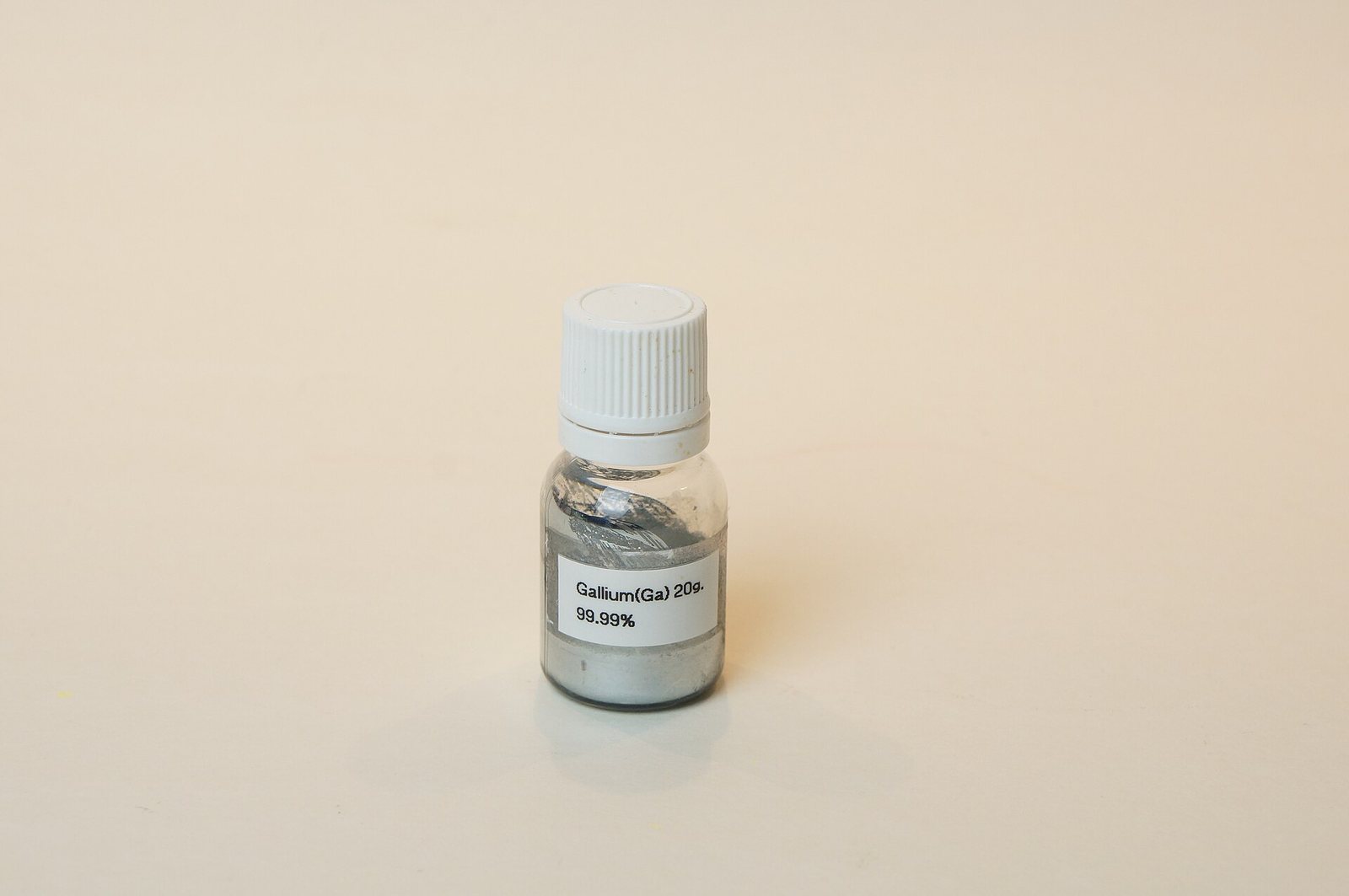
Was ist das?
A silvery metal that melts in your hand, and the basis of the compound semiconductors in fast chargers, radar and LEDs.
Warum ist das wichtig?
Gallium nitride switches far faster than silicon, which is why it appears in phone chargers, 5G base stations, radar and satellite power systems.
Where it is in the Earth
Gallium is not a mineral in its own right. Unlike copper or gold, which form discrete ore minerals that can be selectively concentrated, gallium exists only as a trace impurity lodged inside the crystal structures of other minerals. The two host minerals that matter commercially are gibbsite and boehmite — the aluminium hydroxide and oxyhydroxide minerals that make up bauxite — and sphalerite, the zinc sulfide mineral that is the world's principal source of zinc. In both cases, gallium atoms substitute for aluminium or zinc atoms in the crystal lattice because their ionic radii are similar enough to allow the substitution. The concentrations involved are minute: gallium in bauxite is typically measured in parts per million relative to the aluminium present.
Bauxite forms in tropical and subtropical climates through a process called laterisation. When aluminium-bearing rocks are subjected to intense weathering over long periods, silica and most other elements are progressively leached away, leaving a residue enriched in aluminium hydroxide minerals. Because gallium behaves geochemically similarly to aluminium, it concentrates alongside aluminium during this weathering. The result is that wherever thick, high-aluminium bauxite deposits formed — across West Africa, Australia, the Caribbean and parts of South-East Asia — gallium is also present, albeit at trace levels. The same laterisation process that creates commercial bauxite is therefore the same process that creates any future gallium resource, even though gallium was never the target.
Sphalerite deposits, by contrast, form in entirely different geological settings: hydrothermal veins and sediment-hosted massive sulfide bodies, where metal-bearing fluids circulated through the crust and deposited zinc, lead and iron sulfides. Gallium follows zinc into sphalerite for the same substitution reasons, and some zinc districts carry appreciably higher gallium concentrations than others, though the variation is poorly characterised in public literature. The global distribution of gallium therefore mirrors the combined geography of bauxite and zinc deposits, but the amount recoverable depends on what happens in the processing plant, not in the mine.
Getting it out
Because gallium has no mine of its own, the question of how it is mined has no direct answer. The bauxite that carries most of the world's gallium is extracted by open-pit mining: the thin topsoil and clay overburden above the bauxite horizon is stripped away, the ore is dug out with excavators and shovels, and it is trucked or conveyor-belted to a crushing facility. The operations are large and relatively shallow. The gallium content of the bauxite is not a factor in the mining decision at all — the mine exists for aluminium, and gallium comes along for the ride.
What this means in practice is that the quantity of gallium potentially available to the world is enormous, dwarfing what is actually recovered. Every tonne of bauxite processed through an alumina refinery contains some gallium, but that gallium is only captured if the refinery is equipped to extract it and the economics make doing so worthwhile. Most refineries, historically, have not bothered. The same logic applies to zinc smelters processing sphalerite concentrates: gallium is present in the feed material, but recovering it requires additional processing steps that most smelters do not operate. The effective grade of gallium as a recoverable product is therefore determined more by refinery configuration and operating decisions than by the geological grade of the host ore.
There is no waste-rock calculation for gallium in the way there would be for a primary metal mine. The host ore — bauxite or zinc sulfide — is moved and processed regardless. Gallium recovery is an incremental activity layered on top of an existing industrial process, which is both its economic advantage and the source of its structural vulnerability.
What pulls on it
The applications that consume gallium all depend on the same underlying property: gallium forms compound semiconductors — most importantly gallium arsenide (GaAs) and gallium nitride (GaN) — with electronic and optical characteristics that silicon cannot replicate. Silicon remains the dominant material for general-purpose computing, but it struggles at high frequencies, high temperatures and at the wavelengths used in light emission. Gallium-based compounds handle all three better. GaN transistors switch far faster and at higher voltages than silicon equivalents, which is why GaN has become the material of choice for power conversion in compact chargers, for the amplifiers inside 5G base stations and for the transmit-receive modules in radar systems. GaAs remains important for radio-frequency front-end components in mobile handsets and for solar cells used in space, where its high efficiency per unit area justifies the cost premium over silicon.
The end markets listed for gallium span a wide range, but they share a common thread: they are all situations where the performance gap between gallium compounds and silicon justifies the higher material cost. LEDs and laser diodes rely on gallium compounds for light emission — silicon does not emit light efficiently because of the way its electronic band structure is arranged. CIGS thin-film solar cells use gallium as a dopant to tune the semiconductor's light-absorption characteristics. As power electronics migrate toward higher frequencies and higher power densities — driven by electrification, data centre efficiency requirements and defence electronics — the applications pulling on gallium tend to grow rather than shrink.
A sharp change in demand would most plausibly come from one of two directions. The first is a faster-than-expected adoption of GaN in power electronics and 5G infrastructure, pulling demand up. The second is a technological shift that reduces the gallium content per device — as has happened historically when manufacturers found ways to thin wafers or recover and reuse kerf losses from wafer slicing. The defence and radar segment is relatively insensitive to material cost and would be among the last to substitute away. Consumer electronics are more price-sensitive but have few practical alternatives at the frequencies involved.
Turning ore into product Ebene 3
The recovery of primary gallium begins inside the Bayer process, the standard industrial method for refining bauxite into alumina (aluminium oxide) ahead of smelting. In the Bayer process, crushed bauxite is digested in hot concentrated sodium hydroxide solution, which dissolves the aluminium hydroxide minerals into a sodium aluminate liquor. Gallium, being chemically similar to aluminium, dissolves alongside it. The undissolved residue — red mud — is separated, and the aluminate liquor is seeded to precipitate aluminium hydroxide crystals, which are then calcined to produce alumina. Over repeated cycles of digestion and precipitation, gallium accumulates in the circulating Bayer liquor because it does not precipitate as readily as aluminium. This concentration effect in the liquor is what makes recovery feasible: the gallium is, in effect, pre-concentrated by the normal operation of the alumina plant.
Once gallium has built up to a sufficient level in the Bayer liquor, it is extracted by one of several routes: solvent extraction, ion exchange, or electrochemical deposition. The output is crude gallium, often described as low-grade metal, which is then further refined to higher purity grades. Electronics applications — particularly compound semiconductors — require exceptionally pure material. The semiconductor industry works with gallium expressed as a number of nines: 6N means 99.9999 percent pure, 7N means 99.99999 percent. Achieving these grades requires multiple passes through zone refining or other purification steps, each of which adds cost and removes small quantities of material as impurity-bearing waste. The losses at each step accumulate, so the yield from Bayer liquor to finished 6N or 7N gallium is a fraction of the gallium that entered the refinery in the bauxite. Recovery from zinc processing follows a different route — gallium is typically captured in the leach solutions and flue dusts of zinc hydrometallurgy — but the principle of accumulation and selective extraction is the same.
The cost structure of primary gallium is therefore unusual. The mining and ore-processing costs are borne by the aluminium or zinc business; the gallium producer's direct costs are the extraction and refining steps applied to liquor or residue streams that would exist regardless. This means gallium production can be expanded or curtailed in response to gallium prices without affecting the host refinery's operation, but it also means that a refinery owner who judges gallium recovery uneconomic will simply discharge the gallium into tailings. The decision about how much gallium to capture is made separately from — and often indifferently to — the decisions made by the semiconductor industry that ultimately depends on it.
Substitution and recycling Ebene 3
Substitution for gallium in compound semiconductors is technically possible in some applications and essentially impractical in others. Silicon carbide (SiC) competes with GaN in power electronics, particularly at the highest voltages, and both materials are advancing simultaneously. In the radio-frequency domain, indium phosphide offers performance advantages over GaAs at millimetre-wave frequencies, and silicon-on-insulator technologies have displaced GaAs in some lower-frequency mobile handset applications where the cost difference was decisive. Each substitution carries a performance trade-off: the replacement material either operates less efficiently, requires more die area, generates more heat, or is itself a critical or constrained material. Indium, for instance, is no less supply-constrained than gallium, and SiC depends on a separate supply chain with its own concentration risks.
Recycling of gallium is technically achievable but commercially limited. The largest recoverable stream is the kerf — the material lost when semiconductor wafers are cut from ingots by wire saws — together with rejected or off-specification wafers and epitaxial growth waste. Some of this is collected and reprocessed, particularly in Japan and Germany, where wafer manufacturers have established internal recycling loops. However, once gallium has been incorporated into a finished device — a packaged LED, a radar module, a phone charger — recovery becomes extremely difficult. The gallium content per device is small, the devices are encapsulated in plastics and ceramics, and the collection infrastructure for consumer electronics is not designed to segregate gallium-bearing components at the level required for economic recovery. The recycling rate for gallium from end-of-life products is, by general understanding in the literature, very low. The principal constraint is not the chemistry of recovery but the economics of collection: the gallium in any individual device is worth very little, and the sorting required to accumulate meaningful quantities is costly relative to the value recovered.
Wo es im Gestein vorkommt
Alle Erzminerale →Dies sind die Mineralien, die tatsächlich gallium. Eine Lagerstätte ist nur dann ein Erzkörper, wenn eines der Minerale ausreichend konzentriert ist, um den Abbau wirtschaftlich zu rechtfertigen.
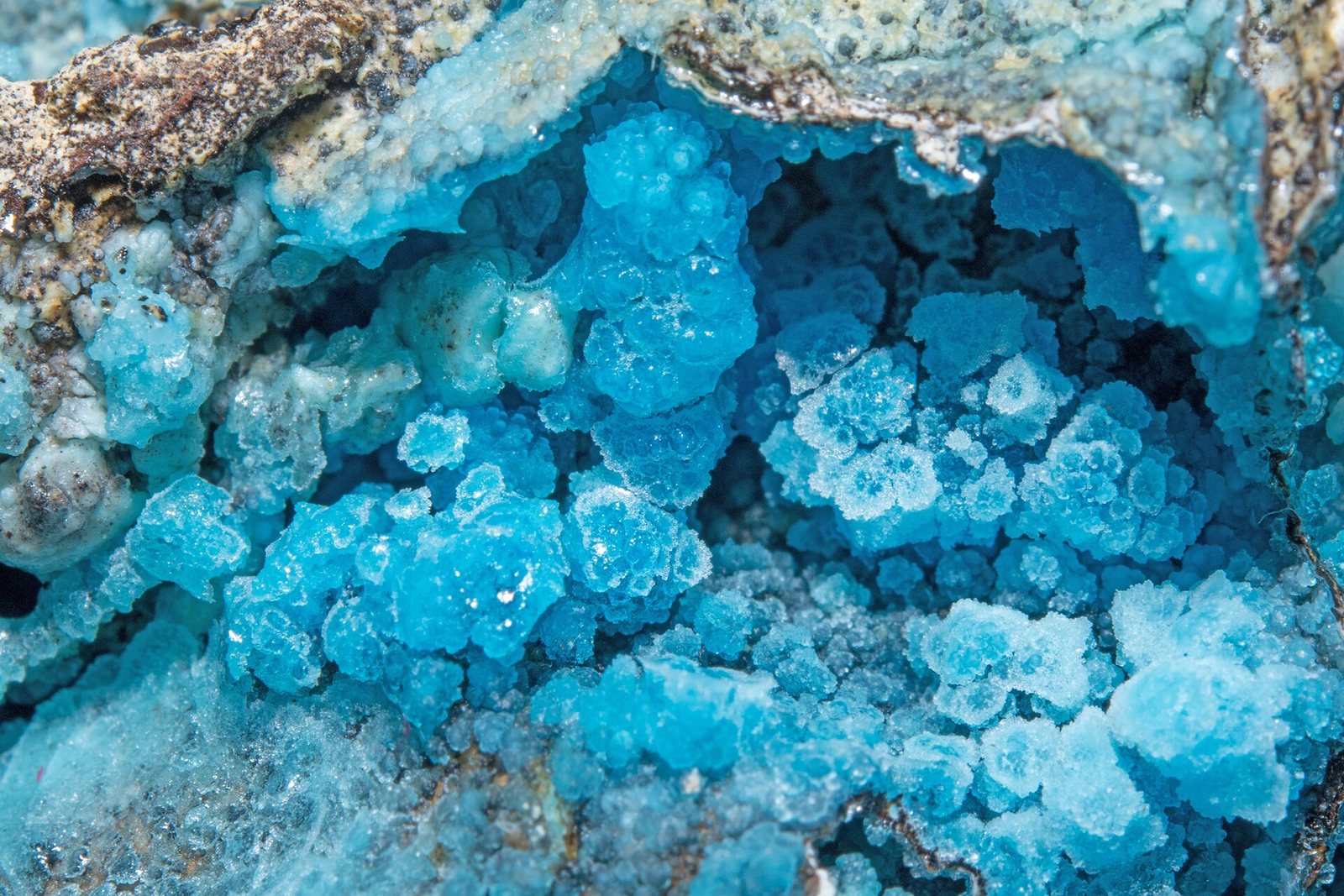
Bauxite (gibbsite/boehmite)
Not one mineral but a rock of aluminium hydroxides left after millions of years of tropical weathering.
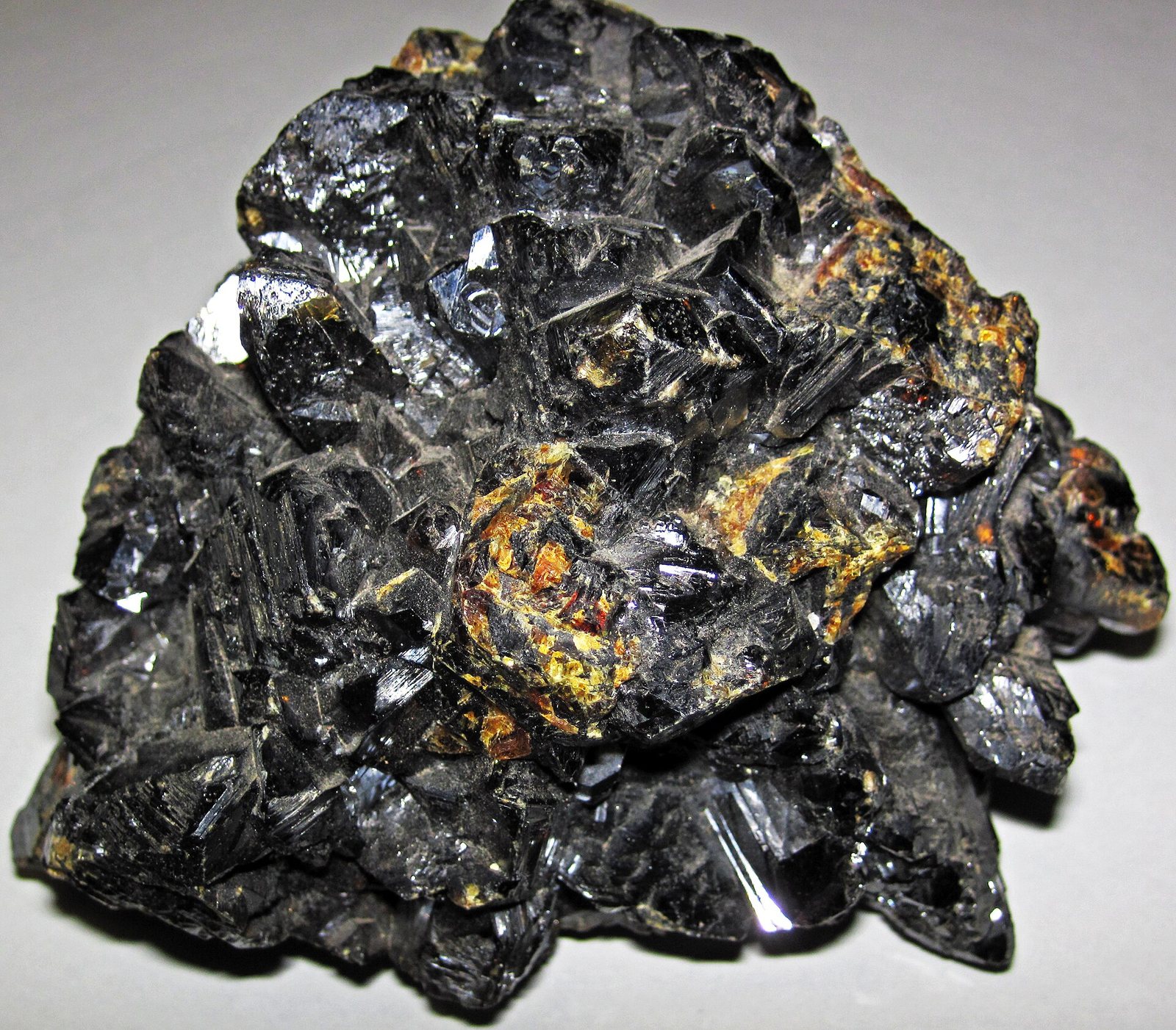
Sphalerite
The main zinc ore, and the world's main source of indium, germanium and gallium as trace substitutions in its lattice.
Wer es produziert
Auf einer Karte anzeigen →Primary production
Primary productionkilograms 2025 (geschätzt) Weltgesamt 900,000 kilograms
USGS Mineral Commodity Summaries 2026 · Primary low-grade gallium production; recovered as a by-product of alumina refining and zinc processing. · Quelle ↗
Tabelle seitwärts scrollen, um die restlichen Spalten zu sehen.
| Land | Produktion | Anteil an der Weltproduktion |
|---|---|---|
| China | 900,000 | 100.0% |
| Russia | 6,000 | 0.7% |
| Japan | 3,000 | 0.3% |
| Other countries | Zero | — |
| United States | Zero | — |
| Weltgesamt | 900,000 | 100% |
„Withheld" bedeutet, dass der USGS den Wert zurückgehalten hat, um keine Rückschlüsse auf Daten einzelner Unternehmen zuzulassen – er bedeutet nicht null. Die Länderwerte addieren sich nicht immer zum Weltgesamt, weil die Quelle jeden Einzelwert unabhängig rundet und eine Zeile „sonstige Länder" nicht immer ausweist.
Preis
average unit value of imports, dollars per kilogram
Jahresdurchschnittdollars per kilogram
Grundlage: average unit value of imports, dollars per kilogram. Jahresdurchschnitte gemäß Veröffentlichung in USGS Mineral Commodity Summaries 2026 · Quelle ↗. Dies sind jährliche Referenzdurchschnittswerte, kein Live-Marktpreis.
Wo es aufbereitet und raffiniert wird
| Anlage | Art | Stufe | Land | Rolle |
|---|---|---|---|---|
| Bayer-Process Alumina Refineries, Western Australia | Raffinerie | Aufbereitung | Australia | Ausgabe |
Wofür es verwendet wird
Alle Endmärkte →| Endmarkt | Was es dort tut | Bedeutung |
|---|---|---|
| Aerospace & Defence | Radar transmit-receive modules | Definition |
| Semiconductors | Compound semiconductors for RF and power | Definition |
| Data Centres & AI | High-efficiency power conversion | Wichtig |
| Consumer Electronics | LED backlighting and RF front end | Wichtig |
| Robotics & Automation | Efficient motor drive electronics | Wichtig |
| Solar Power | CIGS thin film and cell doping | Gegenwart |
Wie viel eine Technologie davon benötigt
| Technologie | Menge | Angegeben | Grundlage |
|---|---|---|---|
| Gallium Nitride Power Device Grams; the constraint is refining capacity, not tonnage. | Spur | per device | Substrate and epitaxial layer |
Indicative range compiled from published technology studies and chemistry; verify against a manufacturer specification before use. Diese Zahlen mit beliebiger Skalierung im Materialrechner ausführen →
Exportkontrollen
| Land | Kontrolle | Gilt für |
|---|---|---|
| China | Export licensing requirement for materials and technologies | Antimony (2024), bismuth (2025), synthesized diamond (2025), gallium (2023), germanium (2023), graphite (2023), indium (2025), magnesium materials (2024), molybdenum (2025), rare earths (2025), silver (2026), tellurium (2025), tungsten (2025), and items related to lithium batteries and artificial graphite anode materials (2025). ↗ |
USGS Mineral Commodity Summaries 2026, table 4 — controls in effect as of January 2026, excluding controls since lifted.