What is it?
The element the very first transistors were made from, now used mainly for infrared lenses and fibre-optic glass.
Why does it matter?
Night-vision and thermal-imaging optics are made of germanium because it is transparent to the infrared light warm objects emit.
Where it is in the Earth
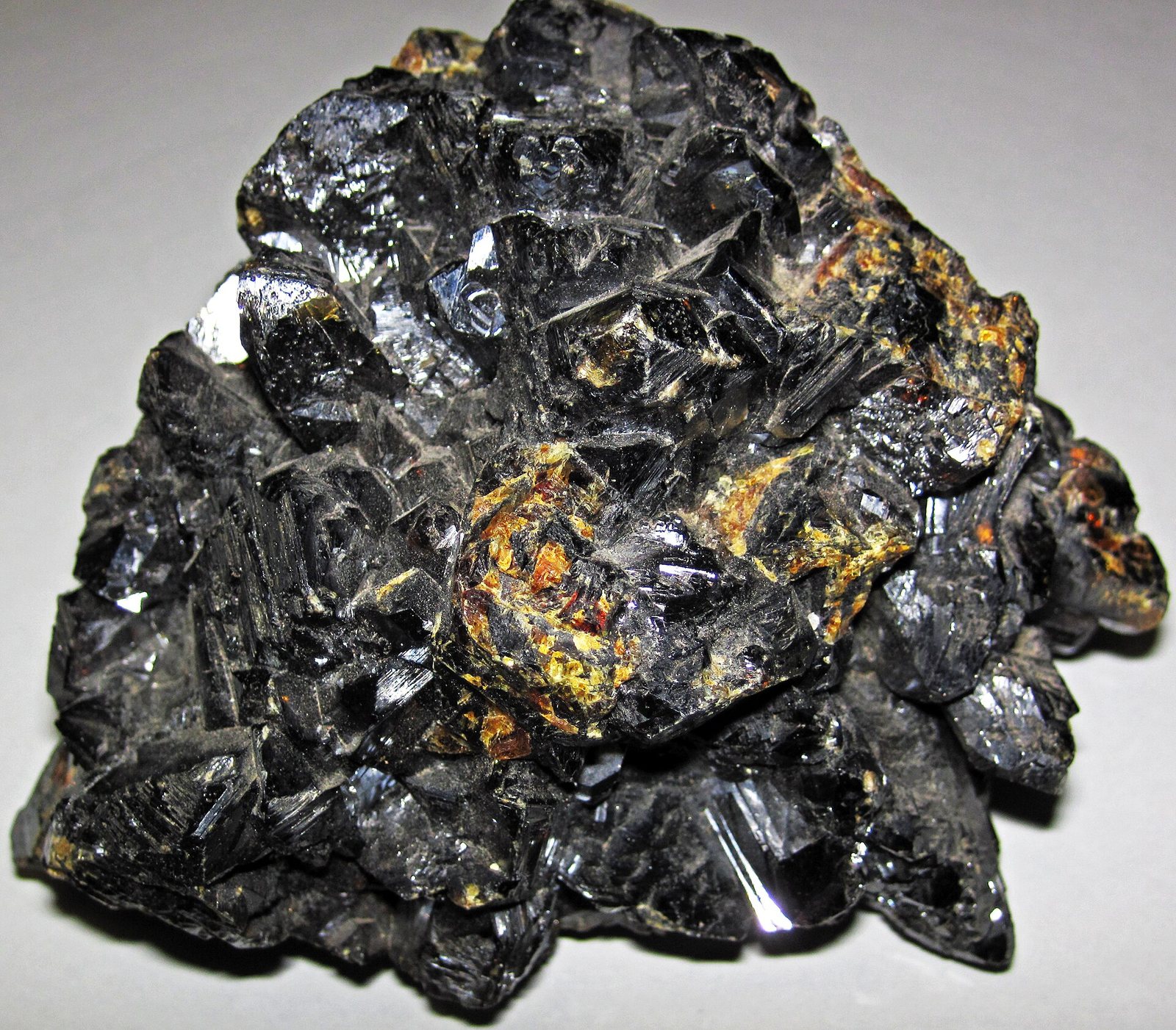
Germanium is not found in nature as a concentrated ore in its own right. Instead it appears as a trace impurity scattered through other minerals, most commonly sphalerite, the zinc sulfide mineral that forms the ore in most of the world's zinc mines. The concentrations involved are very low — a matter of parts per million rather than the percentages that define a conventional ore — so germanium only becomes recoverable because zinc is being processed in large volumes for its own sake. The geological settings that favour germanium enrichment are those that also produce zinc and lead: sediment-hosted (SEDEX) deposits, where metals were carried in hot brines through ancient seafloor sediments, and Mississippi Valley-type (MVT) deposits, a related style found in carbonate rocks. In both cases, organic matter in the host rock appears to have helped concentrate germanium alongside zinc during mineralisation.
A second and less obvious source is coal. Certain coal seams, particularly those where the original peat accumulated in contact with hydrothermal fluids or weathering zinc-bearing rocks, contain germanium at levels high enough to recover from the fly ash left after combustion. This means that coal-fired power stations and coking plants have occasionally served as germanium sources, quite apart from any mining operation. The distribution of these enriched coals is patchy and not always correlated with the most productive zinc belts, so the two source types — zinc refining and coal ash — tend to sit in different parts of the supply chain and different countries.
What unites both sources geologically is that germanium is a chalcophile element, meaning it has a chemical affinity for sulfur-bearing environments, and it is also relatively small and flexible in its bonding, which allows it to substitute quietly into the crystal structures of other minerals without forming a phase of its own. That is precisely why it never forms economically meaningful primary deposits: it is always a guest in someone else's mineral.
Getting it out
Because germanium has no ore deposit of its own, it is never the target of a mining operation. The mine extracts zinc, lead, or coal, and germanium comes along as an unintended passenger. At a zinc operation such as Red Dog in Alaska — a large open-pit sediment-hosted deposit — the rock is drilled and blasted, the broken material loaded and hauled, and the zinc and lead minerals are separated from the waste rock through a series of physical and chemical steps. None of that process is designed around germanium. The germanium simply reports, in trace quantities, to whichever intermediate product or waste stream the processing circuit directs it to.
This by-product status has a practical consequence for understanding what a grade means. At a zinc mine, the headline figure is the percentage of zinc in the ore, and that determines whether the mine is economic. Germanium's concentration in the same ore is orders of magnitude lower, and whether it is recovered at all depends on decisions made further down the chain — at the zinc smelter, not at the mine itself. A mine that sits on zinc ore with above-average germanium content generates no germanium unless a downstream refinery is equipped and willing to extract it. The ore in the ground does not become a germanium resource until that processing infrastructure exists.
The same logic applies to coal ash recovery. A power station or coking plant produces fly ash as a combustion residue, and in some cases that ash is rich enough in germanium to justify treating it as a secondary feed. Again, no mining is directed at germanium; the recovery is parasitic on an industrial process running for entirely different reasons. This means the supply of germanium is paced by, and capped by, the throughput of zinc smelters and coal combustion facilities worldwide, regardless of how large the germanium-bearing resource in the ground might be.
What pulls on it
The largest single use of germanium today is as the optical material in infrared lenses and windows. Germanium is transparent to the wavelengths of infrared radiation that objects at or near room temperature naturally emit, a property that very few materials share. This makes it essentially without equal for the front optics in thermal-imaging cameras used in military sighting systems, border surveillance, firefighting, and automotive driver-assistance. The defence and aerospace sector accounts for a large share of consumption on this basis, and demand from that sector tends to be steady and long-cycle rather than volatile, because the procurement of military optical systems follows government budget processes measured in years.
The second significant use is in fibre-optic telecommunications. Germanium dioxide is added to silica glass during the manufacture of optical fibre to raise the refractive index of the fibre core relative to its cladding — the difference in refractive index is what causes light to travel along the fibre rather than escape through the sides. As global fibre deployment has expanded, this use has grown alongside it, though the amount of germanium per kilometre of fibre is very small, and efficiency improvements in fibre manufacture have tended to reduce the germanium intensity of each kilometre produced over time. A third application, silicon-germanium (SiGe) alloy transistors, is used in high-frequency chips for mobile communications; this segment has grown as 4G and 5G infrastructure expanded, though it remains smaller than the optics and fibre segments.
Demand would change sharply if infrared detector technology moved to materials that do not require a germanium lens — amorphous silicon or vanadium oxide microbolometer arrays, for instance, can operate without a germanium window in some configurations. Wider adoption of uncooled detectors at lower price points could erode demand from the commercial end of the thermal-imaging market, though the optical performance requirements for high-end military systems have so far favoured germanium. On the growth side, any sustained expansion of fibre-optic infrastructure — whether driven by broadband programmes, data-centre construction, or long-haul telecommunications — adds demand, as does the continued rollout of 5G radio equipment containing SiGe chips.
Turning ore into product Level 3
The extraction of germanium from zinc refinery streams begins not at the mine but at the smelter. In a conventional pyrometallurgical zinc smelter — one that uses high-temperature roasting and reduction — germanium tends to concentrate in the flue dusts and residues that form as volatile compounds escape the furnace. In a hydrometallurgical plant, which dissolves roasted zinc concentrate in sulfuric acid, germanium reports to the leach liquor alongside zinc but must be selectively removed before the zinc can be electrodeposited cleanly, because germanium at even trace levels interferes with electrowinning efficiency. In both routes, germanium is recovered by precipitation, often using tannin or other organic reagents that selectively bind germanium from solution, producing a crude intermediate — germanium concentrate or germanium hydroxide — that is then processed further.
That intermediate is converted to germanium dioxide (GeO2) by oxidative roasting or wet chemical treatment, and the dioxide is in turn reduced to metal using hydrogen or carbon at elevated temperature. The resulting metal is of moderate purity and must be refined further for most applications. Zone refining is the standard technique: a narrow molten zone is passed repeatedly along a bar of metal, carrying impurities toward one end, which is then cut off and discarded. The process exploits the fact that most impurities prefer the liquid phase and so concentrate in the moving zone. For infrared optics, the purity requirements are stringent because even small amounts of certain impurities absorb in the infrared and render a lens useless, so multiple zone-refining passes may be needed. The result is material traded as zone-refined metal or fabricated directly into IR-grade optic blanks.
Losses occur at every stage of this chain, and because several transfers of ownership and several processing steps separate the mine from the final product, published recovery figures are rarely complete and rarely consistent across producers. The refinery output data that do exist are often withheld by producers on commercial grounds, which is why — as the data accompanying this page note — refinery output is not separately published by many producers. The cost structure reflects this complexity: germanium's value per kilogram is high relative to zinc precisely because the extraction circuit is additional to the zinc plant, requires specialist reagents and equipment, and must be paid for out of a revenue stream that depends entirely on germanium market conditions rather than the zinc price that drives the smelter's core economics.
Substitution and recycling Level 3
For infrared optics, the substitutes for germanium are real but all carry performance trade-offs. Zinc sulfide and zinc selenide transmit in the infrared and are used in certain optical systems, but their refractive indices differ from germanium's, which means redesigning the optical geometry of a system rather than simply swapping one element for another. Chalcogenide glasses — amorphous materials containing sulfur, selenium, or tellurium — can be moulded into lens shapes more cheaply than germanium can be ground and polished, and they are increasingly used in lower-specification thermal cameras. Crystalline silicon transmits in a useful part of the mid-infrared and is mechanically harder than germanium, but its transmission window does not cover the long-wave infrared band that is most relevant for ambient-temperature thermal imaging. In short, each alternative material works in some circumstances and not others, and switching requires engineering the optical system from the beginning rather than substituting in an otherwise unchanged design.
In fibre optics, phosphorus pentoxide can partly substitute for germanium dioxide as a refractive-index modifier in silica glass, and some fibre manufacturers have adjusted their compositions in response to price movements. The degree of substitution is constrained by the slightly different optical properties of phosphorus-doped fibre compared with germanium-doped fibre, and by the capital cost of requalifying fibre for existing network standards. In SiGe transistors, the germanium content is small enough that cost-driven substitution is less pressing, and the electrical properties of silicon-germanium alloys — particularly their speed at high frequencies — are not easily replicated by silicon alone.
Recycling of germanium exists but is limited. Germanium recovered from optical manufacturing — offcuts, broken blanks, polishing swarf — re-enters the supply chain relatively efficiently because the material is valuable, identifiable, and processed in controlled industrial settings. End-of-life recovery from consumer or military products is far less complete. The germanium in a discarded thermal camera or a length of fibre-optic cable is present in small quantities, is not labelled, and is mixed with other materials in ways that make economic recovery difficult. The result is that recycled germanium provides a meaningful but secondary contribution to supply, without coming close to offsetting dependence on primary refinery production.
Where it comes from in the rock
All ore minerals →These are the minerals that actually carry germanium. A deposit is only an orebody if one of them is concentrated enough to pay for digging it up.
Price
annual average, dollars per kilogram: Germanium dioxide
Annual averagedollars per kilogram
Basis: annual average, dollars per kilogram: Germanium dioxide. Annual averages as published in USGS Mineral Commodity Summaries 2026 · source ↗. These are reference annual averages, not a live market quote.
annual average, dollars per kilogram: Germanium metal
Annual averagedollars per kilogram
Basis: annual average, dollars per kilogram: Germanium metal. Annual averages as published in USGS Mineral Commodity Summaries 2026 · source ↗. These are reference annual averages, not a live market quote.
Mines that produce it
All mines →
What it is used for
All end markets →| End market | What it does there | Importance |
|---|---|---|
| Aerospace & Defence | Infrared optics | Important |
| Semiconductors | SiGe transistors and optics | Important |
Export controls
| Country | Control | Applies to |
|---|---|---|
| China | Export licensing requirement for materials and technologies | Antimony (2024), bismuth (2025), synthesized diamond (2025), gallium (2023), germanium (2023), graphite (2023), indium (2025), magnesium materials (2024), molybdenum (2025), rare earths (2025), silver (2026), tellurium (2025), tungsten (2025), and items related to lithium batteries and artificial graphite anode materials (2025). ↗ |
USGS Mineral Commodity Summaries 2026, table 4 — controls in effect as of January 2026, excluding controls since lifted.