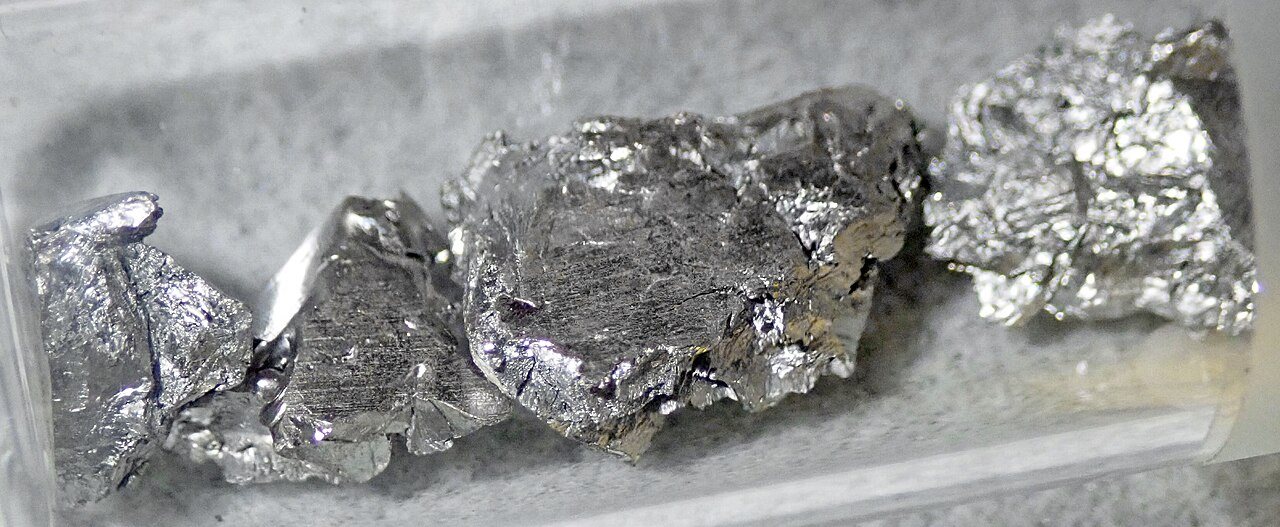
Đây là gì?
Zirconium's chemical shadow — always found with it, almost impossible to separate from it, and the opposite of it in a reactor because it soaks up neutrons.
Tại sao điều này quan trọng?
Hafnium goes into reactor control rods, superalloy turbine blades, and the gate dielectric that let chip transistors keep shrinking after 2007.
Where it is in the Earth
Hafnium does not form deposits of its own. It exists in the Earth's crust as a passenger inside zircon, a zirconium silicate mineral with the formula ZrSiO4. The reason is straightforward chemistry: hafnium and zirconium atoms are almost exactly the same size, a consequence of a phenomenon called the lanthanide contraction, in which the filling of inner electron shells across the lanthanide series of elements compresses atomic radii in the rows that follow. Because the two atoms are so similar in size and charge, hafnium substitutes freely for zirconium in zircon's crystal lattice. Roughly two atoms in every hundred zirconium sites in a typical zircon crystal are actually hafnium. That ratio is remarkably consistent across geological settings, which is why hafnium is described as zirconium's chemical shadow.
Zircon itself concentrates through a process called heavy mineral sorting. When granitic or syenitic magmas — igneous rocks rich in silica and aluminium — cool slowly deep in the crust, zircon crystallises early and settles out. Over geological time, erosion breaks down these ancient igneous and metamorphic rocks, and rivers carry the debris to the sea. Because zircon is dense, chemically inert, and highly resistant to weathering, it survives the journey and accumulates in beach and dune sands alongside other heavy minerals such as ilmenite, rutile, and monazite. These are the heavy mineral sand deposits — also called placer deposits — that constitute the world's practical source of zircon, and therefore of hafnium. Deposits of this type are found along ancient and modern coastlines where the geological conditions produced sustained sediment sorting over long periods.
A smaller quantity of zircon comes from hard-rock mining of the original igneous intrusions, particularly nepheline syenite and carbonatite complexes, but placer sands dominate supply. Because hafnium is entirely dependent on zircon as its carrier mineral, the geography of hafnium supply is simply the geography of heavy mineral sand mining, concentrated in coastal regions of Australia, South Africa, and a handful of other countries.
Getting it out
Zircon, and with it hafnium, is won from heavy mineral sands using methods suited to loose, unconsolidated beach and dune sediments. The most common approach is open excavation — stripping away surface material and either dredging the sand with a floating suction dredge working through an artificial pond, or using dry mining equipment such as bulldozers and scrapers to move material to a wet concentrator plant. Neither method resembles hard-rock mining in any conventional sense: there is no blasting, no narrow ore vein to follow underground. The deposit is essentially a large volume of sand in which valuable heavy minerals are dispersed at low concentration.
That concentration, the grade, is typically measured as the weight of heavy minerals in a tonne of sand. Zircon itself forms only a portion of the total heavy mineral content, and hafnium in turn forms only a small fraction of the zirconium in that zircon. The practical implication is that an enormous tonnage of sand must be processed to yield a modest weight of zircon, and the hafnium content of that zircon is smaller still. The waste in this context is not toxic rock that must be impounded but largely the silica sand that was always the majority of the material, and operations are often designed to return processed sand to the mined area as they advance across the deposit.
What happens next determines whether any hafnium is produced at all. Raw zircon concentrate leaves the mining operation, but separating hafnium from zirconium requires a sophisticated chemical refinery. That step does not happen at the mine and is not attempted by most zircon consumers. Hafnium is only separated when the zirconium is being refined to nuclear-grade purity — a specification that requires the removal of hafnium precisely because hafnium absorbs neutrons so strongly that even small quantities would impair a zirconium alloy's performance inside a reactor. Hafnium is therefore a by-product of nuclear zirconium production, not a co-product of zircon mining.
What pulls on it
Three markets pull on hafnium, and they pull in different directions and on different timescales. The oldest is nuclear power, where hafnium's exceptional ability to absorb neutrons — the very property that makes it undesirable in zirconium alloys — makes it useful in control rods, the elements inserted into or withdrawn from a reactor core to regulate the chain reaction. A pressurised water reactor requires between 0.5 and 3.0 tonnes of hafnium per gigawatt of generating capacity for its control rods. As nuclear generating capacity is built or refurbished, this demand rises; as older plants retire without replacement, it falls. The current period of renewed interest in nuclear power, driven by low-carbon energy targets and the energy security concerns of several governments, represents a potential growth path for this end use, though actual demand depends on how many reactors are completed and at what pace.
The second market is aerospace and defence, where hafnium is alloyed into nickel-based superalloys for turbine blades operating at extreme temperatures. Hafnium improves the grain-boundary strength of these alloys, allowing blades to endure conditions closer to their melting point and thus enabling higher combustion temperatures and better engine efficiency. Demand from this sector tracks aircraft production rates and the replacement cycles of military jet engines, both of which are long-cycle and relatively predictable.
The third and most structurally significant market is semiconductors. After 2007, the principal manufacturers of logic chips introduced hafnium oxide and hafnium silicate as the gate dielectric material — the insulating layer between the control electrode and the conducting channel — in transistors. Conventional silicon dioxide had been thinned to the point where electrons tunnelled through it, wasting power. Hafnium-based compounds have a much higher dielectric constant, meaning a thicker layer can do the same electrical job, stopping the leakage. This transition extended the pace of transistor miniaturisation for a further technology generation. Demand from this sector is tied to the volume of advanced logic chip production and to whether future transistor architectures continue to require hafnium-based dielectrics, which is not guaranteed indefinitely as designs evolve.
Nguồn gốc của nó trong đá
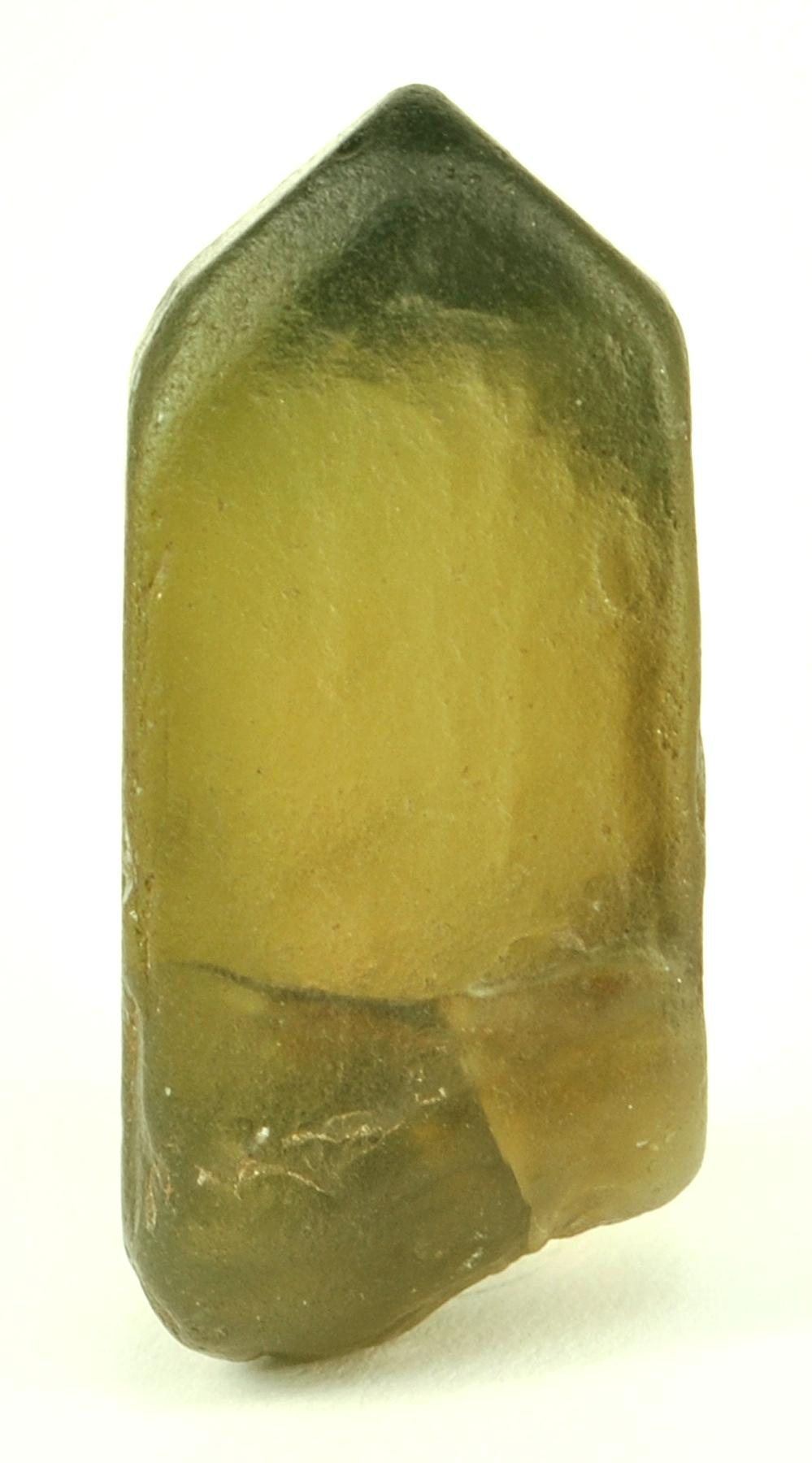
Tất cả khoáng vật quặng →Đây là các khoáng sản thực sự mang lại hafnium. Một mỏ khoáng chỉ là thân quặng khi một trong số chúng có hàm lượng đủ cao để bù đắp chi phí khai thác.
Giá
Price: Hafnium, unwrought, dollars per kilogram
Trung bình nămdollars per kilogram
Cơ sở: Price: Hafnium, unwrought, dollars per kilogram. Trung bình năm theo công bố trong USGS Mineral Commodity Summaries 2026 · nguồn ↗. Đây là mức trung bình hàng năm tham khảo, không phải báo giá thị trường trực tiếp.
Nơi nó được chế biến và tinh luyện
| Nhà máy | Loại | Giai đoạn | Quốc gia | Vai trò |
|---|---|---|---|---|
| TSMC Fab 18, Tainan | Xưởng sản xuất bán dẫn | Thành phần | Taiwan | Đầu vào |
| Aero-Engine Turbine Plant, Derby | Nhà máy sản xuất | Sản phẩm | United Kingdom | Đầu vào |
Công dụng của nó
Tất cả thị trường đầu ra →| Thị trường đầu ra | Chức năng của nó ở đó | Tầm quan trọng |
|---|---|---|
| Nuclear Power | Control rods | Định nghĩa |
| Aerospace & Defence | Superalloy and control rods | Định nghĩa |
| Semiconductors | High-k transistor gate dielectric | Định nghĩa |
Một công nghệ cần bao nhiêu
| Công nghệ | Đại lượng | Báo giá | Cơ sở |
|---|---|---|---|
| Leading-Edge Logic Chip Milligrams per wafer, with no substitute. | vết | per 300 mm wafer | Atomic-layer gate dielectric |
| Pressurised Water Reactor | 0.5–3.00 t | per GW of capacity | Control rods |
| Single-Crystal Turbine Blade | vết | per blade set | Grain-boundary strengthening |
Indicative range compiled from published technology studies and chemistry; verify against a manufacturer specification before use. Chạy các con số này ở bất kỳ quy mô nào trong máy tính vật liệu →