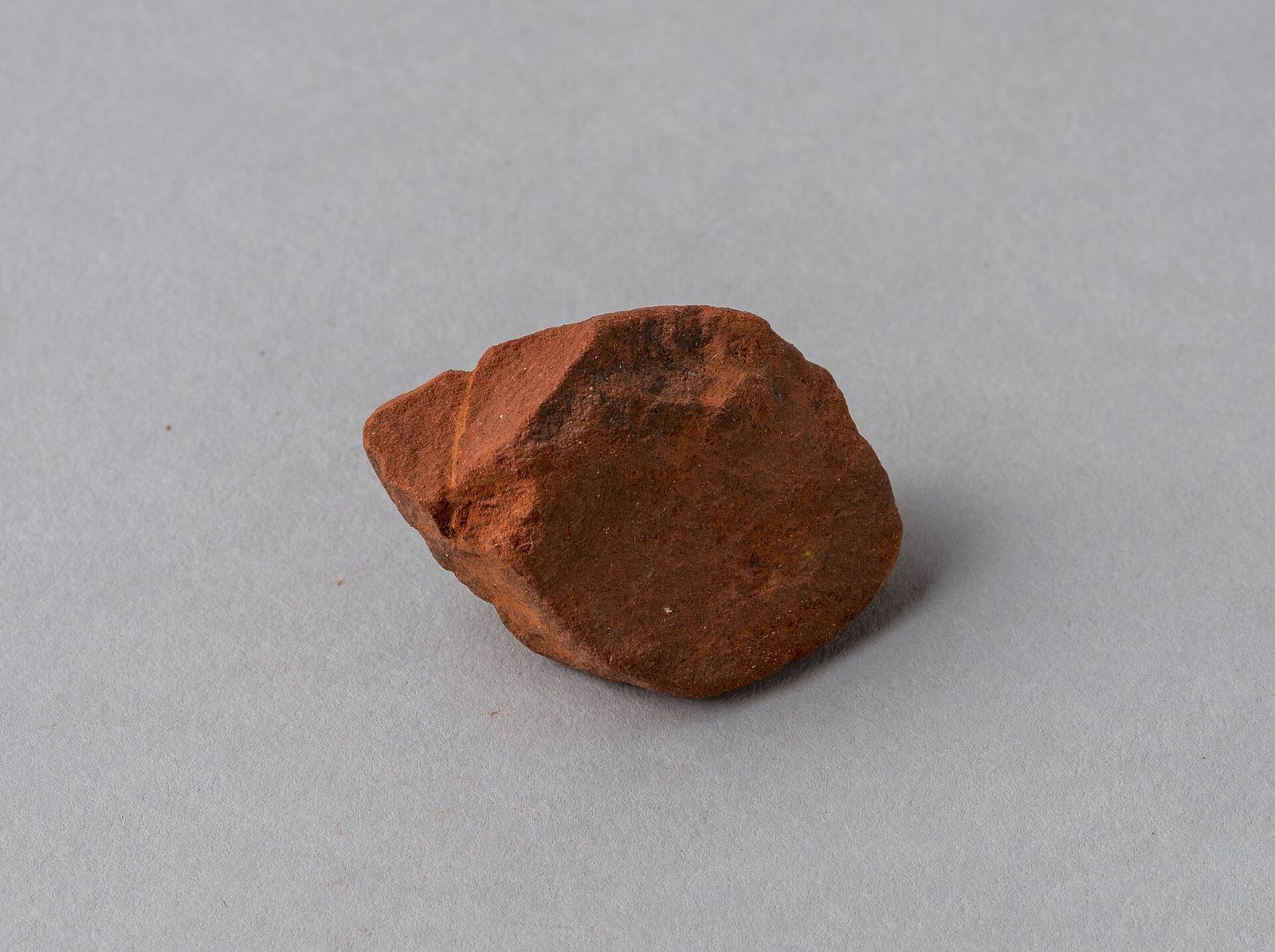
ما هو؟
Rust, refined — the reds, yellows, browns and blacks that have coloured paint and pottery since the first cave walls.
لماذا يهم هذا؟
They are the cheapest, most light-stable colours in existence, and they tint most coloured concrete, brick and paving on Earth.
Where it is in the Earth
Iron oxide pigments draw their colour from iron minerals that are among the most abundant compounds in the Earth's crust. The most important natural forms are the iron oxyhydroxide goethite, which gives yellows and browns, and the iron oxide hematite, which gives reds. A third mineral, magnetite, is an iron oxide that produces blacks. All three form through broadly similar processes: iron-bearing rock weathers and the released iron ions react with oxygen and water, precipitating as coloured minerals that accumulate in soils, sediments and near-surface rock. Because iron is so common and because this oxidation chemistry requires only air and water, iron oxide minerals form almost everywhere on the surface of the planet.
What makes a deposit worth mining for pigment rather than merely for iron metal is chemical purity and physical fineness. The best natural pigment deposits — the ochres and umbers quarried for thousands of years — formed in environments where iron-rich groundwater percolated through sedimentary rock and precipitated slowly, yielding fine-grained, relatively pure material with consistent colour. The Roussillon district of southern France, the soils of Cyprus, and the laterite deposits of India are examples of settings where prolonged tropical or subtropical weathering over geological time stripped away silica and other gangue minerals, leaving iron oxides concentrated at the surface. Laterite, the red-brown residual soil produced by intense tropical weathering, is the geological context for India's very large natural reserves and its dominant position in global output.
Synthetic iron oxide pigments — now the majority of what the market uses — are not mined at all. They are manufactured by controlled chemical reactions: either the precipitation of iron salts in water, or the high-temperature calcination (roasting) of iron compounds. The feedstocks are industrial iron sulfate and scrap iron, both inexpensive and widely available. Synthetic production therefore depends on chemical engineering rather than geology, which is why Germany, without exceptional iron ore deposits, is the second-largest producer in the world. The geology of natural deposits sets a ceiling on colour consistency and an floor on cost for natural grades, but it does not constrain the industry as a whole.
Getting it out
Natural iron oxide pigments are won by open-pit quarrying, sometimes barely distinguishable from soil excavation. The deposits tend to be shallow, soft and close to the surface — a direct consequence of their weathering origin. The work involves stripping overlying soil and uncoloured material, then selectively digging the coloured zones. Because the pigment mineral is already fine-grained and already close to its final chemistry, the operation looks more like clay mining than hard-rock mining: mechanical excavators load loose or weakly consolidated material directly into trucks.
Grade, in this context, means the intensity and purity of colour and the iron oxide content expressed as a percentage of the dry mass, rather than the metal content used in iron ore mining. A tonne of natural ochre can contain a wide range of iron oxide contents depending on how much clay, silica or calcium carbonate the weathering process left behind. Higher iron oxide content generally means stronger colour and greater tinting power — the ability of a given mass of pigment to colour a fixed volume of paint or concrete. Gangue minerals dilute tinting power and can introduce unwanted tints, so selective digging matters.
Because the deposits are soft and shallow, stripping ratios — the volume of waste moved per unit of product — tend to be modest compared with hard-rock mines. The environmental footprint per tonne of product is correspondingly lower than for most metals. Synthetic production has no mine at all; its inputs are industrial chemicals and scrap iron, processed in purpose-built chemical plants. The shift toward synthetic pigments over the past century has therefore reduced the industry's dependence on any particular geological setting, though it has not eliminated demand for natural grades, which are prized for certain earthy tones that are difficult to replicate exactly by synthesis.
What pulls on it
The dominant use of iron oxide pigments is in construction materials: concrete, mortar, brick, paving and roofing products. Iron oxides colour the concrete itself rather than a surface coating, which means the colour is durable for the life of the structure. No organic pigment matches this performance at a comparable cost. The construction sector's appetite for coloured concrete and paving is therefore the single largest driver of demand, and it moves broadly with the pace of construction activity, particularly in residential and infrastructure projects where exposed aggregate and decorative concrete surfaces are specified.
Paints and coatings are the second major end market. Iron oxide reds and yellows appear in primers and corrosion-resistant coatings as well as decorative finishes. In this sector, iron oxides compete with organic pigments for applications requiring bright, saturated colours, and they lose that competition wherever vivid hue matters more than cost and lightfastness — but they win wherever durability outdoors and low cost dominate the specification. Ceramics, rubber, plastics and cosmetics account for smaller but stable volumes.
Demand would shift sharply if construction activity contracted severely and durably, or if a fundamentally different approach to colouring concrete were adopted. Neither appears imminent on the basis of the material's properties. On the upside, growth in infrastructure spending in South and Southeast Asia has supported demand for natural pigments from Indian producers, while the ongoing expansion of coloured paving in urban environments in wealthier economies sustains demand for synthetic grades. The market is not sensitive to technological disruption in the way that, say, battery minerals are, because the application — colouring concrete and paint — is mature and the pigment's performance advantages are well understood.
Turning ore into product المستوى 3
Natural iron oxide pigments require relatively straightforward processing. Run-of-mine material is dried, crushed gently, and milled to a controlled particle size distribution. Particle size governs colour: finer particles scatter light differently and produce more vivid, higher-tinting-strength pigments, while coarser material tends toward duller, earthier tones. Wet washing removes soluble salts and some clay fractions. Calcination — heating to several hundred degrees Celsius — converts yellow goethite (iron oxyhydroxide) to red hematite by driving off the hydroxyl group. This is how natural yellow ochre becomes a red pigment: the chemistry is simple dehydration, and the colour shift is predictable. The losses in the natural processing chain are primarily moisture and fine dust, and the cost is dominated by energy for drying and milling.
Synthetic pigments involve more controlled chemistry. The dominant route for synthetic reds and yellows is the Penniman–Zoph precipitation process, in which scrap iron and iron sulfate are reacted under carefully managed conditions of temperature and pH in large tanks. Seed crystals of the desired iron oxide phase are added to direct crystal growth toward the target colour. The resulting slurry is filtered, washed to remove sulfate, and dried. Blacks are made by controlled partial oxidation of precipitated iron compounds. Calcination of yellow precipitate produces synthetic reds of exceptional consistency. The principal process losses are in filtration and washing; the main cost drivers are energy, iron sulfate feedstock, and the treatment of sulfate-bearing effluent. Effluent management is a material operating cost and a significant environmental compliance obligation, particularly in jurisdictions with tight discharge limits for sulfate and iron.
Recovery and yield figures for synthetic production are not publicly reported in a standardised way, and published capacity figures from different sources often disagree because some producers report saleable pigment only, while others include intermediate products or tinting bases. The unit basis noted in the database — gross weight, natural and synthetic combined — means that the production table conflates two quite different production systems. India's figure predominantly reflects natural pigment from surface deposits; Germany's figure predominantly reflects synthetic chemical manufacture. Comparing them as though they were equivalent processes understates the structural difference between the two supply chains.
Substitution and recycling المستوى 3
Within pigments, the principal alternatives to iron oxides are organic pigments and, for certain applications, titanium dioxide. Organic pigments can achieve colours — particularly vivid yellows, oranges and greens — that iron oxides cannot. However, they are substantially more expensive per kilogram and most are significantly less lightfast and heat-stable in exposed applications. For colouring concrete, where the pigment must survive decades of UV exposure and alkaline conditions without fading, no organic pigment currently offers equivalent durability at a competitive price. Titanium dioxide is the reference for white and near-white coatings but does not compete in the red, yellow and black sectors where iron oxides operate.
Recycling of iron oxide pigments does not occur in any meaningful commercial sense. Once dispersed into concrete, paint or ceramics, the pigment cannot be recovered and reprocessed. The material is consumed as it is used. This is structurally different from metallic commodities where end-of-life scrap can be melted and refined. The reason recycling does not occur is physical: the pigment is intimately blended into a matrix at very low loadings, and no separation technology makes recovery economical. Demand is therefore met entirely from primary production — either mined natural material or synthetically manufactured product. The synthetic route does, however, make use of industrial by-products (iron sulfate from steel pickling and titanium dioxide manufacture) as feedstock, which represents an indirect form of industrial symbiosis even if the pigment itself is not recyclable.
Substitution between natural and synthetic grades occurs within the market and is price- and specification-driven. Synthetic pigments offer tighter colour consistency, higher tinting strength per unit mass, and freedom from the geological variability that affects natural ochres. Natural grades retain a price advantage in less demanding applications and a preference advantage in markets — particularly in artisanal and heritage contexts — where provenance and the character of natural colour are valued. The boundary between these segments shifts gradually with relative prices.
من ينتجه
اعرضه على خريطة →Mine production
Mine productionmetric tons 2025 (مُقدَّر)
USGS Mineral Commodity Summaries 2026 · Gross weight; natural and synthetic pigments reported together. · المصدر ↗
مرِّر الجدول أفقياً لعرض الأعمدة المتبقية.
| الدولة | الإنتاج | حصة من العالم |
|---|---|---|
| Germany | 280,000 | — |
| Italy | 32,000 | — |
| Cyprus | 22,000 | — |
| France | 13,000 | — |
| United States | Withheld | — |
| المجموع العالمي | Not applicable | 100% |
Mine production: ocher
Mine production: ochermetric tons 2025 (مُقدَّر)
USGS Mineral Commodity Summaries 2026 · Gross weight; natural and synthetic pigments reported together. · المصدر ↗
مرِّر الجدول أفقياً لعرض الأعمدة المتبقية.
Mine production: ocher and red iron oxide
Mine production: ocher and red iron oxidemetric tons 2025 (مُقدَّر)
USGS Mineral Commodity Summaries 2026 · Gross weight; natural and synthetic pigments reported together. · المصدر ↗
مرِّر الجدول أفقياً لعرض الأعمدة المتبقية.
| الدولة | الإنتاج | حصة من العالم |
|---|---|---|
| Spain | 19,000 | — |
«محجوب» يعني أن USGS أخفى الرقم تفاديًا للإفصاح عن بيانات شركة بعينها — وهو لا يعني صفرًا. لا يُساوي مجموع صفوف الدول دائمًا المجموع العالمي لأن المصدر يُقرِّب كل رقم باستقلالية ولا يُفصِّل دائمًا خانة «دول أخرى».
من يحتفظ بالاحتياطيات
Reserves
Reservesmetric tons 2025
USGS Mineral Commodity Summaries 2026 · المصدر ↗
| الدولة | الاحتياطيات | حصة من العالم |
|---|---|---|
| Italy | Not applicable | — |
| Cyprus | Moderate | — |
| France | Not applicable | — |
| Germany | Moderate | — |
| United States | Moderate | — |
| المجموع العالمي | Large | 100% |
Reserves: ocher
Reserves: ochermetric tons 2025
USGS Mineral Commodity Summaries 2026 · المصدر ↗
Reserves: ocher and red iron oxide
Reserves: ocher and red iron oxidemetric tons 2025
USGS Mineral Commodity Summaries 2026 · المصدر ↗
| الدولة | الاحتياطيات | حصة من العالم |
|---|---|---|
| Spain | Large | — |
السعر
average unit value, dollars per kilogram
المتوسط السنويdollars per kilogram
الأساس: average unit value, dollars per kilogram. متوسطات سنوية كما نُشرت في USGS Mineral Commodity Summaries 2026 · المصدر ↗. هذه متوسطات سنوية مرجعية، وليست أسعار سوق آنية.
ضوابط التصدير
| الدولة | سيطرة | ينطبق على |
|---|---|---|
| Laos | Export ban | Raw minerals, including copper, gold, iron, nickel, potassium, silver, and zinc (2024). ↗ |
| Vietnam | Export ban | Raw materials of iron, lead-zinc, chromite, manganese, apatite, and rare earths and deeply processed titanium (2012). ↗ |
USGS Mineral Commodity Summaries 2026, table 4 — controls in effect as of January 2026, excluding controls since lifted.