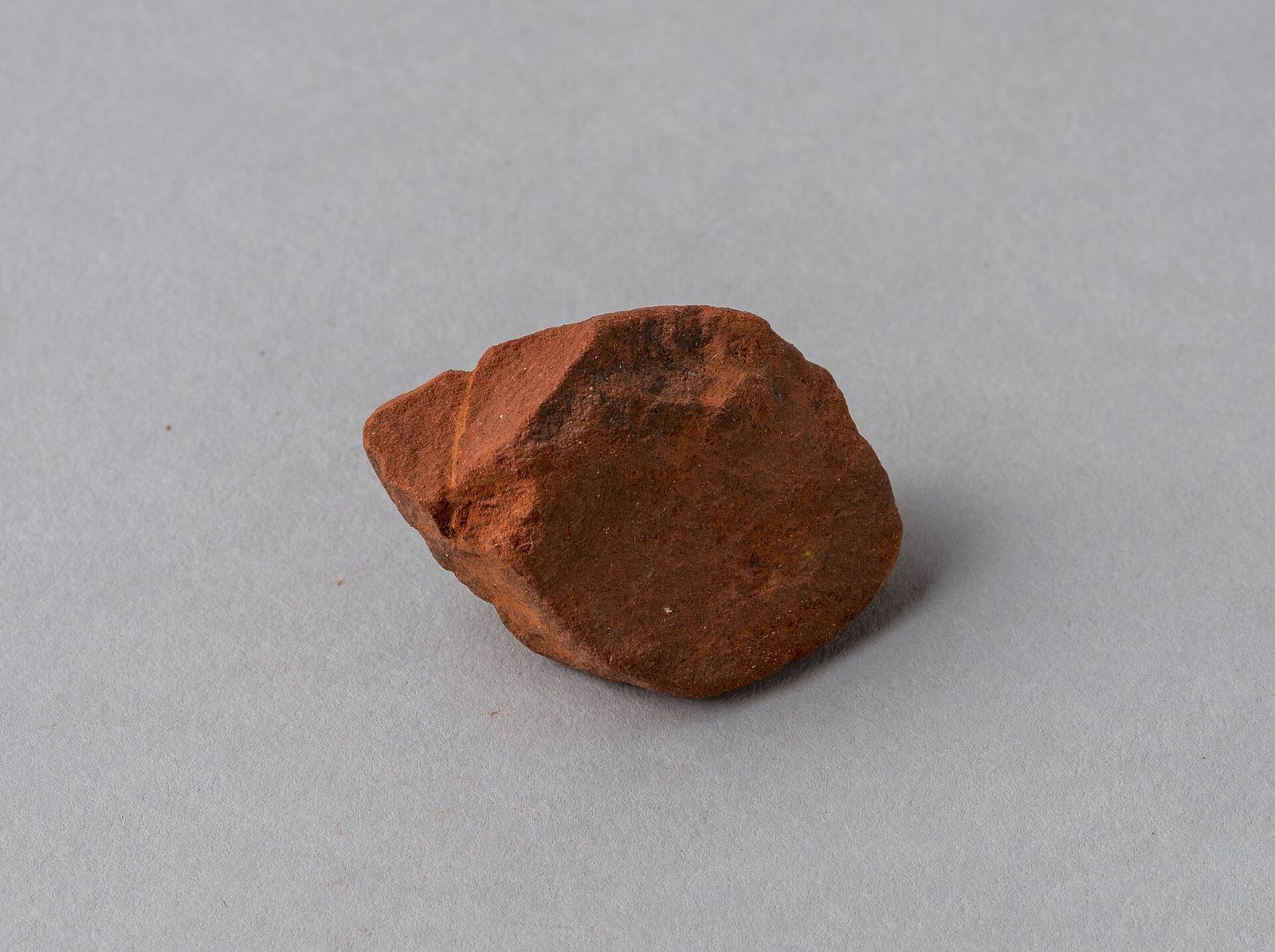
Apa ini?
Rust, refined — the reds, yellows, browns and blacks that have coloured paint and pottery since the first cave walls.
Mengapa ini penting?
They are the cheapest, most light-stable colours in existence, and they tint most coloured concrete, brick and paving on Earth.
Where it is in the Earth
Iron oxide pigments draw their colour from iron minerals that are among the most abundant compounds in the Earth's crust. The most important natural forms are the iron oxyhydroxide goethite, which gives yellows and browns, and the iron oxide hematite, which gives reds. A third mineral, magnetite, is an iron oxide that produces blacks. All three form through broadly similar processes: iron-bearing rock weathers and the released iron ions react with oxygen and water, precipitating as coloured minerals that accumulate in soils, sediments and near-surface rock. Because iron is so common and because this oxidation chemistry requires only air and water, iron oxide minerals form almost everywhere on the surface of the planet.
What makes a deposit worth mining for pigment rather than merely for iron metal is chemical purity and physical fineness. The best natural pigment deposits — the ochres and umbers quarried for thousands of years — formed in environments where iron-rich groundwater percolated through sedimentary rock and precipitated slowly, yielding fine-grained, relatively pure material with consistent colour. The Roussillon district of southern France, the soils of Cyprus, and the laterite deposits of India are examples of settings where prolonged tropical or subtropical weathering over geological time stripped away silica and other gangue minerals, leaving iron oxides concentrated at the surface. Laterite, the red-brown residual soil produced by intense tropical weathering, is the geological context for India's very large natural reserves and its dominant position in global output.
Synthetic iron oxide pigments — now the majority of what the market uses — are not mined at all. They are manufactured by controlled chemical reactions: either the precipitation of iron salts in water, or the high-temperature calcination (roasting) of iron compounds. The feedstocks are industrial iron sulfate and scrap iron, both inexpensive and widely available. Synthetic production therefore depends on chemical engineering rather than geology, which is why Germany, without exceptional iron ore deposits, is the second-largest producer in the world. The geology of natural deposits sets a ceiling on colour consistency and an floor on cost for natural grades, but it does not constrain the industry as a whole.
Getting it out
Natural iron oxide pigments are won by open-pit quarrying, sometimes barely distinguishable from soil excavation. The deposits tend to be shallow, soft and close to the surface — a direct consequence of their weathering origin. The work involves stripping overlying soil and uncoloured material, then selectively digging the coloured zones. Because the pigment mineral is already fine-grained and already close to its final chemistry, the operation looks more like clay mining than hard-rock mining: mechanical excavators load loose or weakly consolidated material directly into trucks.
Grade, in this context, means the intensity and purity of colour and the iron oxide content expressed as a percentage of the dry mass, rather than the metal content used in iron ore mining. A tonne of natural ochre can contain a wide range of iron oxide contents depending on how much clay, silica or calcium carbonate the weathering process left behind. Higher iron oxide content generally means stronger colour and greater tinting power — the ability of a given mass of pigment to colour a fixed volume of paint or concrete. Gangue minerals dilute tinting power and can introduce unwanted tints, so selective digging matters.
Because the deposits are soft and shallow, stripping ratios — the volume of waste moved per unit of product — tend to be modest compared with hard-rock mines. The environmental footprint per tonne of product is correspondingly lower than for most metals. Synthetic production has no mine at all; its inputs are industrial chemicals and scrap iron, processed in purpose-built chemical plants. The shift toward synthetic pigments over the past century has therefore reduced the industry's dependence on any particular geological setting, though it has not eliminated demand for natural grades, which are prized for certain earthy tones that are difficult to replicate exactly by synthesis.
What pulls on it
The dominant use of iron oxide pigments is in construction materials: concrete, mortar, brick, paving and roofing products. Iron oxides colour the concrete itself rather than a surface coating, which means the colour is durable for the life of the structure. No organic pigment matches this performance at a comparable cost. The construction sector's appetite for coloured concrete and paving is therefore the single largest driver of demand, and it moves broadly with the pace of construction activity, particularly in residential and infrastructure projects where exposed aggregate and decorative concrete surfaces are specified.
Paints and coatings are the second major end market. Iron oxide reds and yellows appear in primers and corrosion-resistant coatings as well as decorative finishes. In this sector, iron oxides compete with organic pigments for applications requiring bright, saturated colours, and they lose that competition wherever vivid hue matters more than cost and lightfastness — but they win wherever durability outdoors and low cost dominate the specification. Ceramics, rubber, plastics and cosmetics account for smaller but stable volumes.
Demand would shift sharply if construction activity contracted severely and durably, or if a fundamentally different approach to colouring concrete were adopted. Neither appears imminent on the basis of the material's properties. On the upside, growth in infrastructure spending in South and Southeast Asia has supported demand for natural pigments from Indian producers, while the ongoing expansion of coloured paving in urban environments in wealthier economies sustains demand for synthetic grades. The market is not sensitive to technological disruption in the way that, say, battery minerals are, because the application — colouring concrete and paint — is mature and the pigment's performance advantages are well understood.
Siapa yang memproduksinya
Lihat di peta →Mine production
Mine productionmetric tons 2025 (estimasi)
USGS Mineral Commodity Summaries 2026 · Gross weight; natural and synthetic pigments reported together. · sumber ↗
Gulir tabel ke samping untuk melihat kolom-kolom yang tersisa.
| Negara | Produksi | Pangsa dunia |
|---|---|---|
| Germany | 280,000 | — |
| Italy | 32,000 | — |
| Cyprus | 22,000 | — |
| France | 13,000 | — |
| United States | Withheld | — |
| Total dunia | Not applicable | 100% |
Mine production: ocher
Mine production: ochermetric tons 2025 (estimasi)
USGS Mineral Commodity Summaries 2026 · Gross weight; natural and synthetic pigments reported together. · sumber ↗
Gulir tabel ke samping untuk melihat kolom-kolom yang tersisa.
Mine production: ocher and red iron oxide
Mine production: ocher and red iron oxidemetric tons 2025 (estimasi)
USGS Mineral Commodity Summaries 2026 · Gross weight; natural and synthetic pigments reported together. · sumber ↗
Gulir tabel ke samping untuk melihat kolom-kolom yang tersisa.
| Negara | Produksi | Pangsa dunia |
|---|---|---|
| Spain | 19,000 | — |
"Ditahan" berarti USGS menyembunyikan angka tersebut untuk menghindari pengungkapan data perusahaan tertentu — bukan berarti nol. Baris per negara tidak selalu berjumlah sama dengan total dunia karena sumber membulatkan setiap angka secara independen dan tidak selalu merinci baris "negara lain".
Siapa yang memegang cadangan
Reserves
Reservesmetric tons 2025
USGS Mineral Commodity Summaries 2026 · sumber ↗
| Negara | Cadangan | Pangsa dunia |
|---|---|---|
| Italy | Not applicable | — |
| Cyprus | Moderate | — |
| France | Not applicable | — |
| Germany | Moderate | — |
| United States | Moderate | — |
| Total dunia | Large | 100% |
Reserves: ocher
Reserves: ochermetric tons 2025
USGS Mineral Commodity Summaries 2026 · sumber ↗
Reserves: ocher and red iron oxide
Reserves: ocher and red iron oxidemetric tons 2025
USGS Mineral Commodity Summaries 2026 · sumber ↗
| Negara | Cadangan | Pangsa dunia |
|---|---|---|
| Spain | Large | — |
Harga
average unit value, dollars per kilogram
Rata-rata tahunandollars per kilogram
Dasar: average unit value, dollars per kilogram. Rata-rata tahunan sebagaimana diterbitkan dalam USGS Mineral Commodity Summaries 2026 · sumber ↗. Ini adalah rata-rata tahunan referensi, bukan kuotasi pasar secara langsung.
Kontrol ekspor
| Negara | Kontrol | Berlaku untuk |
|---|---|---|
| Laos | Export ban | Raw minerals, including copper, gold, iron, nickel, potassium, silver, and zinc (2024). ↗ |
| Vietnam | Export ban | Raw materials of iron, lead-zinc, chromite, manganese, apatite, and rare earths and deeply processed titanium (2012). ↗ |
USGS Mineral Commodity Summaries 2026, table 4 — controls in effect as of January 2026, excluding controls since lifted.