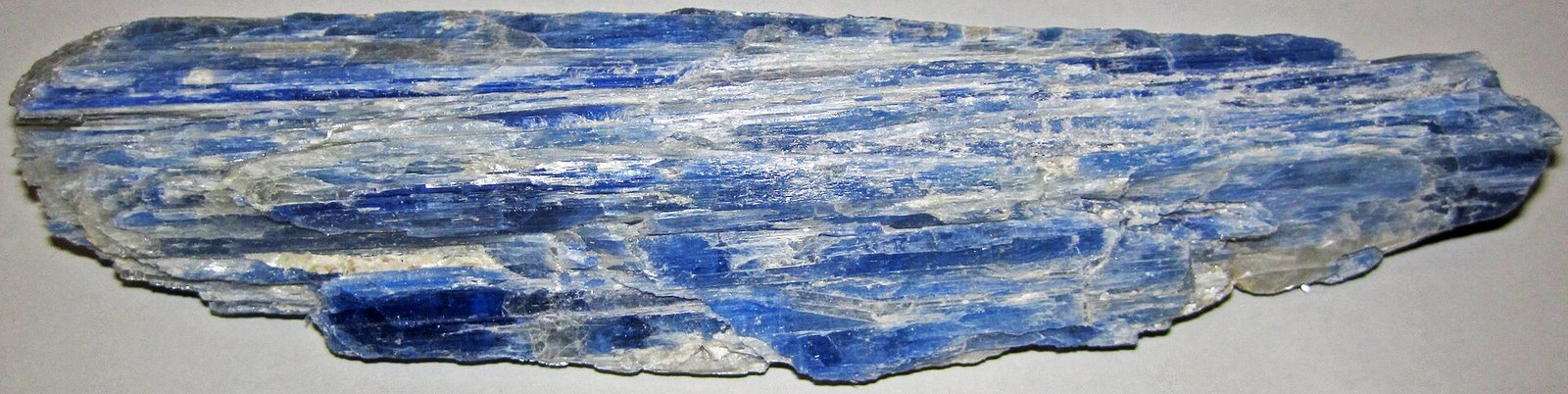
이것은 무엇인가?
Blue-bladed crystals that expand rather than shrink when fired, which makes them the backbone of refractory brick.
왜 중요한가?
Refractories are the containers that every high-temperature industry runs inside. Kyanite, andalusite and sillimanite are what stop them cracking.
Where it is in the Earth
Kyanite, andalusite and sillimanite are three minerals that share exactly the same chemical formula — aluminium silicate — but arrange their atoms differently depending on the pressure and temperature at which they formed. Geologists call this relationship polymorphism: one composition, three structures. Each polymorph is a signpost to the conditions inside the crust at the time of formation. Kyanite grows under relatively high pressure, andalusite under low pressure and moderate temperature, and sillimanite under the highest temperatures. Because of this, the three minerals tend to occur in different rock belts around the world, even though they are chemically identical.
All three form during metamorphism, the process by which existing rocks are recrystallised by heat and pressure deep in the crust without melting entirely. The starting material is usually an aluminium-rich sedimentary rock — a shale or mudstone — that was buried and squeezed, often during the collision of tectonic plates. The result is a family of rocks called pelitic schists and gneisses, in which the aluminium silicate crystals grow as distinct, often large blades or prisms. Because the surrounding rock weathers more easily than the resistant aluminium silicate minerals, erosion can concentrate them in stream sediments as well as in hard-rock outcrops, giving rise to both primary and secondary deposit types.
The global distribution of production reflects this geology directly. South Africa holds large deposits of andalusite in ancient metamorphic terranes of the Transvaal. France's deposits, centred on the Massif Central, are also andalusite. India's reserves — the largest recorded in the data — are spread across Precambrian metamorphic belts in states such as Rajasthan and Andhra Pradesh and include substantial kyanite and sillimanite. The United States has significant kyanite deposits in Virginia and Georgia, hosted in Appalachian metamorphic rocks. The deposits exist where they do because the right combination of aluminium-rich source rock and metamorphic event happened to coincide, and erosion has since exposed them at the surface.
Getting it out
Because kyanite, andalusite and sillimanite occur as distinct, hard crystals dispersed through metamorphic rock, the ore is almost always mined by open-pit methods. An open pit removes rock in a series of stepped benches, working downward. The technique suits these deposits because the mineralised zones are broad and shallow enough that stripping away the overlying material — the waste rock or overburden — to reach the ore is economically practical. Underground mining, which costs considerably more per tonne of rock moved, is generally not used for a mineral of this value unless surface access is impossible.
The concept of ore grade matters here in a specific way. Grade for an aluminium silicate deposit is expressed as the proportion of the target mineral in the run-of-mine rock, and it determines how much total rock must be blasted and hauled to yield one tonne of saleable product. Where the mineral content is low, the ratio of waste moved to product recovered — the strip ratio — rises, and so does the cost per tonne of finished material. The three polymorphs can occur in the same quarry face in varying proportions, which adds complexity to grade control. Selective mining, where different zones are kept separate to feed different product specifications, is common at larger operations.
Some secondary production comes from alluvial or placer deposits, where the hard, chemically stable aluminium silicate minerals have been freed from their host rock by weathering and accumulated in river sands and gravels. Placer mining uses water-based methods to wash and separate the dense mineral grains from lighter material. India's production includes a proportion of this type. However, hard-rock quarrying dominates global output, and the operational decisions at those quarries — bench height, blast design, haul distances — govern the economics more than any other factor.
What pulls on it
The dominant pull on kyanite and its polymorphs comes from the steel industry. Steel is made in furnaces, converters and ladles that must contain molten metal at temperatures that would destroy ordinary construction materials. The vessels are lined with refractory materials — specialised ceramics engineered to survive extreme heat, chemical attack from slags, and the mechanical stresses of repeated heating and cooling. Aluminium silicate minerals, calcined to mullite, are a primary ingredient in many refractory formulations because of their thermal stability, low thermal expansion after conversion, and resistance to slag penetration. Every tonne of steel produced consumes a small quantity of refractory lining material, and steel production is large enough that even this small intensity adds up to substantial demand.
Beyond steel, the same thermal and chemical stability makes these minerals useful in the ceramics industry for kiln furniture — the shelves, setters and posts that hold ceramic ware during firing. Glass furnaces, cement kilns and non-ferrous metal smelters also use aluminium silicate refractories. The foundry industry, where molten metals are cast into moulds, uses fine-grained kyanite in mould and core sands because the expansion on firing compensates for the contraction of the metal as it solidifies, improving dimensional accuracy.
Demand would shift sharply if steel production moved substantially away from high-temperature furnace routes. Electric arc furnaces, which re-melt scrap steel, still require refractories but tend to consume somewhat different compositions and at different rates than integrated steelworks using blast furnaces and basic oxygen converters. A long-term shift in the balance of steelmaking technology would therefore affect which grades and quantities of aluminium silicate minerals are in demand, though it would not eliminate the need for refractories. Demand for refractory-grade minerals generally tracks industrial production in heavy manufacturing economies rather than consumer cycles.
생산 주체
지도에서 보기 →Mine production
Mine productionmetric tons 2025 (추정치)
USGS Mineral Commodity Summaries 2026 · Gross weight; kyanite, andalusite and sillimanite reported together. · 출처 ↗
나머지 열을 보려면 표를 옆으로 스크롤하십시오.
| 국가 | 생산 | 세계 비중 |
|---|---|---|
| 세계 합계 | Not available | 100% |
Mine production: andalusite
Mine production: andalusitemetric tons 2025 (추정치)
USGS Mineral Commodity Summaries 2026 · Gross weight; kyanite, andalusite and sillimanite reported together. · 출처 ↗
나머지 열을 보려면 표를 옆으로 스크롤하십시오.
| 국가 | 생산 | 세계 비중 |
|---|---|---|
| South Africa | 120,000 | — |
| France | 60,000 | — |
| Peru | 40,000 | — |
Mine production: andalusite, crude ore
Mine production: andalusite, crude oremetric tons 2025 (추정치)
USGS Mineral Commodity Summaries 2026 · Gross weight; kyanite, andalusite and sillimanite reported together. · 출처 ↗
나머지 열을 보려면 표를 옆으로 스크롤하십시오.
| 국가 | 생산 | 세계 비중 |
|---|---|---|
| China | 50,000 | — |
Mine production: kyanite
Mine production: kyanitemetric tons 2025 (추정치)
USGS Mineral Commodity Summaries 2026 · Gross weight; kyanite, andalusite and sillimanite reported together. · 출처 ↗
나머지 열을 보려면 표를 옆으로 스크롤하십시오.
| 국가 | 생산 | 세계 비중 |
|---|---|---|
| United States | 80,000 | — |
Mine production: kyanite and sillimanite
Mine production: kyanite and sillimanitemetric tons 2025 (추정치)
USGS Mineral Commodity Summaries 2026 · Gross weight; kyanite, andalusite and sillimanite reported together. · 출처 ↗
나머지 열을 보려면 표를 옆으로 스크롤하십시오.
| 국가 | 생산 | 세계 비중 |
|---|---|---|
| India | 2,500 | — |
'비공개'는 USGS가 개별 기업의 데이터 노출을 막기 위해 수치를 억제한 것으로, 0을 의미하지 않습니다. 출처가 각 수치를 독립적으로 반올림하고 '기타 국가' 항목을 항상 별도로 구분하지는 않기 때문에, 국가별 합계가 세계 합계와 일치하지 않을 수 있습니다.
매장량 보유 주체
Reserves
Reservesmetric tons 2025
USGS Mineral Commodity Summaries 2026 · 출처 ↗
| 국가 | 매장량 | 세계 비중 |
|---|---|---|
| 세계 합계 | Not available | 100% |
Reserves: andalusite
Reserves: andalusitemetric tons 2025
USGS Mineral Commodity Summaries 2026 · 출처 ↗
| 국가 | 매장량 | 세계 비중 |
|---|---|---|
| South Africa | Not applicable | — |
| France | Not applicable | — |
| Peru | Not applicable | — |
Reserves: andalusite, crude ore
Reserves: andalusite, crude oremetric tons 2025
USGS Mineral Commodity Summaries 2026 · 출처 ↗
| 국가 | 매장량 | 세계 비중 |
|---|---|---|
| China | 5,000,000 | — |
Reserves: kyanite
Reserves: kyanitemetric tons 2025
USGS Mineral Commodity Summaries 2026 · 출처 ↗
| 국가 | 매장량 | 세계 비중 |
|---|---|---|
| United States | Large | — |
Reserves: kyanite and sillimanite
Reserves: kyanite and sillimanitemetric tons 2025
USGS Mineral Commodity Summaries 2026 · 출처 ↗
| 국가 | 매장량 | 세계 비중 |
|---|---|---|
| India | 9,100,000 | — |
가격
average unit value of exports (free alongside ship), dollars per metric ton
연간 평균dollars per metric ton
기준: average unit value of exports (free alongside ship), dollars per metric ton. 다음 자료에 게재된 연간 평균 USGS Mineral Commodity Summaries 2026 · 출처 ↗. 이 수치는 기준 연간 평균값이며, 실시간 시장 가격이 아니다.