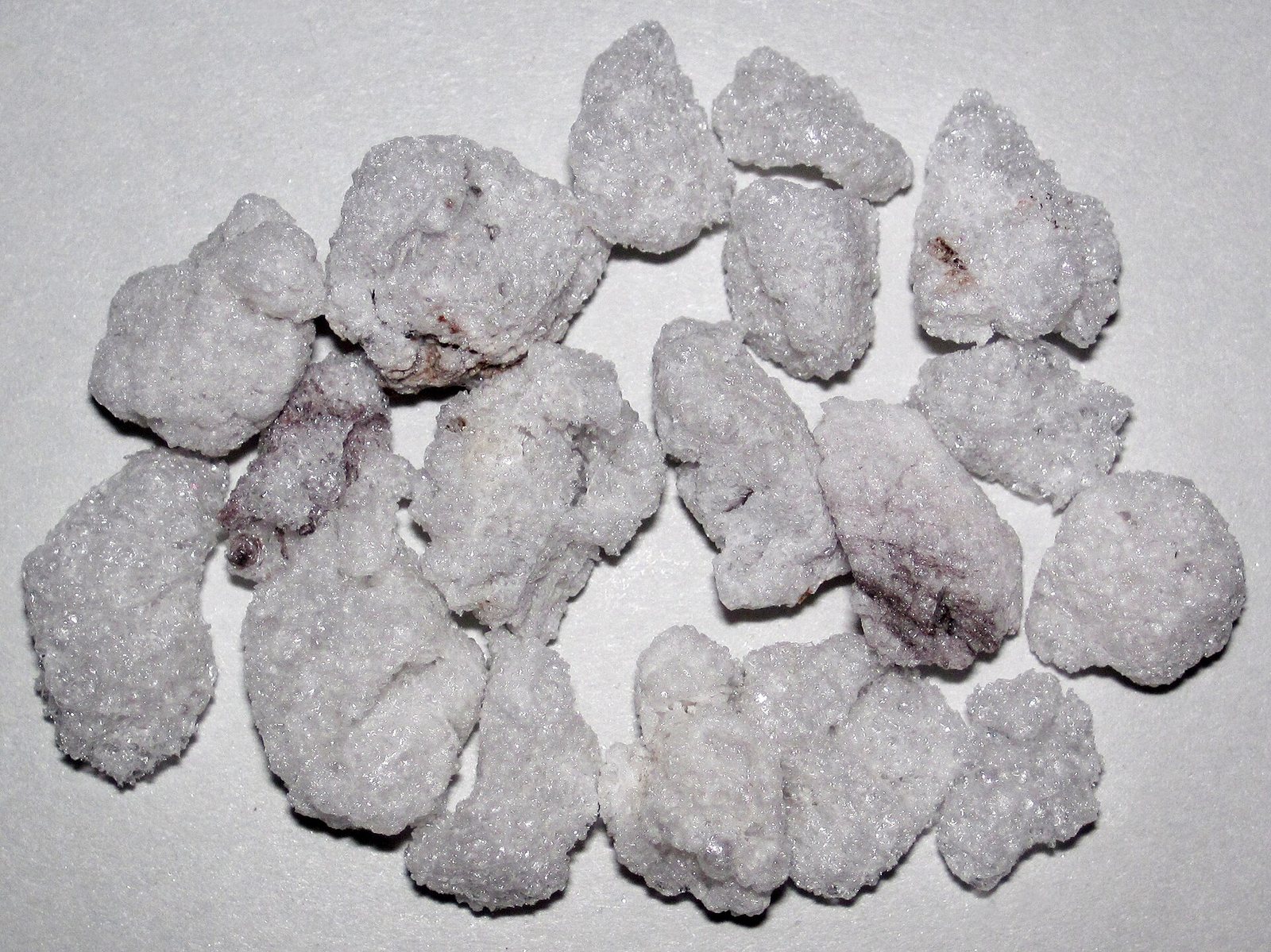
这是什么?
A volcanic glass with water trapped inside it that pops like popcorn when heated, expanding to many times its size.
为何重要?
Expanded perlite is one of the cheapest ways to make something light and insulating — in plaster, in filters, and in the growing medium under most greenhouse crops.
Where it is in the Earth
Perlite is a form of volcanic glass — rhyolitic in composition, meaning it formed from silica-rich magma. When that magma erupted and cooled rapidly at the surface or near it, the resulting glassy rock trapped a small amount of water within its structure. That water is not liquid; it is chemically bound within the glass matrix, typically at a few per cent by weight. This combination of glassy structure and bound water is what makes perlite behave so differently from ordinary rock when it is heated.
The deposits tend to occur in geologically young volcanic arcs and rift zones, where silicic eruptions have taken place within the last few tens of millions of years. Older deposits are less common because volcanic glass is metastable: over geological time, groundwater and heat convert it into clay minerals and other secondary phases, destroying the glassy texture that gives perlite its commercial character. This is why the world's largest and most reliable deposits cluster around active or recently active tectonic margins — the Aegean region, the western United States, central China, and parts of Central America and the Pacific.
Not all volcanic glass qualifies. The deposit must be thick enough, laterally continuous enough, and close enough to the surface to mine economically. Hydration must be reasonably uniform, because pockets of devitrified or otherwise altered glass within a deposit reduce the expansion ratio of the product and must either be blended away or discarded. Greece's deposits on the island of Milos are among the largest and most homogeneous known, which explains why Greece holds by far the largest reported reserves and exports crude ore worldwide despite being a relatively small country.
Getting it out
Perlite is almost always mined by open-pit methods. The rock is close to the surface, relatively soft for a silicate, and occurs in large tabular or dome-shaped bodies that suit a simple strip-and-bench approach. Heavy equipment removes any overburden — soil, weathered rock, or altered volcanic material that will not expand usefully — and the crude perlite is then drilled, blasted, and loaded into trucks. Because the deposits are generally near-surface and the rock is not exceptionally hard, the ratio of waste moved to ore produced is lower than in many hard-rock mining operations, though it varies considerably with the geometry of each deposit and the thickness of the overburden.
Grade in perlite mining is expressed differently from most metallic ores. What matters is not the concentration of a target element but the expansion ratio — how many times the rock's volume increases when it is rapidly heated. A good crude perlite will expand to many times its original volume; material that expands less may still be mined but commands a lower price or is blended with better material. Moisture content of the crude ore also matters in practice, because excess surface moisture interferes with the furnace process downstream. For this reason, crude ore is often stockpiled and allowed to air-dry before shipment or processing.
Because expanded perlite is largely air by volume, it is uneconomic to ship long distances in its expanded state. The standard commercial logic is therefore to export crude ore and expand it at or near the point of use. This shapes the entire geography of the industry: a country like Greece ships crude ore in bulk across the world, while expansion plants are built close to the construction sites, horticultural operations, and filtration facilities that consume the product.
What pulls on it
Perlite is consumed in three broad areas: construction, horticulture, and industrial filtration. In construction it appears as a lightweight aggregate in plaster and ceiling tiles, and as a loose-fill insulation in cavity walls and around cryogenic tanks. In horticulture it is used as a growing medium component — mixed with peat, coir, or other substrates — because it retains air around plant roots while resisting compaction and biological decay. In filtration it acts as a filter aid, forming a porous cake through which liquids such as beer, wine, edible oils, and pharmaceuticals are clarified. These three markets pull on perlite for quite different reasons, which means demand is spread across sectors with different economic cycles.
Construction demand follows the level of building activity and renovation, particularly in regions where lightweight plaster systems are standard practice. Horticultural demand has been growing as controlled-environment agriculture — greenhouse cultivation in particular — expands to supply urban markets and to extend growing seasons in northern climates. The inert, repeatable character of perlite makes it attractive where growers need a substrate that does not introduce pathogens or variable nutrients. Filtration demand is relatively stable, tied to the production volumes of the food and beverage industries, though it is subject to competition from alternative filter aids.
A sharp change in demand would most likely follow either a major shift in construction methods away from lightweight plaster systems, or a sustained substitution of alternative substrates in horticulture. Neither appears imminent in the near term, but the horticultural sector is actively evaluating materials such as coir and expanded clay aggregate, and any significant cost advantage for those alternatives could erode perlite's position. Demand is also sensitive to energy costs at the expansion plant level: because the crude ore must be expanded near the point of use, a sharp rise in local energy prices can make the expanded product less competitive against substitutes.
生产主体
在地图上查看 →Production
Productionthousand metric tons 2025 (估计值) 全球合计 4,600 thousand metric tons
USGS Mineral Commodity Summaries 2026 · Gross weight of crude perlite, not the expanded product. · 来源 ↗
横向滚动表格以查看其余列。
| 国家/地区 | 产量 | 占全球份额 |
|---|---|---|
| China | 1,500 | 32.6% |
| Turkey | 1,400 | 30.4% |
| Greece | 840.0 | 18.3% |
| United States | 460.0 | 10.0% |
| Hungary | 80.00 | 1.7% |
| Iran | 70.00 | 1.5% |
| Slovakia | 40.00 | 0.9% |
| Georgia | 40.00 | 0.9% |
| Argentina | 30.00 | 0.7% |
| Mexico | 30.00 | 0.7% |
| Armenia | 30.00 | 0.7% |
| Philippines | 20.00 | 0.4% |
| New Zealand | 20.00 | 0.4% |
| South Africa | 10.00 | 0.2% |
| Other countries | 10.00 | 0.2% |
| 全球合计 | 4,600 | 100% |
"未披露"表示美国地质调查局(USGS)为避免泄露单个企业数据而对该数字进行了保密处理——并不意味着数值为零。各国行数之和不一定等于世界合计,原因在于来源对每个数字单独进行四舍五入处理,且并不总是单独列出"其他国家/地区"一行。
储量持有方
Reserves
Reservesthousand metric tons 2025
USGS Mineral Commodity Summaries 2026 · 来源 ↗
| 国家/地区 | 储量 | 占全球份额 |
|---|---|---|
| Greece | 180,000 | — |
| United States | 50,000 | — |
| China | 32,000 | — |
| Slovakia | 30,000 | — |
| Iran | 15,000 | — |
| New Zealand | Not applicable | — |
| Philippines | Not applicable | — |
| South Africa | Not applicable | — |
| Turkey | Not applicable | — |
| Other countries | Not applicable | — |
| Mexico | Not applicable | — |
| Argentina | Not applicable | — |
| Armenia | Not applicable | — |
| Georgia | Not applicable | — |
| Hungary | Not applicable | — |
| 全球合计 | Not applicable | 100% |
价格
average value, free on board mine, dollars per metric ton
年度平均值dollars per metric ton
基准: average value, free on board mine, dollars per metric ton. 年度平均值,来源: USGS Mineral Commodity Summaries 2026 · 来源 ↗. 以下为参考年度均价,非实时市场报价。