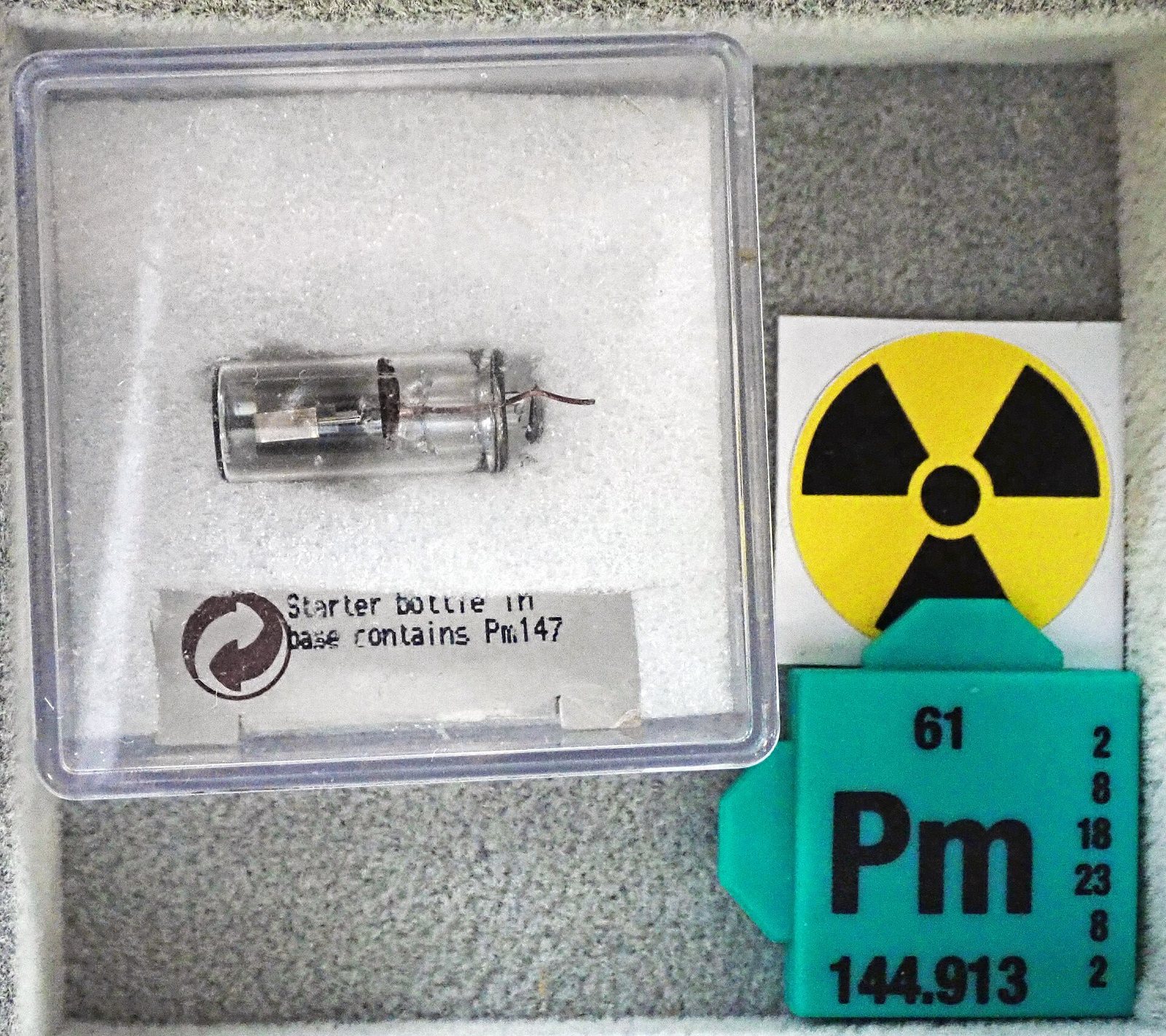
What is it?
The one rare earth with no stable form at all — every atom of it is radioactive and decays away, so essentially none exists naturally on Earth.
Why does it matter?
It completes the row, and it explains why the rare-earth series has a gap: promethium has to be made in a reactor, not mined.
Where it is in the Earth
Promethium occupies atomic number 61 in the periodic table, sitting between neodymium and samarium in the lanthanide series. Every isotope of promethium is radioactive, meaning the nucleus of every promethium atom is unstable and will, in time, shed particles and energy until it becomes a different element altogether. The half-lives involved — the time it takes for half of a given quantity to decay away — are short on geological timescales. The longest-lived isotope, promethium-145, has a half-life measured in years rather than millennia. Any promethium that existed when the Earth formed roughly four and a half billion years ago decayed away completely long before the first rocks solidified into their present form.
This is why the element has no ore minerals listed in the table above and why no deposit of it exists anywhere on Earth. Trace quantities do arise spontaneously through a process called spontaneous fission, in which uranium atoms in certain minerals occasionally split apart and produce promethium as a fragment, and minuscule amounts appear in the fission products of natural uranium decay chains. But these quantities are so vanishingly small that they are of no practical consequence. For all purposes relevant to supply and industry, promethium does not occur in the Earth's crust in any meaningful sense. The gap it leaves in the lanthanide sequence is not an accident of exploration or a failure to find the right rock type — it is a consequence of nuclear physics.
Getting it out
There is nothing to mine. Because promethium has no stable form and no geologically significant natural occurrence, the production and reserve figures in the tables above are empty not because the data are withheld but because the quantities genuinely do not exist to report. The concept of ore grade — the concentration of a target element in the rock being extracted — has no application here, and neither do the familiar questions about waste rock ratios or pit geometry.
Promethium is instead produced inside nuclear reactors. When uranium fuel undergoes fission, the nucleus of each splitting atom breaks into two smaller fragments; promethium isotopes appear among those fragments. The element can also be made by bombarding neodymium or praseodymium targets with neutrons inside a reactor. Either way, the output is measured in grams rather than in the tonnes or kilograms that frame discussions of even the scarcest conventionally mined materials. The traded form shown in the database — a reactor-produced isotope used in nuclear batteries and thickness gauges — reflects this reality entirely. Production is a radiochemical operation, not an extractive one.
What pulls on it
The uses that create demand for promethium are narrow and specialised, which is consistent with the fact that supply is itself narrow and tightly controlled. Nuclear batteries — more formally called radioisotope thermoelectric generators or betavoltaic cells — exploit the energy released as promethium decays to generate small but steady electrical currents. This makes promethium useful in contexts where a conventional battery would need replacing and replacement is difficult or impossible: certain military and aerospace instruments, remote sensing equipment, and similar applications where reliability over years without maintenance matters more than the cost or the complication of using a radioactive source.
Thickness gauges represent a second application. When a thin sheet of material passes between a promethium source and a detector, the degree to which the emitted radiation is absorbed tells a measuring system how thick the sheet is. This technique is used in manufacturing processes where continuous, non-contact measurement of material thickness is needed. Neither of these applications drives large quantities; demand is calibrated in grams rather than tonnes. The end-markets table above is empty not because the uses are unknown but because they do not generate reportable commercial tonnages. Demand would change sharply only if a significantly better radioactive source displaced promethium in existing devices, or if some new technology created a genuinely novel requirement for its specific nuclear properties.