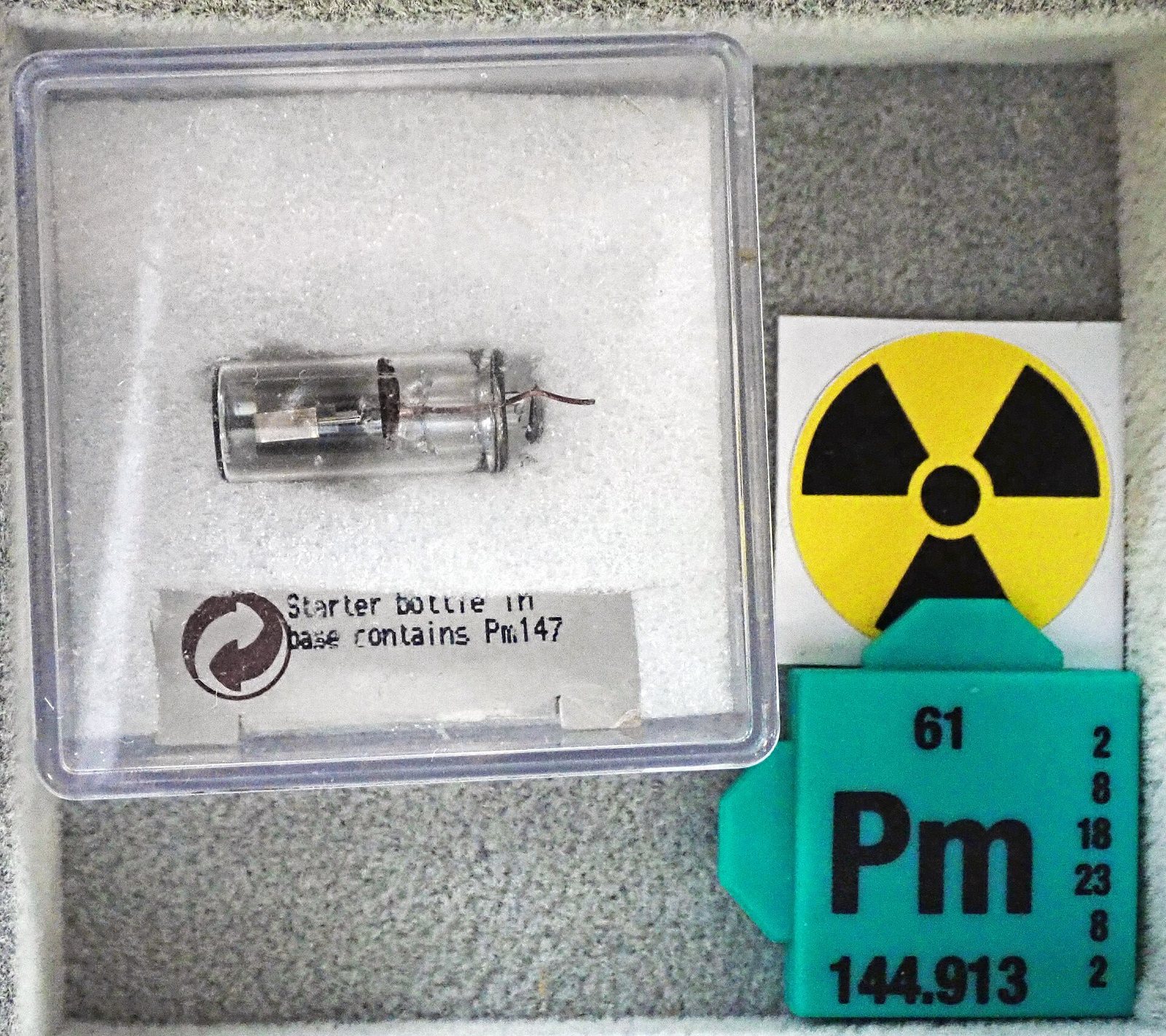
这是什么?
The one rare earth with no stable form at all — every atom of it is radioactive and decays away, so essentially none exists naturally on Earth.
为何重要?
It completes the row, and it explains why the rare-earth series has a gap: promethium has to be made in a reactor, not mined.
Where it is in the Earth
Promethium occupies atomic number 61 in the periodic table, sitting between neodymium and samarium in the lanthanide series. Every isotope of promethium is radioactive, meaning the nucleus of every promethium atom is unstable and will, in time, shed particles and energy until it becomes a different element altogether. The half-lives involved — the time it takes for half of a given quantity to decay away — are short on geological timescales. The longest-lived isotope, promethium-145, has a half-life measured in years rather than millennia. Any promethium that existed when the Earth formed roughly four and a half billion years ago decayed away completely long before the first rocks solidified into their present form.
This is why the element has no ore minerals listed in the table above and why no deposit of it exists anywhere on Earth. Trace quantities do arise spontaneously through a process called spontaneous fission, in which uranium atoms in certain minerals occasionally split apart and produce promethium as a fragment, and minuscule amounts appear in the fission products of natural uranium decay chains. But these quantities are so vanishingly small that they are of no practical consequence. For all purposes relevant to supply and industry, promethium does not occur in the Earth's crust in any meaningful sense. The gap it leaves in the lanthanide sequence is not an accident of exploration or a failure to find the right rock type — it is a consequence of nuclear physics.
Getting it out
There is nothing to mine. Because promethium has no stable form and no geologically significant natural occurrence, the production and reserve figures in the tables above are empty not because the data are withheld but because the quantities genuinely do not exist to report. The concept of ore grade — the concentration of a target element in the rock being extracted — has no application here, and neither do the familiar questions about waste rock ratios or pit geometry.
Promethium is instead produced inside nuclear reactors. When uranium fuel undergoes fission, the nucleus of each splitting atom breaks into two smaller fragments; promethium isotopes appear among those fragments. The element can also be made by bombarding neodymium or praseodymium targets with neutrons inside a reactor. Either way, the output is measured in grams rather than in the tonnes or kilograms that frame discussions of even the scarcest conventionally mined materials. The traded form shown in the database — a reactor-produced isotope used in nuclear batteries and thickness gauges — reflects this reality entirely. Production is a radiochemical operation, not an extractive one.
What pulls on it
The uses that create demand for promethium are narrow and specialised, which is consistent with the fact that supply is itself narrow and tightly controlled. Nuclear batteries — more formally called radioisotope thermoelectric generators or betavoltaic cells — exploit the energy released as promethium decays to generate small but steady electrical currents. This makes promethium useful in contexts where a conventional battery would need replacing and replacement is difficult or impossible: certain military and aerospace instruments, remote sensing equipment, and similar applications where reliability over years without maintenance matters more than the cost or the complication of using a radioactive source.
Thickness gauges represent a second application. When a thin sheet of material passes between a promethium source and a detector, the degree to which the emitted radiation is absorbed tells a measuring system how thick the sheet is. This technique is used in manufacturing processes where continuous, non-contact measurement of material thickness is needed. Neither of these applications drives large quantities; demand is calibrated in grams rather than tonnes. The end-markets table above is empty not because the uses are unknown but because they do not generate reportable commercial tonnages. Demand would change sharply only if a significantly better radioactive source displaced promethium in existing devices, or if some new technology created a genuinely novel requirement for its specific nuclear properties.
Turning ore into product 级别 3
Once promethium has been produced in a reactor, the work of separating it from the mixture of other fission products is a radiochemical challenge rather than a metallurgical one. Fission yields dozens of different isotopes simultaneously, and the target promethium fraction must be isolated from neighbours that are chemically similar — a difficulty the lanthanide series presents even under ordinary circumstances, since the elements in that group differ from one another only subtly in ionic radius. Ion-exchange chromatography and solvent extraction, the same broad families of technique used to separate stable rare earths, are applied here, but the entire operation must be conducted behind radiation shielding, with handling times constrained by the ongoing decay of the material.
The density of promethium metal is given in the database as 7.26 grams per cubic centimetre and its melting point as 1042 degrees Celsius, figures that characterise the pure metal. In practice, the end-use forms are typically sealed radioactive sources — the promethium encapsulated in a housing that captures its emitted beta radiation or converts it to electricity — rather than bulk metal. Losses during separation are not reported openly in the literature in the way that recovery rates for commercial metals are disclosed, partly because production volumes are small enough that the economics differ entirely from those of conventional refining, and partly because reactor facilities operate under regulatory frameworks that govern how radiological material accounting is reported.
Substitution and recycling 级别 3
Substitution for promethium depends entirely on which property the application requires. In nuclear batteries, other beta-emitting isotopes — such as tritium or certain isotopes of strontium — can in principle fulfil a similar role, though each brings different half-lives, different radiation characteristics, and different handling requirements that affect how well they fit a given device. No substitute is straightforwardly superior across all parameters; the choice is an engineering trade-off between decay energy, half-life, the nature of the emitted radiation, and the regulatory burden associated with each isotope. For thickness gauging, other radioactive sources and, in some configurations, entirely different measurement technologies such as X-ray systems or laser gauges can achieve comparable results without radioactive material at all.
Recycling of promethium is constrained first by the physics: the material decays continuously, so any promethium that has been used in a device is partly gone by the time the device reaches end of life. Spent sealed sources do enter regulated waste-handling streams, but reconstitution of the promethium content is not a meaningful pathway given the quantities involved and the decay that has already occurred. The recycling fraction is not reported in the database and is, in any practical sense, negligible.
Where the chain is fragile 级别 4
The supply chain for promethium sits entirely outside the frameworks that govern conventional critical-material risk assessments. There are no producing countries in the ordinary sense, no mine-level concentration ratios, no reserve life calculations to dispute. Supply depends on the operational capacity of nuclear reactors capable of irradiating targets or processing fission products, and on the radiochemical facilities equipped to handle the separation. Both types of facility are limited in number globally, exist predominantly within national nuclear programmes, and are subject to regulatory oversight that has no direct parallel in commercial mining or refining. Access to promethium is therefore as much a question of international nuclear cooperation frameworks as it is of industrial supply chains.
Published figures on promethium production are essentially absent from open commercial databases, and the data block for this entry reflects that accurately. Where numbers do appear in the scientific literature, they describe experimental or research quantities and do not constitute a market in any conventional sense. The unit basis noted in the database — gram quantities — signals that the usual analytical tools for assessing supply risk, such as comparing mine production against reserve estimates or calculating processing bottlenecks in terms of annual throughput, do not translate. The meaningful uncertainties are instead about reactor availability, isotope separation capacity, and the regulatory conditions under which radioactive material can be transferred between institutions or across borders, none of which are captured in the kind of national production statistics that populate the tables for other elements on this site.
It is worth noting that the half-life of the commercially relevant isotopes introduces a time dimension that has no counterpart in stable-element supply chains. A stockpile of promethium is not a fixed reserve: it diminishes continuously regardless of whether any material is used. This means that even if production capacity were expanded, the ability to accumulate strategic stocks is inherently limited by the physics of radioactive decay, and lead times for reactor-based production must be matched carefully against the time window in which the product remains useful.