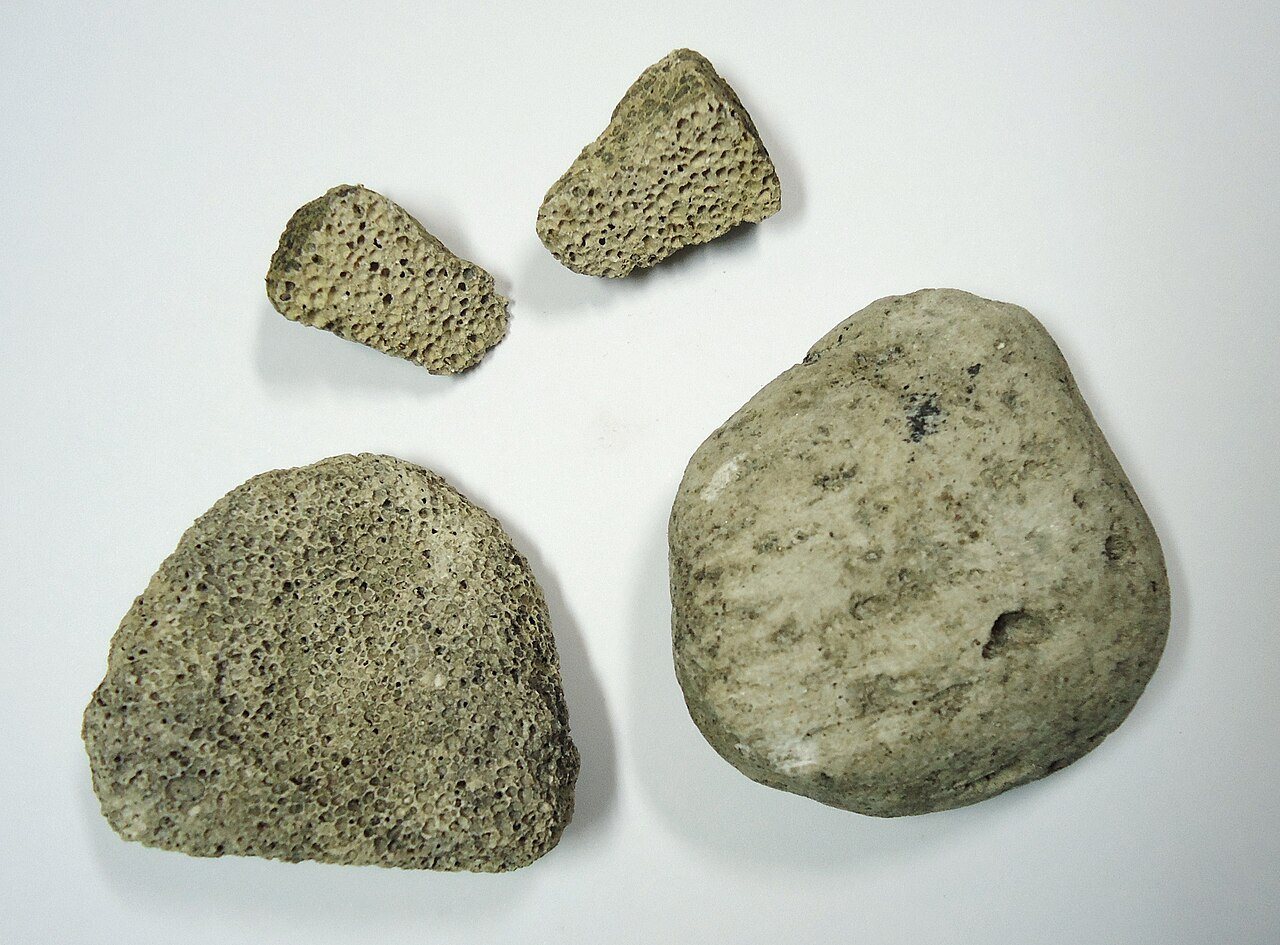
Che cos'è?
Volcanic froth — rock so full of gas bubbles that it floats — quarried for lightweight concrete and abrasives.
Perché è importante?
Pumice is why some concrete blocks are light enough to lift one-handed, and why stonewashed denim looks the way it does.
Where it is in the Earth
Pumice is born from violent volcanic eruptions in which silica-rich magma — molten rock with a high proportion of dissolved gases — is ejected so rapidly that the gases cannot escape in an orderly way. Instead they expand as countless tiny bubbles at the moment the magma reaches the surface, freezing in place as the melt quenches almost instantaneously into glass. The result is a rigid foam: a rock whose volume is dominated by sealed or connected pores rather than solid mineral matter. This is why a fresh piece of pumice floats on water, a property geologists call vesicularity. Pumicite is simply the finer, more powdery equivalent — either erupted directly as a fine ash or produced when coarser pumice weathers and fragments over time.
The deposits that are large enough to quarry economically are almost always associated with rhyolitic or dacitic volcanism — eruption types that produce high-silica lavas capable of holding large quantities of dissolved gas until the moment of explosive release. Basaltic lavas, which are lower in silica and generally less viscous, tend to lose their gas more gently and produce denser rocks. This is why the world map of pumice production follows the great volcanic arcs and rift zones: the Mediterranean island chains, the Andean cordillera, the East African Rift, and the island arcs of the western Pacific. Turkey's dominance in the production tables is a direct consequence of its position at the intersection of several major tectonic zones that have generated extensive rhyolitic eruptions, leaving thick, accessible pumice deposits across parts of Anatolia and on islands such as Neşe and in the region around the Cappadocia volcanic field.
Deposits vary considerably in thickness, lateral extent, and purity. The most valuable accumulations are those where erupted material settled in thick, relatively uncontaminated beds — either as ignimbrites (sheets of hot pyroclastic material that welded or cooled quickly) or as fall deposits where wind carried the ejected fragments a consistent distance from the vent before they settled. Where pumice has been reworked by rivers or the sea, individual deposits can extend over wide areas but may be mixed with other sediments, reducing the grade available for direct use.
Getting it out
Pumice is almost universally extracted by open-pit quarrying, and the reasons for this are straightforward. The deposits are surficial or near-surface, formed by volcanic eruptions that laid material down on the landscape rather than intruding it deep into the crust. The rock itself is soft and highly porous, meaning it requires no blasting in most cases: mechanical excavators, scrapers and bulldozers can break and load it directly. This makes pumice one of the lower-cost industrial minerals to extract in terms of energy and equipment complexity. Overburden — the soil, vegetation and any overlying rock that must be moved before reaching the usable pumice — is typically modest relative to the thickness of the pumice layer, which in productive deposits can run to many metres.
Unlike metallic ores, where the concept of a cut-off grade (the minimum metal content that makes processing worthwhile) drives decisions about what to mine and what to leave, pumice is assessed primarily on physical properties: vesicularity, colour, hardness, and the absence of dense inclusions or contaminating minerals. A pocket of material that is too dense — because the original lava cooled slowly enough for bubbles to collapse — may be left in place or blended away, but there is no chemical assay driving the decision. Waste ratios are consequently low by the standards of mining: most of what is dug up can be sold in one form or another, either as coarse aggregate, as milled pumicite, or as finer fractions for abrasive and horticultural uses.
Where deposits occur on islands or coastal cliffs, extraction sometimes involves quarrying directly into the sea-facing face, with material loaded onto barges. Greece's Aegean island deposits have historically been worked this way. In landlocked settings, standard road haulage to a nearby processing facility is the norm. Because pumice is low in value per tonne relative to transport costs, quarries must be reasonably close to either a processing plant or a port; long inland hauls quickly erode any margin.
What pulls on it
The largest single pull on pumice comes from the construction sector, where it is used as a lightweight aggregate in concrete blocks and panels. Concrete made with pumice aggregate weighs considerably less than concrete made with conventional crushed rock, which matters for upper floors, partition walls and any application where self-weight of the structure is a design constraint. Demand from this sector broadly tracks construction activity, particularly residential and commercial building in countries where pumice deposits are accessible and local stone is expensive to quarry or transport. The Mediterranean basin, the Middle East and East Africa — all regions well represented in the production tables — have active construction markets that draw on local pumice supply.
The stonewashing of denim and other garments is the application most people encounter indirectly. Pumice stones tumbled together with fabric in large industrial washing machines abrade the surface of the textile, producing the faded, worn appearance that has been a consistent fashion preference for several decades. This use is sensitive to fashion cycles and to competition from chemical and ozone-based finishing processes that can replicate the aesthetic without physical abrasion. The finishing industry has been exploring these alternatives partly to reduce the logistics of handling and disposing of the residual pumice dust that accumulates in wastewater after tumbling.
Horticultural uses — pumice as a drainage amendment in potting media and as a growing substrate in hydroponic systems — have grown steadily as commercial horticulture has moved toward soilless cultivation methods. Filtration applications, where pumice's open pore structure makes it useful as a slow-flow filter medium for water treatment, represent a smaller but stable outlet. For demand to shift sharply upward, the main driver would be an acceleration in lightweight construction in regions currently underserved by local supply; for demand to fall, the most plausible mechanism would be a sustained move away from pumice in textile finishing or the displacement of pumice concrete block by competing lightweight systems.
Turning ore into product Livello 3
Raw quarried pumice reaches the processing plant as a heterogeneous mix of lumps, fines and occasional dense inclusions. The first stage is screening — passing material over vibrating mesh screens to separate it by particle size. This alone produces several distinct product streams: coarse lumps used in construction aggregate, medium fractions for concrete block manufacture, and fines that are collected as crude pumicite. Material that is too dense sinks out during wet processing or is separated by visual inspection and hand-sorting at smaller operations. The critical physical principle exploited here is the same one that defines pumice in the first place: its low bulk density relative to ordinary rock. Wet jigging or hydraulic classifiers can separate lighter, more vesicular fragments from denser material by allowing water currents to stratify the feed by effective density.
Milling is the next step for value-added products. Pumicite for use in abrasive preparations, filtration media or as a pozzolan (a siliceous material that reacts with calcium hydroxide to form cementitious compounds) must be ground to controlled particle-size distributions. Ball mills or roller mills reduce the coarser fractions to the required fineness, and air classification — in which particles are separated by their settling velocity in an upward air current — allows tight cuts to be made without the energy cost of over-grinding. Losses in processing are relatively low because the material itself is not being chemically transformed; the main source of yield reduction is the rejection of dense or discoloured fragments and any fines too small to handle economically, which may go to waste or find lower-value outlets.
For the stonewashing application, pumice is sold as graded lumps rather than as powder, and quality control centres on hardness consistency and the absence of inclusions that could scratch or mark denim unevenly. For lightweight concrete block, the aggregate fraction must meet specific grading curves and maximum density limits set by the relevant construction standards. This means that a single quarry will typically produce several commercial grades simultaneously, with the economics of the operation depending on selling all of them rather than just the premium fraction.
Substitution and recycling Livello 3
In lightweight aggregate applications, pumice competes with expanded clay (sold under trade names based on the rotary kiln process that puffs clay pellets with heat), expanded shale, and various industrial by-products such as slag and fly ash that have been processed into lightweight forms. These alternatives can generally match pumice's density reduction, but they are manufactured products with energy-intensive production processes, which gives natural pumice a cost advantage in markets close to deposits. Where pumice is distant and transport costs are high, manufactured lightweight aggregates close the gap. Perlite — another volcanic mineral that is expanded by rapid heating — overlaps with pumice in some filtration and horticultural applications and is a direct competitor there.
In textile finishing, the substitutes are process changes rather than material swaps. Cellulase enzymes can achieve a biowashed appearance on denim, ozone treatment can fade fabric without physical contact, and laser finishing can simulate wear patterns with high precision. Each of these approaches eliminates the abrasive step entirely rather than substituting a different mineral for pumice. Their adoption has been uneven: some markets and brands have moved substantially toward enzyme and laser finishing, while others continue with pumice for cost or aesthetic reasons. If regulatory pressure on wastewater from finishing plants increases in major producing countries, the rate of substitution away from pumice in textiles could accelerate.
Recycling of pumice is not practically meaningful. The material is consumed or comminuted in use — stonewashing grinds it to silt, concrete aggregate locks it permanently into the matrix, and filtration media exhausts its capacity over time. There is no economically viable route to recover pumice from any of these end uses and return it to the supply chain. This means the industry is entirely dependent on mined supply with no secondary source to buffer it.
Where the chain is fragile Livello 4
The most evident structural feature of the pumice supply picture is geographic concentration at the production stage. Turkey alone accounts for nearly half of recorded world output at 9,700 thousand metric tonnes out of a world total of 20,000 thousand metric tonnes in 2025. This is not the same kind of concentration risk that applies to, say, a critical metal where a single country controls refining capacity for globally traded material — pumice deposits are widespread and the barriers to entry are low — but it does mean that Turkish export policy, logistics infrastructure and domestic demand have an outsized influence on international trade in higher-grade pumicite products. A period of strong Turkish domestic construction demand can tighten export availability without any change in global reserves.
The absence of published reserve figures in standard reporting is itself informative. Unlike metallic minerals where reserve estimation follows established codes (JORC, NI 43-101 and similar), pumice deposits are rarely subject to formal resource estimation because the economics do not require it: the material is so widespread and the barriers to opening a new quarry are low enough that formal reserve declaration adds limited value to operators. This means that published figures focus on annual production rather than resource life, and independent assessment of how long any given deposit will sustain output is difficult from public data alone. Reported figures aggregate many small operators, and the unit values shown in the price series — ranging from 41 to 65 dollars per metric tonne f.o.b. mine or mill across 2021 to 2025 — reflect blended averages across product grades and origins, masking the spread between commodity-grade aggregate and higher-specification milled pumicite.
Permitting and lead-time risks are lower for pumice than for hard-rock metallic mines, because open-pit quarrying of a non-toxic, non-radioactive industrial mineral in established volcanic terrain rarely triggers the same regulatory scrutiny as a new metal mine. The primary constraints on supply expansion are access to land, proximity to transport infrastructure, and proximity to the market — not processing technology or capital intensity. Where demand were to shift sharply, new supply from currently unexploited deposits in countries already appearing in the production table could respond within a few years rather than the decade-plus timescales typical of base-metal project development. The fragility of the chain lies less in geological scarcity or technical processing bottlenecks and more in the logistics of a bulky, low-value commodity whose economics depend on short supply chains and where trade statistics from smaller producing countries are often estimated rather than directly measured.
Chi lo produce
Visualizza sulla mappa →Mine production
Mine productionthousand metric tons 2025 (stimato) Totale mondiale 20,000 thousand metric tons
USGS Mineral Commodity Summaries 2026 · Gross weight. · fonte ↗
Scorrere la tabella lateralmente per visualizzare le colonne rimanenti.
| Paese | Produzione | Quota mondiale |
|---|---|---|
| Turkey | 9,700 | 48.5% |
| Jordan | 1,100 | 5.5% |
| Other countries | 1,100 | 5.5% |
| Greece | 1,000 | 5.0% |
| Saudi Arabia | 980.0 | 4.9% |
| Algeria | 900.0 | 4.5% |
| Uganda | 830.0 | 4.2% |
| Ecuador | 800.0 | 4.0% |
| Guatemala | 570.0 | 2.9% |
| Chile | 530.0 | 2.6% |
| Ethiopia | 510.0 | 2.5% |
| United States | 430.0 | 2.1% |
| Cameroon | 370.0 | 1.9% |
| Tanzania | 350.0 | 1.8% |
| Spain | 300.0 | 1.5% |
| Jamaica | 290.0 | 1.4% |
| France | 280.0 | 1.4% |
| Totale mondiale | 20,000 | 100% |
«Withheld» significa che l'USGS ha soppresso il dato per evitare di divulgare informazioni relative a una singola azienda — non equivale a zero. I valori per paese non sempre sommano al totale mondiale perché la fonte arrotonda ciascun dato in modo indipendente e non sempre disaggrega la voce «altri paesi».
Prezzo
average unit value, f.o.b. mine or mill, dollars per metric ton
Media annualedollars per metric ton
Base: average unit value, f.o.b. mine or mill, dollars per metric ton. Medie annuali pubblicate in USGS Mineral Commodity Summaries 2026 · fonte ↗. Queste sono medie annuali di riferimento, non quotazioni di mercato in tempo reale.