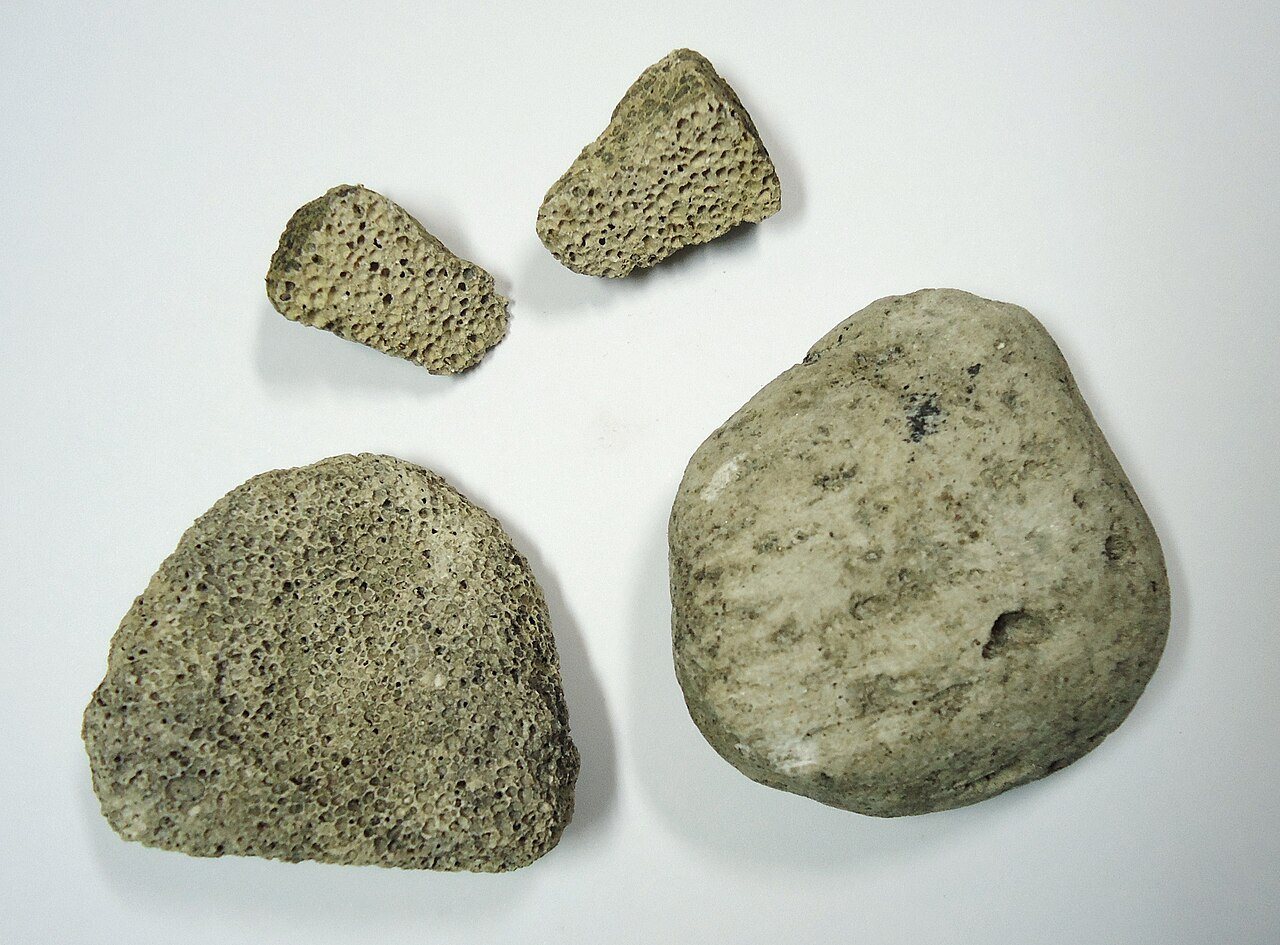
이것은 무엇인가?
Volcanic froth — rock so full of gas bubbles that it floats — quarried for lightweight concrete and abrasives.
왜 중요한가?
Pumice is why some concrete blocks are light enough to lift one-handed, and why stonewashed denim looks the way it does.
Where it is in the Earth
Pumice is born from violent volcanic eruptions in which silica-rich magma — molten rock with a high proportion of dissolved gases — is ejected so rapidly that the gases cannot escape in an orderly way. Instead they expand as countless tiny bubbles at the moment the magma reaches the surface, freezing in place as the melt quenches almost instantaneously into glass. The result is a rigid foam: a rock whose volume is dominated by sealed or connected pores rather than solid mineral matter. This is why a fresh piece of pumice floats on water, a property geologists call vesicularity. Pumicite is simply the finer, more powdery equivalent — either erupted directly as a fine ash or produced when coarser pumice weathers and fragments over time.
The deposits that are large enough to quarry economically are almost always associated with rhyolitic or dacitic volcanism — eruption types that produce high-silica lavas capable of holding large quantities of dissolved gas until the moment of explosive release. Basaltic lavas, which are lower in silica and generally less viscous, tend to lose their gas more gently and produce denser rocks. This is why the world map of pumice production follows the great volcanic arcs and rift zones: the Mediterranean island chains, the Andean cordillera, the East African Rift, and the island arcs of the western Pacific. Turkey's dominance in the production tables is a direct consequence of its position at the intersection of several major tectonic zones that have generated extensive rhyolitic eruptions, leaving thick, accessible pumice deposits across parts of Anatolia and on islands such as Neşe and in the region around the Cappadocia volcanic field.
Deposits vary considerably in thickness, lateral extent, and purity. The most valuable accumulations are those where erupted material settled in thick, relatively uncontaminated beds — either as ignimbrites (sheets of hot pyroclastic material that welded or cooled quickly) or as fall deposits where wind carried the ejected fragments a consistent distance from the vent before they settled. Where pumice has been reworked by rivers or the sea, individual deposits can extend over wide areas but may be mixed with other sediments, reducing the grade available for direct use.
Getting it out
Pumice is almost universally extracted by open-pit quarrying, and the reasons for this are straightforward. The deposits are surficial or near-surface, formed by volcanic eruptions that laid material down on the landscape rather than intruding it deep into the crust. The rock itself is soft and highly porous, meaning it requires no blasting in most cases: mechanical excavators, scrapers and bulldozers can break and load it directly. This makes pumice one of the lower-cost industrial minerals to extract in terms of energy and equipment complexity. Overburden — the soil, vegetation and any overlying rock that must be moved before reaching the usable pumice — is typically modest relative to the thickness of the pumice layer, which in productive deposits can run to many metres.
Unlike metallic ores, where the concept of a cut-off grade (the minimum metal content that makes processing worthwhile) drives decisions about what to mine and what to leave, pumice is assessed primarily on physical properties: vesicularity, colour, hardness, and the absence of dense inclusions or contaminating minerals. A pocket of material that is too dense — because the original lava cooled slowly enough for bubbles to collapse — may be left in place or blended away, but there is no chemical assay driving the decision. Waste ratios are consequently low by the standards of mining: most of what is dug up can be sold in one form or another, either as coarse aggregate, as milled pumicite, or as finer fractions for abrasive and horticultural uses.
Where deposits occur on islands or coastal cliffs, extraction sometimes involves quarrying directly into the sea-facing face, with material loaded onto barges. Greece's Aegean island deposits have historically been worked this way. In landlocked settings, standard road haulage to a nearby processing facility is the norm. Because pumice is low in value per tonne relative to transport costs, quarries must be reasonably close to either a processing plant or a port; long inland hauls quickly erode any margin.
What pulls on it
The largest single pull on pumice comes from the construction sector, where it is used as a lightweight aggregate in concrete blocks and panels. Concrete made with pumice aggregate weighs considerably less than concrete made with conventional crushed rock, which matters for upper floors, partition walls and any application where self-weight of the structure is a design constraint. Demand from this sector broadly tracks construction activity, particularly residential and commercial building in countries where pumice deposits are accessible and local stone is expensive to quarry or transport. The Mediterranean basin, the Middle East and East Africa — all regions well represented in the production tables — have active construction markets that draw on local pumice supply.
The stonewashing of denim and other garments is the application most people encounter indirectly. Pumice stones tumbled together with fabric in large industrial washing machines abrade the surface of the textile, producing the faded, worn appearance that has been a consistent fashion preference for several decades. This use is sensitive to fashion cycles and to competition from chemical and ozone-based finishing processes that can replicate the aesthetic without physical abrasion. The finishing industry has been exploring these alternatives partly to reduce the logistics of handling and disposing of the residual pumice dust that accumulates in wastewater after tumbling.
Horticultural uses — pumice as a drainage amendment in potting media and as a growing substrate in hydroponic systems — have grown steadily as commercial horticulture has moved toward soilless cultivation methods. Filtration applications, where pumice's open pore structure makes it useful as a slow-flow filter medium for water treatment, represent a smaller but stable outlet. For demand to shift sharply upward, the main driver would be an acceleration in lightweight construction in regions currently underserved by local supply; for demand to fall, the most plausible mechanism would be a sustained move away from pumice in textile finishing or the displacement of pumice concrete block by competing lightweight systems.
생산 주체
지도에서 보기 →Mine production
Mine productionthousand metric tons 2025 (추정치) 세계 합계 20,000 thousand metric tons
USGS Mineral Commodity Summaries 2026 · Gross weight. · 출처 ↗
나머지 열을 보려면 표를 옆으로 스크롤하십시오.
| 국가 | 생산 | 세계 비중 |
|---|---|---|
| Turkey | 9,700 | 48.5% |
| Jordan | 1,100 | 5.5% |
| Other countries | 1,100 | 5.5% |
| Greece | 1,000 | 5.0% |
| Saudi Arabia | 980.0 | 4.9% |
| Algeria | 900.0 | 4.5% |
| Uganda | 830.0 | 4.2% |
| Ecuador | 800.0 | 4.0% |
| Guatemala | 570.0 | 2.9% |
| Chile | 530.0 | 2.6% |
| Ethiopia | 510.0 | 2.5% |
| United States | 430.0 | 2.1% |
| Cameroon | 370.0 | 1.9% |
| Tanzania | 350.0 | 1.8% |
| Spain | 300.0 | 1.5% |
| Jamaica | 290.0 | 1.4% |
| France | 280.0 | 1.4% |
| 세계 합계 | 20,000 | 100% |
'비공개'는 USGS가 개별 기업의 데이터 노출을 막기 위해 수치를 억제한 것으로, 0을 의미하지 않습니다. 출처가 각 수치를 독립적으로 반올림하고 '기타 국가' 항목을 항상 별도로 구분하지는 않기 때문에, 국가별 합계가 세계 합계와 일치하지 않을 수 있습니다.
가격
average unit value, f.o.b. mine or mill, dollars per metric ton
연간 평균dollars per metric ton
기준: average unit value, f.o.b. mine or mill, dollars per metric ton. 다음 자료에 게재된 연간 평균 USGS Mineral Commodity Summaries 2026 · 출처 ↗. 이 수치는 기준 연간 평균값이며, 실시간 시장 가격이 아니다.