从矿石到产品,全程溯源
The Materials Atlas
材料 矿山与矿床 加工与精炼 溯源记录 供应链 企业 国家/地区 资讯
按货架浏览材料 电池材料 稀土元素 铜与电气 半导体材料 核材料 航空航天与国防 贵金属 钢铁与合金金属 工业矿物 农业矿物 能源原材料 矿石矿物 元素周期表
需求 终端市场 技术 材料计算器 地图 筛选器
学习与工具 了解术语表 数据问答AI智能体 研究与数据API ★ 已保存
关于 关于我们方法论 数据来源联系我们 免责声明
阅读选项
🧭 引导视图 初次接触矿石品位、精矿、精炼、副产品等概念?我们在您浏览时对每个术语进行解释,语言浅显易懂,数据相同,帮助内置其中。
⚡ 专家视角 您已熟悉这一行业,直接看数据即可——简洁、快速、紧凑,无附加说明。此为默认视图。
主题
界面语言
深度 材料页面分四个级别撰写。在任意材料页面选择后,系统将记住您的选择。
★ 已保存 研究与数据
Scandium

稀土元素 · Heavy rare earth

Scandium Sc · 21

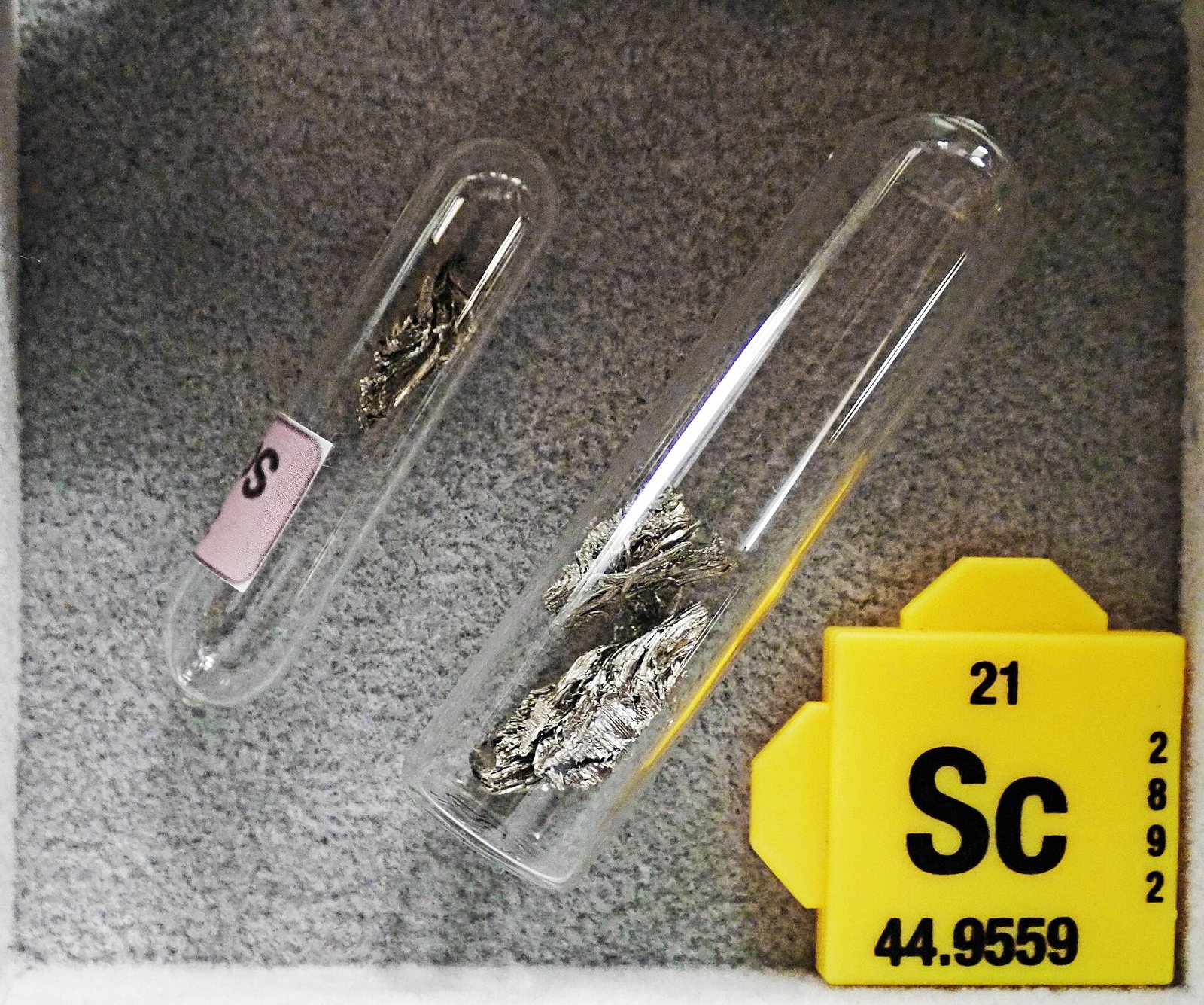
A light metal that makes aluminium dramatically stronger and weldable — and which is produced in tonnes per year worldwide, not thousands of tonnes.

Scandium (Element - 21) · James St. John · CC BY 2.0 · Wikimedia Commons

这是什么?

A light metal that makes aluminium dramatically stronger and weldable — and which is produced in tonnes per year worldwide, not thousands of tonnes.

为何重要?

Scandium-aluminium alloy is a genuinely better aerospace material that almost nobody can buy, because supply is a by-product trickle.

Where it is in the Earth

Scandium is one of the more abundant elements in the Earth's crust by weight, yet it is almost never found in a concentrated form. The reason is chemistry: scandium ions are small and carry a charge that allows them to substitute quietly into the crystal lattices of dozens of common rock-forming minerals — pyroxenes, garnets, and micas among them — without ever becoming the dominant ingredient in any of them. There is no common scandium mineral the way there is a copper mineral or an iron mineral. Instead, scandium disperses itself across much of the rock record at low, fairly uniform concentrations, which makes it geochemically common but economically elusive.

The deposits that carry enough scandium to attract attention are those where geological processes have done secondary work to concentrate it above background levels. Laterite profiles — the thick, chemically weathered crusts that develop over ultramafic rocks in tropical and subtropical climates — are the most important setting. When water percolates through these profiles over millions of years, it dissolves and removes many elements while leaving others behind. Scandium, along with nickel and cobalt, tends to be residually enriched in the lower, clay-rich portions of laterite sequences. This is also why scandium almost always appears alongside nickel and, separately, alongside titanium in ilmenite and zircon heavy-mineral sand deposits: it is a passenger in systems defined by other metals. Ion-adsorption clays, the deeply weathered granite profiles of southern China that are mined primarily for rare earth elements, carry scandium as a further minor component, adsorbed onto clay mineral surfaces alongside the rarer lanthanides.

Australia holds the largest reported reserves, and the geology there is consistent with this pattern: the Syerston deposit in New South Wales sits within a lateritised ultramafic intrusion. Most other significant concentrations are similarly tied to laterite nickel or titanium mineral-sand provinces, which explains both the geography of potential supply and the structural difficulty of ever treating scandium as anything other than a minor companion to something else.

Getting it out

Because scandium has no deposit type of its own, it is not mined for its own sake anywhere in the world at commercial scale. It arrives as a by-product — a trace constituent recovered from the processing streams of operations that exist to produce nickel, cobalt, titanium, aluminium, or rare earth elements. The world total production figure in the table above, reported in tonnes of scandium oxide per year, reflects this reality: the number is small enough that the U.S. Geological Survey reports it as a range rather than a single figure.

In practice, scandium reaches a refinery not because a mine was designed around it, but because some processing step — acid leaching of laterite ore, for instance — dissolves scandium along with the target metal, and someone has chosen to install additional circuits to capture it from the pregnant leach solution rather than let it pass into tailings. The grade of scandium in the host material is typically measured in parts per million, meaning that even after all the processing of a large nickel laterite, the total scandium recovered may be a small fraction of the plant's output by mass. The concept of waste-to-product ratio, which in conventional mining describes how many tonnes of rock must be moved per tonne of saleable product, translates here into a question of how much leach solution must be processed and how many additional chemical steps must be run to yield a kilogram of scandium oxide.

The consequence is that scandium supply is not governed by decisions about scandium. It is governed by decisions about nickel, titanium, or rare earths. If those host operations run at high throughput, scandium recovery is possible; if they curtail, scandium output falls regardless of demand or price for scandium itself. This structural dependence is the central fact about scandium supply and the reason the price history shown in the table above does not behave like that of a commodity with elastic supply.

What pulls on it

The uses of scandium divide neatly into two categories at very different scales. The larger potential use — stronger, more weldable aluminium alloys for aerospace structures, fuel systems, and defence applications — has been understood since the Soviet Union incorporated scandium-aluminium alloys into military aircraft frames. Small additions of scandium to aluminium refine the grain structure of the metal during solidification, which improves both strength and resistance to cracking during welding. The resulting alloys are genuinely superior to conventional high-strength aluminium in several respects. The reason this potential has not translated into mass adoption is supply: quantities available are insufficient to support high-volume aerospace manufacturing at acceptable certainty of delivery, and the price per kilogram of scandium oxide remains far above the threshold at which alloy use becomes routine.

The second category of use is as an electrolyte material in solid-oxide fuel cells (SOFCs). Scandia-stabilised zirconia — zirconium oxide doped with scandium oxide — conducts oxygen ions at lower operating temperatures than conventional yttria-stabilised zirconia, which is the dominant electrolyte material. This efficiency advantage is real but comes at the cost of using a scarce and expensive oxide. SOFC manufacturers have consequently remained cautious about committing to scandia-stabilised formulations at scale, and the market remains small. Ceramics and phosphors account for further minor uses.

For demand to shift sharply upward, at least one of two things would need to happen. Either aerospace manufacturers would need to secure long-term, reliable supply contracts at volumes sufficient to qualify scandium-aluminium alloys in certified structures — a process that takes years — or the SOFC industry would need to grow to a scale where scandia-stabilised electrolytes justify dedicated supply chains. Either pathway requires supply to become reliably available first, which creates a circular problem: supply does not scale without demand, and demand does not commit without supply.

Turning ore into product 级别 3

Recovering scandium from a laterite leach circuit begins with the same sulfuric acid or hydrochloric acid dissolution used for the target metal — nickel or cobalt — which brings scandium, along with iron, aluminium, and other impurities, into solution. The separation challenge is then to isolate scandium from a highly complex liquor where it is present at trace concentration alongside elements at far higher concentrations. Solvent extraction, the workhorse separation technique of hydrometallurgy, is the standard approach: an organic solvent carrying a specific extractant molecule is contacted with the leach liquor, and scandium is selectively pulled into the organic phase. Multiple stages of extraction and scrubbing are required because the selectivity is imperfect, particularly in separating scandium from titanium and zirconium, which have similar ionic chemistry. Stripping — reversing the extraction with a different aqueous solution — then recovers the scandium into a cleaner, more concentrated solution.

From that intermediate, precipitation with oxalic acid or ammonia produces a scandium-bearing solid that is calcined (heated in a furnace to drive off water and organic residues) to give scandium oxide, the form in which the element is most commonly traded. Further reduction steps — typically using calcium metal as a reductant in a sealed reactor — are needed to produce scandium metal. Alloying with aluminium to make a master alloy (a concentrated precursor that can then be diluted into aluminium melts) is a separate metallurgical step carried out at specialist facilities. The losses at each stage accumulate: scandium that enters the leach but is not efficiently extracted, scandium that co-precipitates with unwanted solids and reports to waste, and scandium that remains in raffinate (the spent aqueous phase after solvent extraction). Overall recoveries from host ore to final oxide depend heavily on the selectivity of the solvent extraction circuit and the care taken to manage competing impurities, and these figures vary between operations and are not generally published in the open literature.

The cost structure reflects this chain. The host mine bears the cost of ore extraction and primary leaching; the scandium recovery circuit adds capital and operating cost for what may be a small incremental revenue stream relative to nickel or cobalt. This economics argument — whether the scandium credits justify the additional plant — is what determines whether a given laterite operator installs recovery at all, and most do not. The processing plants that do produce scandium oxide are concentrated in China, with some capacity in Russia tied to uranium and titanium processing streams, and emerging capacity elsewhere linked to nickel projects.

Substitution and recycling 级别 3

In aluminium alloys, the performance that small additions of scandium provide — grain refinement, weld-zone strength, resistance to recrystallisation during heat treatment — can be approximated but not fully replicated by other alloying elements. Zirconium is the closest functional substitute for grain refinement, and titanium and hafnium have some analogous effects; these elements are used in aerospace aluminium alloys already, and they are considerably cheaper and more available. The trade-off is that none of them provides the same combination of properties at the same addition levels, so a designer moving away from scandium must either accept lower performance or compensate with additional alloy content and processing steps. In welded structures specifically, the loss of scandium's effect on the heat-affected zone is difficult to recover through other means without redesigning the joint.

In solid-oxide fuel cells, yttria-stabilised zirconia is the established electrolyte, and it functions adequately, though at higher operating temperatures than scandia-stabilised alternatives. Gadolinium- and samarium-doped ceria are also used. These substitutes are available at far greater scale and lower cost, which is precisely why scandia-stabilised zirconia has not displaced them despite its performance advantages. The substitution here runs in both directions: scandium may substitute for yttrium, but yttrium also substitutes for scandium, and the direction the market takes depends on whether the temperature-reduction benefit of scandium is worth the supply risk and cost premium.

Recycling of scandium is negligible in practice. The quantities present in any given manufactured article are small, and the articles themselves — aircraft frames, fuel-cell stacks — are not processed through streams designed to recover scandium at end of life. Aluminium scrap recycling captures the bulk metal but not the trace scandium, which disperses into general aluminium secondary material at concentrations too low to recover economically. No significant secondary supply exists, and the structural reasons for this — dispersal into large-mass products at trace addition levels — are not likely to change without a deliberate and costly collection and processing scheme that does not currently exist anywhere.

Where the chain is fragile 级别 4

The supply picture for scandium presents several overlapping sources of fragility, each of which is worth treating separately because they interact in ways that make aggregate risk difficult to quantify. The first is concentration: China is the leading producing country, and the United States reports 100 percent net import reliance, sourcing material through Japan and China as intermediaries. The precise share of world production attributable to China is withheld by USGS in the data underlying this page, which itself reflects a reporting environment where production figures are uncertain and not fully disclosed by the major producing country. Even the world total production figure is given as a range rather than a point estimate, which is a signal about data quality, not just about the smallness of the market.

The second source of fragility is by-product dependence. Scandium supply is a function of decisions made by operators of nickel laterite, titanium, and uranium processing facilities, none of whom regard scandium as their primary business. A decision to curtail a nickel operation for reasons having nothing to do with scandium — commodity price, permitting, energy cost — immediately reduces scandium availability. There is no primary scandium mine anywhere in the world that could absorb this reduction by increasing output; the infrastructure does not exist. Australia holds the largest reported reserves at 34,000 metric tonnes, and projects there have been in various stages of development for years, but as of the data available to this page, no operating mine appears in the mines table, which reflects where the industry actually stands rather than where it aspires to be.

The third fragility is the processing bottleneck. Even where scandium-bearing feed material is available, the specialised solvent extraction and refining capacity to convert it to oxide and metal is concentrated in a small number of facilities. Building new capacity requires capital expenditure that is difficult to justify when the downstream demand remains constrained by supply uncertainty — the circularity noted in the demand section has a supply-chain analogue. Lead times for permitting, constructing, and commissioning a hydrometallurgical plant capable of producing battery-grade or aerospace-grade scandium compounds are measured in years, and the track record of projects reaching production on schedule in this sector is not strong. Researchers working with published production and trade data should be aware that the figures reported by different national statistical agencies use different unit bases and reporting thresholds, and that the volumes involved are small enough that a single plant starting or stopping can shift apparent world production substantially within a single reporting year.

正确读取数据。 World production is reported in tonnes of scandium oxide and is small enough that USGS gives a range. Oxide, master alloy with aluminium, and solid-oxide fuel-cell electrolyte.

其在岩石中的来源

所有含矿矿物 →

实际承载以下内容的矿物: scandium. 只有其中某种物质的富集程度足以覆盖开采成本,矿床才能成为矿体。

global production

global productionmetric tons 2025 (估计值) 全球合计 80.00 metric tons

USGS Mineral Commodity Summaries 2026 · World production is reported in tonnes of scandium oxide and is small enough that USGS gives a range. · 来源 ↗

横向滚动表格以查看其余列。

国家/地区产量 占全球份额
全球合计 80.00100%

"未披露"表示美国地质调查局(USGS)为避免泄露单个企业数据而对该数字进行了保密处理——并不意味着数值为零。各国行数之和不一定等于世界合计,原因在于来源对每个数字单独进行四舍五入处理,且并不总是单独列出"其他国家/地区"一行。

储量持有方

"储量"是一个严格的术语。它是指已知矿床中,按当前价格和当前技术,在经济上可行的可采部分——而非地下所有存量。当价格上涨或新工艺出现时,储量增加;当价格下跌时,储量减少。

Australia’s reserves (accessible Economic Demonstrated Resources)

Australia’s reserves (accessible Economic Demonstrated Resources)metric tons 2023

USGS Mineral Commodity Summaries 2026 · 来源 ↗

国家/地区储量占全球份额
Australia 34,000

价格

global, dollars per kilogram, range of average values: Scandium metal, ingot, 99.999% purity, 1- to 10-kilogram lot size

年度平均值dollars per kilogram

2021 · 5,300 高 5,500 dollars per kilogram 2025 · 5,200

基准: global, dollars per kilogram, range of average values: Scandium metal, ingot, 99.999% purity, 1- to 10-kilogram lot size. 年度平均值,来源: USGS Mineral Commodity Summaries 2026 · 来源 ↗. 以下为参考年度均价,非实时市场报价。
global, dollars per kilogram, range of average values: Scandium-aluminum alloy, ingot,scandium 2%, 1- to 30-kilogram lot size

年度平均值dollars per kilogram

2021 · 42.00 高 42.00 dollars per kilogram 2025 · 30.00

基准: global, dollars per kilogram, range of average values: Scandium-aluminum alloy, ingot,scandium 2%, 1- to 30-kilogram lot size. 年度平均值,来源: USGS Mineral Commodity Summaries 2026 · 来源 ↗. 以下为参考年度均价,非实时市场报价。

终端市场其在彼处的用途重要性
Aerospace & Defence High-strength aluminium alloy 至今
Hydrogen & Electrolysis Solid-oxide cell electrolyte 至今

材料

所有材料 关键矿产 稀土 电池材料 矿石矿物 元素周期表 筛选器

地层

矿山与矿床 加工与精炼 国家/地区 地图

经济体

溯源记录 供应链 终端市场 技术 企业 材料计算器

了解

了解术语表 数据问答AI智能体 研究与数据开放 API 资讯★ 已保存

关于我们

关于我们联系我们 方法论数据来源 编辑方针 隐私政策使用条款 免责声明