Madenden ürüne, izlenerek
The Materials Atlas
Materyaller Madenler ve yataklar İşleme ve rafinasyon Velayet güzergâhları Tedarik zincirleri Şirketler Ülkeler Haberler
Rafa göre materyaller Pil Malzemeleri Nadir Toprak Elementleri Bakır ve Elektrik Yarıiletken Malzemeler Nükleer Malzemeler Havacılık ve Savunma Kıymetli Metaller Çelik ve Alaşım Metalleri Endüstriyel Mineraller Tarım Mineralleri Enerji Ham Maddeleri Cevher mineralleri Periyodik tablo
Talep Son pazarlar Teknolojiler Materyal hesaplayıcı Haritalar Tarayıcı
Öğren ve araçlar ÖğrenSözlük Veriye SorYapay zeka ajanları Araştırma ve veriAPI ★ Kaydedildi
Hakkında HakkımızdaMetodoloji Veri kaynaklarıİletişim Sorumluluk reddi
Okuma seçenekleri
🧭 Rehberli Görünüm Cevher tenörü, konsantre, rafinasyon, yan ürün gibi kavramlar size yeni mi? Gezinirken her terimi sade bir dille açıklıyoruz. Aynı veriler, yerleşik yardımla birlikte.
⚡ Uzman Görünümü Sektörü zaten biliyorsunuz. Sadece veri — temiz, hızlı ve özlü, fazladan açıklama yok. Bu varsayılan görünümdür.
Tema
Arayüz dili
Derinlik Materyal sayfaları dört düzeyde hazırlanmıştır. Herhangi bir materyal sayfasında bir düzey seçin; bu tercih kaydedilir.
★ Kaydedildi Araştırma ve veri
Graphite

Pil Malzemeleri

Graphite C · 6

Pure carbon in soft, slippery sheets — the same stuff as pencil lead — and the material that holds the lithium when a battery is charged.

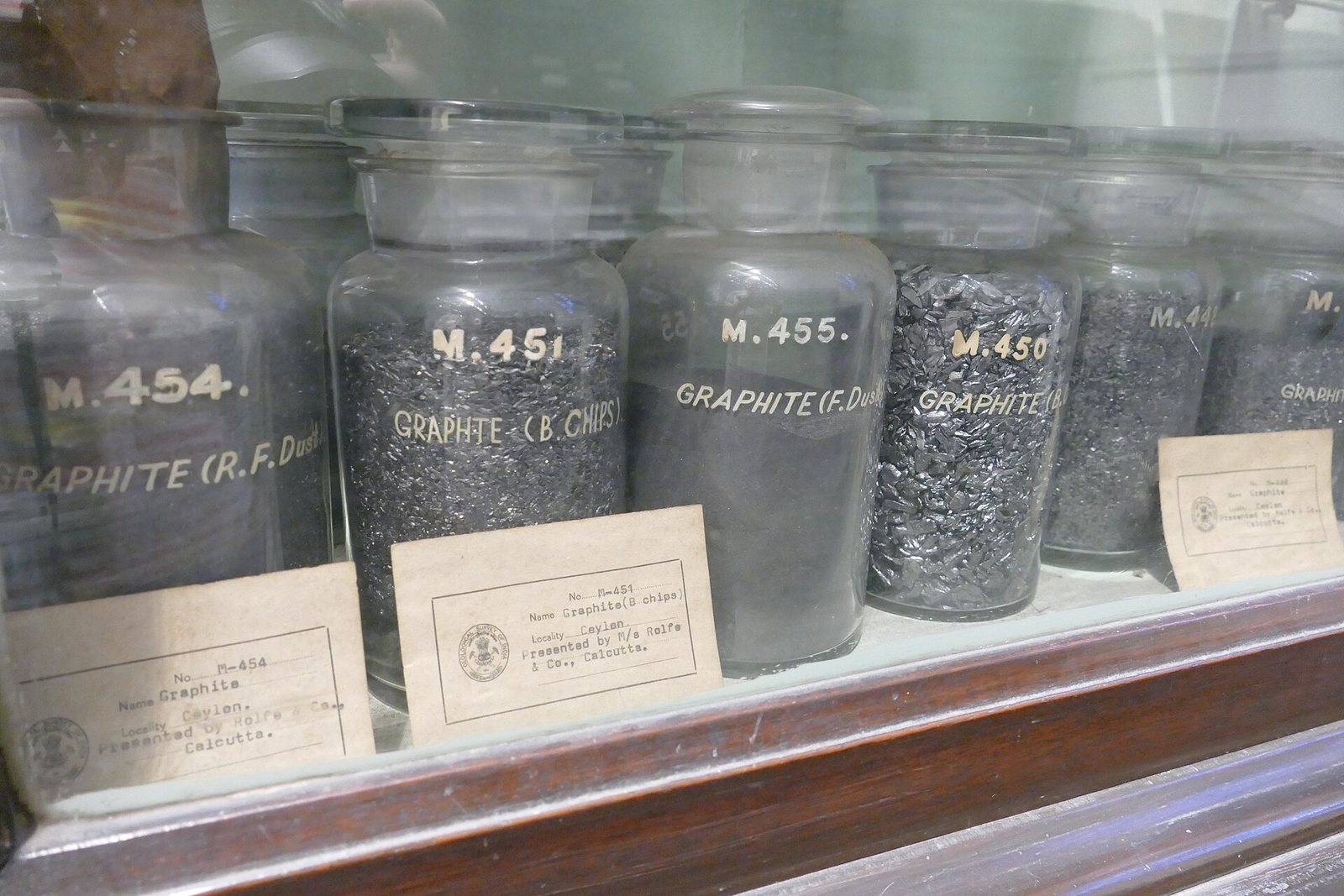
Minerals in the Indian Museum, Kolkata 05 · Kritzolina · CC BY-SA 4.0 · Wikimedia Commons

Bu nedir?

Pure carbon in soft, slippery sheets — the same stuff as pencil lead — and the material that holds the lithium when a battery is charged.

Neden önemli?

Every lithium-ion cell has a graphite anode, and by weight there is more graphite in a battery than lithium. It is also the electrode that makes electric-arc steelmaking possible.

Where it is in the Earth

Graphite is a crystalline form of carbon, meaning its atoms are arranged in flat, parallel sheets held loosely together — which is why it feels slippery and leaves marks on paper. It reaches mineable concentrations through two quite different geological routes, and which route produced a deposit largely determines what the graphite looks like and what it is good for.

The more common route is metamorphic: ancient organic matter, buried deeply and subjected to intense heat and pressure over millions of years, loses its hydrogen, oxygen and other elements and recombines as pure carbon in a crystalline lattice. The result is flake graphite, found in metamorphic rocks such as schists, gneisses and marbles. These deposits tend to be large and geographically widespread; they account for the great majority of what is mined. The other route is igneous: carbon-bearing fluids moving through fractures in rock can precipitate graphite directly, producing vein or lump deposits. Sri Lanka is the world's principal source of this rarer, higher-purity vein type, which commands a notably higher price than flake, as the import value data on this page shows. A third variety, amorphous graphite, is not truly amorphous in the strict chemical sense — it is microcrystalline flake graphite so finely divided that individual crystals are invisible. It forms from coal seams that have been baked by igneous intrusions.

The reason deposits cluster where they do follows from these origins. The great metamorphic belts of eastern China, the East African coast, Brazil's ancient basement rocks, and parts of India and Russia all host the kind of deeply buried, carbon-rich sediments that metamorphism converts into flake graphite. China's concentration reflects the sheer scale of its Precambrian metamorphic terranes — the very old rock formations that cover large parts of the country's interior and north-east. East African deposits in Madagascar, Tanzania and Mozambique have attracted considerable attention because they lie within similar ancient geological provinces and carry flake sizes that suit battery applications.

Getting it out

Most graphite is mined by open-pit methods, which means removing the soil and rock sitting above the ore body in a series of descending steps called benches, then extracting the ore itself. Open-pit mining is preferred when the deposit lies close to the surface and extends broadly in area, because the economics of moving large volumes of material are far more manageable in the open air than underground. Underground mining is used where the ore body is narrow, deep, or where surface conditions make open-pit impractical; some older Chinese and Indian operations follow this pattern.

Ore grade is the single most important number governing whether a deposit can be mined at all. For flake graphite, the tables on this page note that typical run-of-mine ore contains between five and fifteen percent graphitic carbon. That means for every tonne of ore dug up, somewhere between 850 and 950 kilograms is waste rock that must be moved, crushed and disposed of. The ratio of waste to ore — called the strip ratio in open-pit mining — determines a great deal of the cost. A deposit with a higher grade moves less waste per tonne of graphite recovered, which directly affects whether it can survive periods of lower prices. Vein graphite in Sri Lanka is an exception: grades are substantially higher, which is part of why it has been mined continuously from underground workings for well over a century despite the labour-intensive nature of the method.

Unlike metals such as copper or lithium, graphite is not extracted from a chemical compound but recovered as the mineral itself. There is no smelting step required to liberate the metal from its ore; the challenge instead is separating intact graphite flakes from the surrounding rock without breaking them. Flake size matters enormously to buyers, particularly for battery applications, so mining practice is shaped as much by the need to preserve crystal integrity as by the need to move tonnes efficiently.

What pulls on it

Graphite has two distinct demand bases that operate largely independently of each other. The older and still very large use is in steel and foundry applications, principally as electrodes in electric-arc furnaces — the vessels that melt scrap steel using enormous electrical currents — and as refractory linings and lubricants in metallurgical processes. This segment has been relatively stable over decades, tied to the rate of steel production from scrap rather than from iron ore, and it consumes a different product from the battery sector: primarily synthetic graphite made from petroleum coke, or large-flake natural graphite in specific refractory applications.

The newer and faster-growing use is as the anode material in lithium-ion batteries. Every lithium-ion cell, regardless of the cathode chemistry used, requires a graphite anode, and by weight graphite is the largest single active material in the cell. The material-intensity figures on this page give concrete meaning to this: a single battery pack of the kind used in an electric vehicle requires tens of kilograms of graphite anode material. As electric vehicle production has grown, battery demand for graphite has grown with it. Consumer electronics and grid-scale energy storage add further to this pull, though the per-unit quantities involved are smaller than in vehicle applications.

For demand to shift sharply, one of two things would need to happen: either the lithium-ion battery chemistry itself would have to change — replacing graphite anodes with a material such as silicon or lithium metal — or steelmaking patterns would have to shift away from electric-arc furnace routes. Silicon anodes are an active area of research precisely because silicon holds more lithium per unit volume than graphite, but replacing graphite entirely is a different matter from blending small amounts of silicon into a graphite anode, which is already done. Battery chemistries that store energy without a graphite anode do exist — sodium-ion batteries use alternative anode materials — but their penetration into the market remains, as of the data period covered here, modest. The more immediate question for flake graphite is not whether demand will fall but whether supply can be built outside China quickly enough to track growth in battery manufacturing in other regions.

Sayıları doğru okuyun. USGS reports natural graphite only. Synthetic graphite, made by baking petroleum coke at ~3,000 C, is a separate and larger industry. Flake, amorphous and vein grades, then spheronised and coated to become battery anode material.

Kayada nereden gelir

Tüm cevher mineralleri →

Bunlar gerçekten taşıyan mineraller graphite. Bir yatak, ancak içindeki minerallerden biri çıkarma maliyetini karşılayacak kadar yüksek tenörde olduğunda cevher kütlesi sayılır.

Kim üretiyor

Haritada gör →

Mine production

Mine productionmetric tons 2025 (tahmini) Dünya toplamı 1,800,000 metric tons

USGS Mineral Commodity Summaries 2026 · USGS reports natural graphite only. Synthetic graphite, made by baking petroleum coke at ~3,000 C, is a separate and larger industry. · kaynak ↗

Kalan sütunlar için tabloyu yatay kaydırın.

ÜlkeÜretim Dünya payı
China 1,400,000 77.8%
Madagascar 80,000 4.4%
Tanzania 75,000 4.2%
Brazil 65,000 3.6%
Mozambique 60,000 3.3%
Russia 25,000 1.4%
India 17,000 0.9%
Korea, North 8,000 0.4%
Canada 8,000 0.4%
Norway 6,600 0.4%
Sri Lanka 3,200 0.2%
Turkey 2,200 0.1%
Ukraine 800.0 0.0%
Mexico 740.0 0.0%
Vietnam 500.0 0.0%
Korea, Republic of 500.0 0.0%
Austria 200.0 0.0%
Germany 140.0 0.0%
United States Zero
Dünya toplamı 1,800,000100%

"Gizli tutulmuş", USGS'nin tek bir şirketin verisini ifşa etmekten kaçınmak amacıyla rakamı yayımlamadığı anlamına gelir; sıfır anlamına gelmez. Kaynak her rakamı bağımsız olarak yuvarladığı ve her zaman "diğer ülkeler" satırını ayrıştırmadığı için ülke satırları her zaman dünya toplamına eşit olmayabilir.

Rezervleri kim elinde bulunduruyor

"Rezervler" kesin bir terimdir. Bugünkü fiyatlar ve bugünkü teknoloji ile şu anda ekonomik olarak çıkarılabilecek bilinen bir yatağın bölümünü ifade eder; yeraltındaki her şeyi değil. Rezervler, fiyatlar yükseldiğinde veya yeni bir proses geliştirildiğinde artar; düştüklerinde ise azalır.

Reserves

Reservesmetric tons 2025

USGS Mineral Commodity Summaries 2026 · kaynak ↗

ÜlkeRezervlerDünya payı
China 100,000,000 32.3%
Brazil 74,000,000 23.9%
Madagascar 27,000,000 8.7%
Mozambique 25,000,000 8.1%
Tanzania 18,000,000 5.8%
Russia 14,000,000 4.5%
Vietnam 9,700,000 3.1%
India 8,600,000 2.8%
Turkey 6,900,000 2.2%
Canada 5,900,000 1.9%
Mexico 3,100,000 1.0%
Korea, North 2,000,000 0.6%
Korea, Republic of 1,800,000 0.6%
Sri Lanka 1,500,000 0.5%
Norway 600,000 0.2%
United States s
Austria s
Germany s
Ukraine s
Dünya toplamı 310,000,000100%

Fiyat

average unit value of imports, dollars per metric ton at foreign ports: Amorphous

Yıllık ortalamadollars per metric ton

2021 · 629.0 yüksek 629.0 dollars per metric ton 2025 · 470.0

Dayanak: average unit value of imports, dollars per metric ton at foreign ports: Amorphous. Şurada yayımlanan yıllık ortalamalar: USGS Mineral Commodity Summaries 2026 · kaynak ↗. Bunlar referans yıllık ortalamalar olup canlı piyasa fiyatı değildir.

average unit value of imports, dollars per metric ton at foreign ports: Lump and chip (Sri Lanka)

Yıllık ortalamadollars per metric ton

2021 · 2,010 yüksek 2,810 dollars per metric ton 2025 · 2,600

Dayanak: average unit value of imports, dollars per metric ton at foreign ports: Lump and chip (Sri Lanka). Şurada yayımlanan yıllık ortalamalar: USGS Mineral Commodity Summaries 2026 · kaynak ↗. Bunlar referans yıllık ortalamalar olup canlı piyasa fiyatı değildir.

average unit value of imports, dollars per metric ton at foreign ports: Flake

Yıllık ortalamadollars per metric ton

2021 · 1,330 yüksek 1,330 dollars per metric ton 2025 · 1,000

Dayanak: average unit value of imports, dollars per metric ton at foreign ports: Flake. Şurada yayımlanan yıllık ortalamalar: USGS Mineral Commodity Summaries 2026 · kaynak ↗. Bunlar referans yıllık ortalamalar olup canlı piyasa fiyatı değildir.

Nerede işlenir ve rafine edilir

TesisTür AşamaÜlkeRol
CATL Ningde Plants GigafabrikaBileşen ChinaGirdi
Gigafactory Nevada GigafabrikaBileşen United StatesGirdi
Son pazarOrada ne işe yararÖnem
Electric Vehicles The anode — the heaviest active material in the cell Tanımlama
Consumer Electronics Battery anode Tanımlama
Grid Storage Anode Tanımlama

Bir teknolojinin ne kadar ihtiyaç duyduğu

"Yoğunluk", bir şeyin bir biriminin ne kadar materyal içerdiği anlamına gelir. Bunlar gösterge aralıklardır — gerçek tasarımlar üreticiye ve model yılına göre farklılık gösterir; mühendisler daha az kullanmayı öğrendikçe tüm bu değerler düşmektedir.
TeknolojiMiktar Kote edilenDayanak
LFP Lithium-Ion Battery 55.00–85.00 kg per 75 kWh packAnode active material
NMC Lithium-Ion Battery Roughly 1 kg of anode material per kWh. 50.00–80.00 kg per 75 kWh packAnode active material

Indicative range compiled from published technology studies and chemistry; verify against a manufacturer specification before use. Bu rakamları malzeme hesaplayıcısında istediğiniz ölçekte çalıştırın →

İhracat kontrolleri

ÜlkeKontrolUygulandığı kapsam
ChinaExport licensing requirement for materials and technologies Antimony (2024), bismuth (2025), synthesized diamond (2025), gallium (2023), germanium (2023), graphite (2023), indium (2025), magnesium materials (2024), molybdenum (2025), rare earths (2025), silver (2026), tellurium (2025), tungsten (2025), and items related to lithium batteries and artificial graphite anode materials (2025).
NamibiaExport ban Ores and concentrates of cobalt, graphite, lithium, manganese, and rare earths (2023).

USGS Mineral Commodity Summaries 2026, table 4 — controls in effect as of January 2026, excluding controls since lifted.

Haberlerde

Daha fazla →

GrafTech plans shutdown of Monterrey graphite facility in Mexico

Mining Technology01 Sep 2026

Materyaller

Tüm malzemeler Kritik mineraller Nadir toprak elementleri Pil malzemeleri Cevher mineralleri Periyodik tablo Tarayıcı

Zemin

Madenler ve yataklar İşleme ve rafinasyon Ülkeler Haritalar

Ekonomi

Velayet güzergâhları Tedarik zincirleri Son pazarlar Teknolojiler Şirketler Materyal hesaplayıcı

Öğren

ÖğrenSözlük Veriye SorYapay zeka ajanları Araştırma ve veriAçık API Haberler★ Kaydedildi

Hakkımızda

Hakkımızdaİletişim MetodolojiVeri kaynakları Editoryal politika Gizlilik politikasıKullanım koşulları Sorumluluk reddi