鉱石から製品まで、経路を追跡
The Materials Atlas
素材 鉱山・鉱床 処理・精製 管理移転経路 サプライチェーン 企業 ニュース
棚別素材 バッテリー材料 希土類元素 銅・電気 半導体材料 核物質 航空宇宙・防衛 貴金属 鉄鋼・合金金属 工業用鉱物 農業用鉱物 エネルギー原材料 鉱石鉱物 周期表
需要 最終市場 技術 素材計算機 地図 スクリーナー
学習・ツール 学ぶ用語集 データに質問するAIエージェント 調査・データAPI ★ 保存済み
概要 運営について方法論 データソースお問い合わせ 免責事項
表示オプション
🧭 ガイドビュー 鉱石品位、精鉱、精錬、副産物といった用語が初めての方へ。閲覧しながらすべての用語をわかりやすく解説します。同じデータを、解説付きでご覧いただけます。
⚡ 専門家向け解説 業界の知識はお持ちのはず。データのみを——簡潔、迅速、コンパクトに、余分な説明なしで。これがデフォルト表示です。
テーマ
インターフェース言語
深度 素材ページは4段階のレベルで構成されている。任意の素材ページでレベルを選択すると、その設定が記憶される。
★ 保存済み 調査・データ
Hafnium

核物質

Hafnium Hf · 72

Zirconium's chemical shadow — always found with it, almost impossible to separate from it, and the opposite of it in a reactor because it soaks up neutrons.

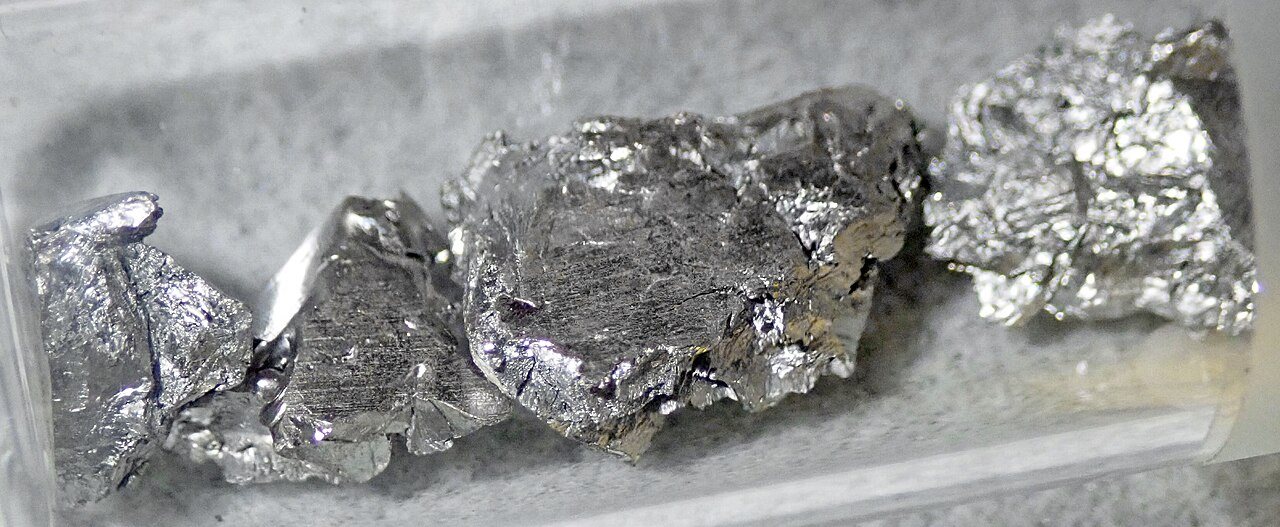
Hafnium (Element - 72) 2 · James St. John · CC BY 2.0 · Wikimedia Commons

これは何か

Zirconium's chemical shadow — always found with it, almost impossible to separate from it, and the opposite of it in a reactor because it soaks up neutrons.

なぜ重要なのか

Hafnium goes into reactor control rods, superalloy turbine blades, and the gate dielectric that let chip transistors keep shrinking after 2007.

Where it is in the Earth

Hafnium does not form deposits of its own. It exists in the Earth's crust as a passenger inside zircon, a zirconium silicate mineral with the formula ZrSiO4. The reason is straightforward chemistry: hafnium and zirconium atoms are almost exactly the same size, a consequence of a phenomenon called the lanthanide contraction, in which the filling of inner electron shells across the lanthanide series of elements compresses atomic radii in the rows that follow. Because the two atoms are so similar in size and charge, hafnium substitutes freely for zirconium in zircon's crystal lattice. Roughly two atoms in every hundred zirconium sites in a typical zircon crystal are actually hafnium. That ratio is remarkably consistent across geological settings, which is why hafnium is described as zirconium's chemical shadow.

Zircon itself concentrates through a process called heavy mineral sorting. When granitic or syenitic magmas — igneous rocks rich in silica and aluminium — cool slowly deep in the crust, zircon crystallises early and settles out. Over geological time, erosion breaks down these ancient igneous and metamorphic rocks, and rivers carry the debris to the sea. Because zircon is dense, chemically inert, and highly resistant to weathering, it survives the journey and accumulates in beach and dune sands alongside other heavy minerals such as ilmenite, rutile, and monazite. These are the heavy mineral sand deposits — also called placer deposits — that constitute the world's practical source of zircon, and therefore of hafnium. Deposits of this type are found along ancient and modern coastlines where the geological conditions produced sustained sediment sorting over long periods.

A smaller quantity of zircon comes from hard-rock mining of the original igneous intrusions, particularly nepheline syenite and carbonatite complexes, but placer sands dominate supply. Because hafnium is entirely dependent on zircon as its carrier mineral, the geography of hafnium supply is simply the geography of heavy mineral sand mining, concentrated in coastal regions of Australia, South Africa, and a handful of other countries.

Getting it out

Zircon, and with it hafnium, is won from heavy mineral sands using methods suited to loose, unconsolidated beach and dune sediments. The most common approach is open excavation — stripping away surface material and either dredging the sand with a floating suction dredge working through an artificial pond, or using dry mining equipment such as bulldozers and scrapers to move material to a wet concentrator plant. Neither method resembles hard-rock mining in any conventional sense: there is no blasting, no narrow ore vein to follow underground. The deposit is essentially a large volume of sand in which valuable heavy minerals are dispersed at low concentration.

That concentration, the grade, is typically measured as the weight of heavy minerals in a tonne of sand. Zircon itself forms only a portion of the total heavy mineral content, and hafnium in turn forms only a small fraction of the zirconium in that zircon. The practical implication is that an enormous tonnage of sand must be processed to yield a modest weight of zircon, and the hafnium content of that zircon is smaller still. The waste in this context is not toxic rock that must be impounded but largely the silica sand that was always the majority of the material, and operations are often designed to return processed sand to the mined area as they advance across the deposit.

What happens next determines whether any hafnium is produced at all. Raw zircon concentrate leaves the mining operation, but separating hafnium from zirconium requires a sophisticated chemical refinery. That step does not happen at the mine and is not attempted by most zircon consumers. Hafnium is only separated when the zirconium is being refined to nuclear-grade purity — a specification that requires the removal of hafnium precisely because hafnium absorbs neutrons so strongly that even small quantities would impair a zirconium alloy's performance inside a reactor. Hafnium is therefore a by-product of nuclear zirconium production, not a co-product of zircon mining.

What pulls on it

Three markets pull on hafnium, and they pull in different directions and on different timescales. The oldest is nuclear power, where hafnium's exceptional ability to absorb neutrons — the very property that makes it undesirable in zirconium alloys — makes it useful in control rods, the elements inserted into or withdrawn from a reactor core to regulate the chain reaction. A pressurised water reactor requires between 0.5 and 3.0 tonnes of hafnium per gigawatt of generating capacity for its control rods. As nuclear generating capacity is built or refurbished, this demand rises; as older plants retire without replacement, it falls. The current period of renewed interest in nuclear power, driven by low-carbon energy targets and the energy security concerns of several governments, represents a potential growth path for this end use, though actual demand depends on how many reactors are completed and at what pace.

The second market is aerospace and defence, where hafnium is alloyed into nickel-based superalloys for turbine blades operating at extreme temperatures. Hafnium improves the grain-boundary strength of these alloys, allowing blades to endure conditions closer to their melting point and thus enabling higher combustion temperatures and better engine efficiency. Demand from this sector tracks aircraft production rates and the replacement cycles of military jet engines, both of which are long-cycle and relatively predictable.

The third and most structurally significant market is semiconductors. After 2007, the principal manufacturers of logic chips introduced hafnium oxide and hafnium silicate as the gate dielectric material — the insulating layer between the control electrode and the conducting channel — in transistors. Conventional silicon dioxide had been thinned to the point where electrons tunnelled through it, wasting power. Hafnium-based compounds have a much higher dielectric constant, meaning a thicker layer can do the same electrical job, stopping the leakage. This transition extended the pace of transistor miniaturisation for a further technology generation. Demand from this sector is tied to the volume of advanced logic chip production and to whether future transistor architectures continue to require hafnium-based dielectrics, which is not guaranteed indefinitely as designs evolve.

Turning ore into product レベル 3

The separation of hafnium from zirconium is among the more demanding tasks in industrial chemistry. The two elements are so similar — nearly identical ionic radius, the same valence, comparable solubility behaviour — that the standard separation techniques used for most metals fail entirely. The method that works at industrial scale is liquid-liquid extraction, sometimes called solvent extraction. Zircon is first broken down chemically, typically by fusion with sodium hydroxide or by chlorination at high temperature to produce zirconium tetrachloride vapour. The resulting intermediate is dissolved in aqueous solution and then contacted with an organic solvent — historically tributyl phosphate in a kerosene diluent — which preferentially extracts one element over the other under carefully controlled acid concentrations. Repeated extraction and back-extraction stages are needed to achieve the separation factors required for nuclear-grade zirconium, which demands hafnium content below a very low threshold. The hafnium that is stripped out in this process is the world's hafnium supply.

After separation, hafnium is usually converted to hafnium tetrachloride and then reduced to metal by the Kroll process — the same magnesium-reduction route used for titanium and zirconium — to yield hafnium sponge. For applications demanding higher purity, crystal bar refining using the iodide process is applied, a batch technique in which hafnium is deposited from its vapour onto a hot filament. For semiconductor applications, the metal or sponge is converted to hafnium oxide or hafnium silicate precursor compounds suitable for atomic layer deposition, a technique that builds films one molecular layer at a time inside chip fabrication equipment. Each conversion step adds cost and introduces potential loss, and the yield from separated hafnium to finished semiconductor precursor is considerably lower than the yield at the earlier stages of the chain.

Because hafnium separation only occurs at facilities set up to produce nuclear-grade zirconium, the number of points in the world where hafnium actually comes into existence as a discrete material is very small. Capacity at those points is set by the nuclear zirconium market, not by hafnium demand. If more hafnium were wanted without a corresponding increase in nuclear zirconium output, production could not simply be scaled up: the feed material — zircon processed to the point where separation is economically sensible — would not be available in larger quantity on any short timescale.

Substitution and recycling レベル 3

In nuclear control rods, the main alternative to hafnium is boron, usually in the form of boron carbide or boron steel. Boron is far more abundant and less expensive. The trade-off is physical: hafnium rods are denser and more durable over long irradiation lifetimes, and they do not generate problematic gas as boron does when it absorbs neutrons. Some reactor designs and operating contexts strongly prefer hafnium on technical grounds; others use boron without difficulty. The existence of a workable boron alternative places a practical ceiling on how far hafnium pricing can diverge before operators seek design changes, but the switch is not frictionless — it involves regulatory review and engineering qualification, which take years.

In superalloys, hafnium's role as a grain-boundary strengthener can be partially replicated by other refractory elements including yttrium, lanthanum, and certain combinations of rare earth additions. However, removing hafnium from a qualified aerospace alloy is not a simple substitution; it requires requalification of the material through a testing and certification process that can take a decade and carries significant cost. In practice, established alloy compositions tend to be retained unless there is sustained supply pressure that makes reformulation worthwhile.

In semiconductors, the situation is more nuanced. The high-k dielectric function of hafnium oxide could in principle be served by other high-dielectric-constant oxides — aluminium oxide, lanthanum oxide, and others have been studied. None has displaced hafnium in high-volume production because the industry has accumulated substantial process knowledge around hafnium-based materials and because changing a core material in a chip process requires exhaustive validation. Recycling of hafnium is minimal in practice. The quantities used per chip are extremely small, the material is distributed across large numbers of devices, and no economic collection and recovery pathway exists at present. In nuclear and aerospace applications, end-of-life material does sometimes re-enter the supply chain, but the volumes involved are modest relative to primary production and the data on this flow are not published in any consistent form.

Where the chain is fragile レベル 4

The most structurally distinctive feature of hafnium supply is that it cannot be increased independently of nuclear-grade zirconium production. Hafnium is not mined; it is separated from a stream that exists because nuclear utilities need zirconium alloy cladding for fuel rods. The production data illustrate the opacity of this arrangement: as the data source for this entry notes, figures are largely withheld. The USGS and comparable national geological surveys do not publish comprehensive hafnium output numbers because the handful of producers treat the data as commercially sensitive and because hafnium volumes are small enough that reporting them would identify individual company positions. This makes independent assessment of the supply-demand balance very difficult and means that published price series — which moved from $781 per kilogram in 2021 to $6,130 per kilogram in 2023 before retreating — are one of the more informative signals available, even though price alone does not reveal which market is driving the movement or where physical tightness sits in the chain.

Concentration risk is present at multiple stages. Zircon mining is geographically concentrated in a small number of countries. The chemical separation of hafnium from zirconium is performed at an even smaller number of facilities, each of which is tied to a specific nuclear zirconium supply chain with its own regulatory framework and national context. The conversion of separated hafnium into semiconductor-grade precursors adds a further layer of processing concentration, visible in the fact that advanced chip fabrication — as represented by facilities such as those listed in the plant data for this entry — is itself geographically concentrated. A disruption at any one of these nodes propagates through to users who may have no straightforward means of switching source on a short timescale.

Lead times compound the concentration problem. Qualifying a new source of nuclear-grade zirconium — and therefore a new source of hafnium — involves extensive testing against reactor safety standards, a process measured in years rather than months. Building new separation capacity requires capital investment justified against a hafnium market whose production volumes are not publicly disclosed, making the investment case difficult to construct. Permitting for new zircon mineral sand operations in most producing countries is itself a multi-year process. The combination of by-product dependence, processing concentration, qualification barriers, and data opacity places hafnium in a category of materials where the supply response to a demand shock is structurally slow regardless of price signals, and where the uncertainty in even basic supply accounting is genuine rather than merely a data-collection inconvenience.

数値の読み方に注意してください。 Production figures are largely withheld; hafnium is a by-product of nuclear-grade zirconium production. Sponge, crystal bar, and hafnium oxide precursors for chip deposition.

岩石中の産出箇所

全鉱石鉱物 →

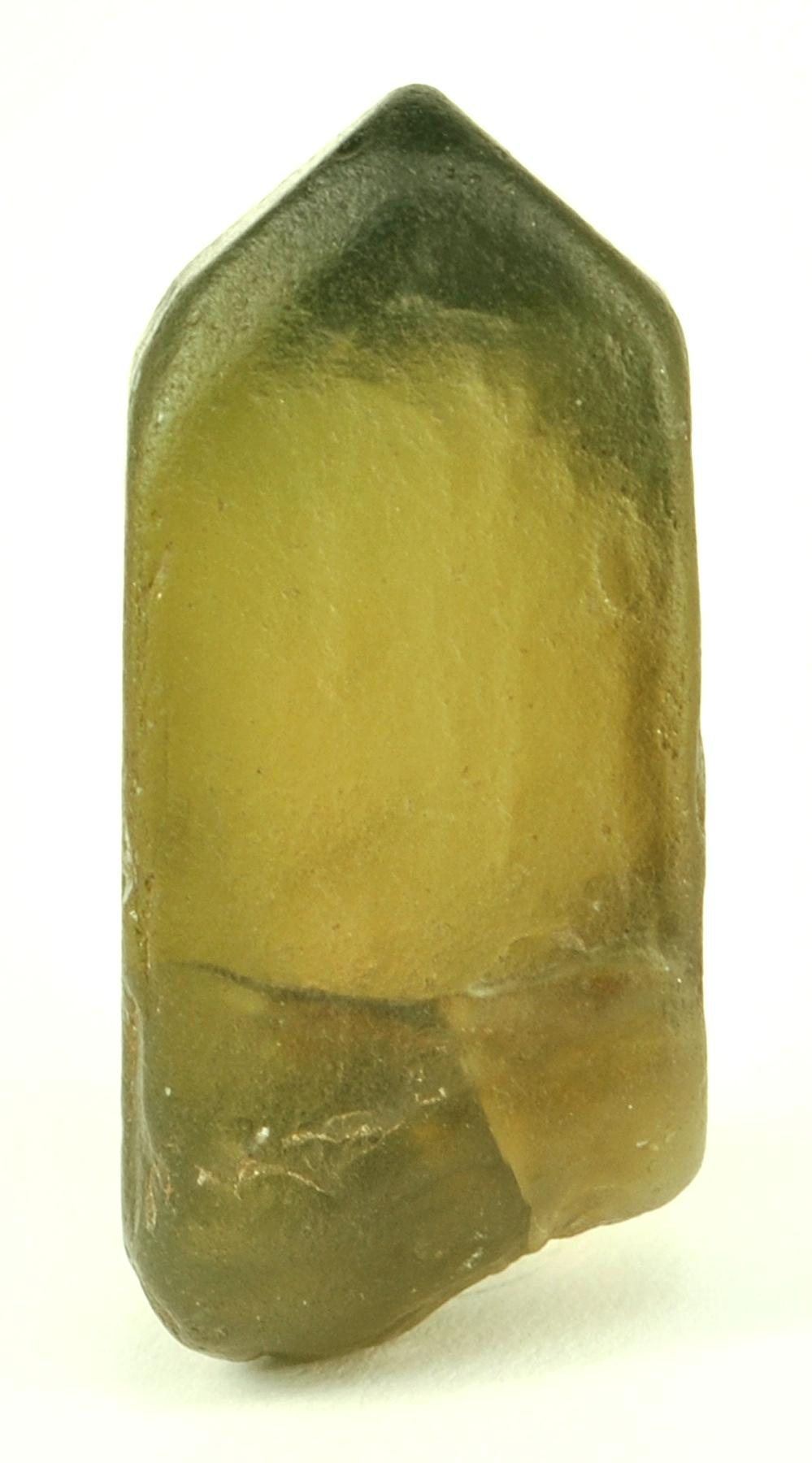
実際に以下を担う鉱物 hafnium. 鉱床が鉱体となるのは、採掘コストを回収できるほど十分な濃度で鉱石が濃集している場合に限られる。
価格

Price: Hafnium, unwrought, dollars per kilogram

年間平均dollars per kilogram

2021 · 781.0 高 6,130 dollars per kilogram 2025 · 3,800

基準: Price: Hafnium, unwrought, dollars per kilogram. 以下に公表された年間平均値: USGS Mineral Commodity Summaries 2026 · 出典 ↗. これらは参照用の年間平均値であり、リアルタイムの市況相場ではない。

処理・精製が行われる場所

プラント種別 ステージ役割
TSMC Fab 18, Tainan 半導体製造工場コンポーネント Taiwan投入
Aero-Engine Turbine Plant, Derby 製造プラント製品 United Kingdom投入
最終市場そこでの機能重要度
Nuclear Power Control rods 定義
Aerospace & Defence Superalloy and control rods 定義
Semiconductors High-k transistor gate dielectric 定義

技術が必要とする量

「インテンシティ」とは、ある製品1単位に含まれる素材の量を指します。ここに示す値は参考レンジであり、実際の設計はメーカーやモデル年によって異なります。また、エンジニアが使用量を削減する技術を習得するにつれ、いずれの値も低下し続けています。
技術数量 建値基準
Leading-Edge Logic Chip Milligrams per wafer, with no substitute. 微量 per 300 mm waferAtomic-layer gate dielectric
Pressurised Water Reactor 0.5–3.00 t per GW of capacityControl rods
Single-Crystal Turbine Blade 微量 per blade setGrain-boundary strengthening

Indicative range compiled from published technology studies and chemistry; verify against a manufacturer specification before use. 素材計算機で任意の規模に換算して実行 →

素材

全素材 重要鉱物 レアアース バッテリー材料 鉱石鉱物 周期表 スクリーナー

地下

鉱山・鉱床 処理・精製 地図

経済

管理移転経路 サプライチェーン 最終市場 技術 企業 素材計算機

学ぶ

学ぶ用語集 データに質問するAIエージェント 調査・データオープンAPI ニュース★ 保存済み

運営について

運営についてお問い合わせ 方法論データソース 編集方針 プライバシーポリシー利用規約 免責事項