¿Qué es?
The only element cold enough to keep an MRI magnet superconducting, and the only one light enough to escape Earth's gravity for good once released.
¿Por qué importa?
Helium is extracted as a by-product of natural gas. When it is vented it is gone from the planet permanently.
Where it is in the Earth
Helium is not a mineral in any conventional sense. It does not crystallise, it does not bond with other elements, and it leaves no trace in rock chemistry the way copper or iron does. Instead, it accumulates as a gas, and it does so because of radioactive decay deep in the Earth's crust. Uranium and thorium, both present in granites and certain other ancient rocks, shed alpha particles as they decay over geological time. An alpha particle is simply a helium nucleus — two protons, two neutrons — and once it captures a pair of electrons from its surroundings it becomes a helium atom. That atom is chemically inert and extraordinarily small, so it migrates slowly upward through rock until something stops it.
What stops it is the same thing that traps natural gas: an impermeable cap rock — typically a dense shale, evaporite, or tight carbonate — arching over a porous reservoir. Helium collects in the pore spaces of that reservoir alongside methane and other gases. The key geological requirement is that the cap rock must be tight enough to hold a molecule even smaller than hydrogen, and the geological setting must be old enough for meaningful volumes to have accumulated. This is why the most productive helium provinces sit on ancient stable platforms — the mid-continent United States, the Siberian craton, the great gas fields beneath the Qatar peninsula — where thick sequences of source rock have had hundreds of millions of years to generate helium and where structural geology has provided the right traps. Younger, tectonically disturbed terrains rarely hold it in economic concentrations because the cap rocks have been fractured and the gas has long since seeped away.
A useful recent addition to the picture is the discovery that the East African Rift system can deliver large helium accumulations through a different mechanism: volcanic heat accelerates degassing from ancient crustal rocks, and the helium migrates into shallow sedimentary traps. Tanzania's discovery showed that not all prospective provinces are already known, and that geologists are still refining their understanding of where the gas can concentrate.
Getting it out
Helium is never mined in isolation. Because it occurs as a component of natural gas — usually a small fraction of the total gas stream — it is recovered at whatever point natural gas is being produced and processed. There is no helium mine in the way there is a copper mine. The primary operation is a gas well, drilled and completed using conventional petroleum techniques, and the helium is extracted as a by-product of that operation. The natural gas field is developed for its methane content; the helium comes along because it is there.
The concentration of helium in the raw gas stream — its grade, in the language of mining — varies considerably between fields. Ordinary natural gas contains only trace amounts, far too little to be worth separating. The fields that produce commercial helium contain materially higher concentrations, though the exact percentages differ by location and are not uniform even within a single reservoir. What matters economically is that the concentration must be high enough that the cost of separating helium from the other gases is recovered in the value of the helium sold. Fields that sit just below that threshold may become viable if the gas is being processed anyway for other reasons, or may never be developed specifically for helium at all.
Because helium production is tied to natural gas production, the rate at which helium is extracted is not set by helium demand alone. When natural gas output at a host field falls — because the reservoir pressure drops, because methane prices make production uneconomic, or because a facility is shut for maintenance — helium output falls with it. This dependency is structural and cannot be engineered away without developing dedicated helium wells, which remain uncommon.
What pulls on it
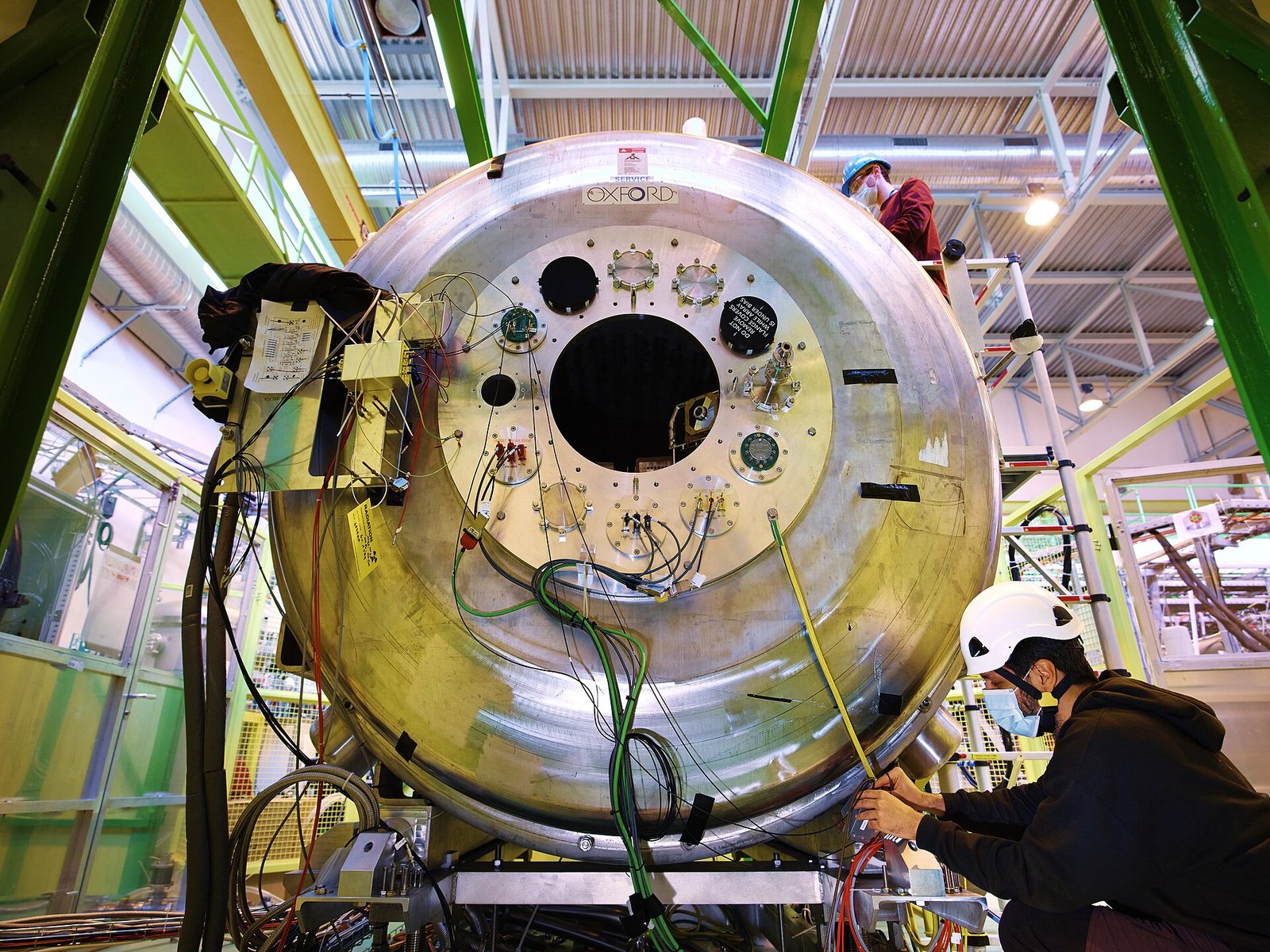
The single largest use of helium is cooling the superconducting electromagnets inside magnetic resonance imaging (MRI) scanners. A superconducting magnet carries electrical current with no resistance, but only when it is kept below a critical temperature that, for the alloys used in MRI, requires immersion in liquid helium. The global installed base of MRI machines is large and growing, particularly as middle-income countries expand their health infrastructure, so this demand is persistent and relatively insensitive to price. Hospitals cannot simply switch off their magnets or substitute another coolant without replacing the machine entirely.
The semiconductor industry is the second major consumer, in two distinct ways. Helium is used in the process chambers where silicon wafers are etched and deposited upon, because its inertness and thermal conductivity help control temperature precisely without contaminating the substrate. It is also used to detect leaks in equipment and pipelines, a role that exploits its small atomic radius — helium passes through the finest imperfection that a larger molecule would not. As semiconductor manufacturing has moved toward ever smaller feature sizes and more demanding process conditions, the gas-phase requirements of fabrication have grown. The processing plants listed in the accompanying table — TSMC's Fab 18 in Taiwan and Samsung's Pyeongtaek campus — are representative of the high-volume chip fabs that depend on a reliable helium supply.
Uses in data centres and in emerging fields such as hard-disk drive manufacturing and certain aspects of AI infrastructure add further demand, though these remain smaller in aggregate than medicine and semiconductors. What would have to change for demand to fall sharply is either the commercial availability of MRI magnets that do not require liquid helium coolant — a technology that has been demonstrated at small scale but not yet deployed widely — or a significant shift away from superconducting magnets in medical imaging. Neither appears imminent. In the other direction, demand could rise sharply if novel superconducting technologies — for power transmission, quantum computing, or particle physics — move from laboratory to commercial scale.
Quién lo produce
Verlo en un mapa →Helium Production
Helium Productionmillion cubic meters 2025 (estimado) Total mundial 190.0 million cubic meters
USGS Mineral Commodity Summaries 2026 · Reported in million cubic metres of gas, not tonnes. · fuente ↗
Desplace la tabla lateralmente para ver las columnas restantes.
| País | Producción | Cuota mundial |
|---|---|---|
| United States | 81.00 | 42.6% |
| Qatar | 63.00 | 33.2% |
| Russia | 18.00 | 9.5% |
| Algeria | 11.00 | 5.8% |
| Canada | 6.00 | 3.2% |
| Poland | 3.00 | 1.6% |
| China | 3.00 | 1.6% |
| South Africa | s | — |
| Total mundial | 190.0 | 100% |
«Withheld» significa que el USGS suprimió el dato para evitar revelar información de una empresa concreta — no equivale a cero. Las filas por país no siempre suman el total mundial porque la fuente redondea cada cifra de forma independiente y no siempre desglosa una línea de «otros países».
Quién posee las reservas
Helium Reserves
Helium Reservesmillion cubic meters 2025
USGS Mineral Commodity Summaries 2026 · fuente ↗
| País | Reservas | Cuota mundial |
|---|---|---|
| United States | 8,500 | — |
| Algeria | 1,800 | — |
| Russia | 1,700 | — |
| South Africa | 400.0 | — |
| Poland | 24.00 | — |
| Qatar | Large | — |
| China | Not applicable | — |
| Canada | Not applicable | — |
| Total mundial | Not applicable | 100% |
Dónde se procesa y refina
| Planta | Tipo | Etapa | País | Función |
|---|---|---|---|---|
| Samsung Pyeongtaek Campus | Fábrica de semiconductores | Componente | South Korea | Entrada |
| TSMC Fab 18, Tainan | Fábrica de semiconductores | Componente | Taiwan | Entrada |
Para qué se usa
Todos los mercados finales →| Mercado final | Lo que hace allí | Importancia |
|---|---|---|
| Medicine & Health | Cooling superconducting MRI magnets | Definición de |
| Semiconductors | Cooling and leak detection | Importante |
| Data Centres & AI | Used in some drive designs and in chip manufacturing | Presente |
Cuánto necesita una tecnología
| Tecnología | Cantidad | Citado | Base |
|---|---|---|---|
| Leading-Edge Logic Chip Consumed as gas, not incorporated. | traza | per 300 mm wafer | Process cooling and leak detection |
Indicative range compiled from published technology studies and chemistry; verify against a manufacturer specification before use. Ejecute estas cifras a cualquier escala en la calculadora de materiales →