从矿石到产品,全程溯源
The Materials Atlas
材料 矿山与矿床 加工与精炼 溯源记录 供应链 企业 国家/地区 资讯
按货架浏览材料 电池材料 稀土元素 铜与电气 半导体材料 核材料 航空航天与国防 贵金属 钢铁与合金金属 工业矿物 农业矿物 能源原材料 矿石矿物 元素周期表
需求 终端市场 技术 材料计算器 地图 筛选器
学习与工具 了解术语表 数据问答AI智能体 研究与数据API ★ 已保存
关于 关于我们方法论 数据来源联系我们 免责声明
阅读选项
🧭 引导视图 初次接触矿石品位、精矿、精炼、副产品等概念?我们在您浏览时对每个术语进行解释,语言浅显易懂,数据相同,帮助内置其中。
⚡ 专家视角 您已熟悉这一行业,直接看数据即可——简洁、快速、紧凑,无附加说明。此为默认视图。
主题
界面语言
深度 材料页面分四个级别撰写。在任意材料页面选择后,系统将记住您的选择。
★ 已保存 研究与数据
Helium

工业矿物

Helium He · 2

The only element cold enough to keep an MRI magnet superconducting, and the only one light enough to escape Earth's gravity for good once released.

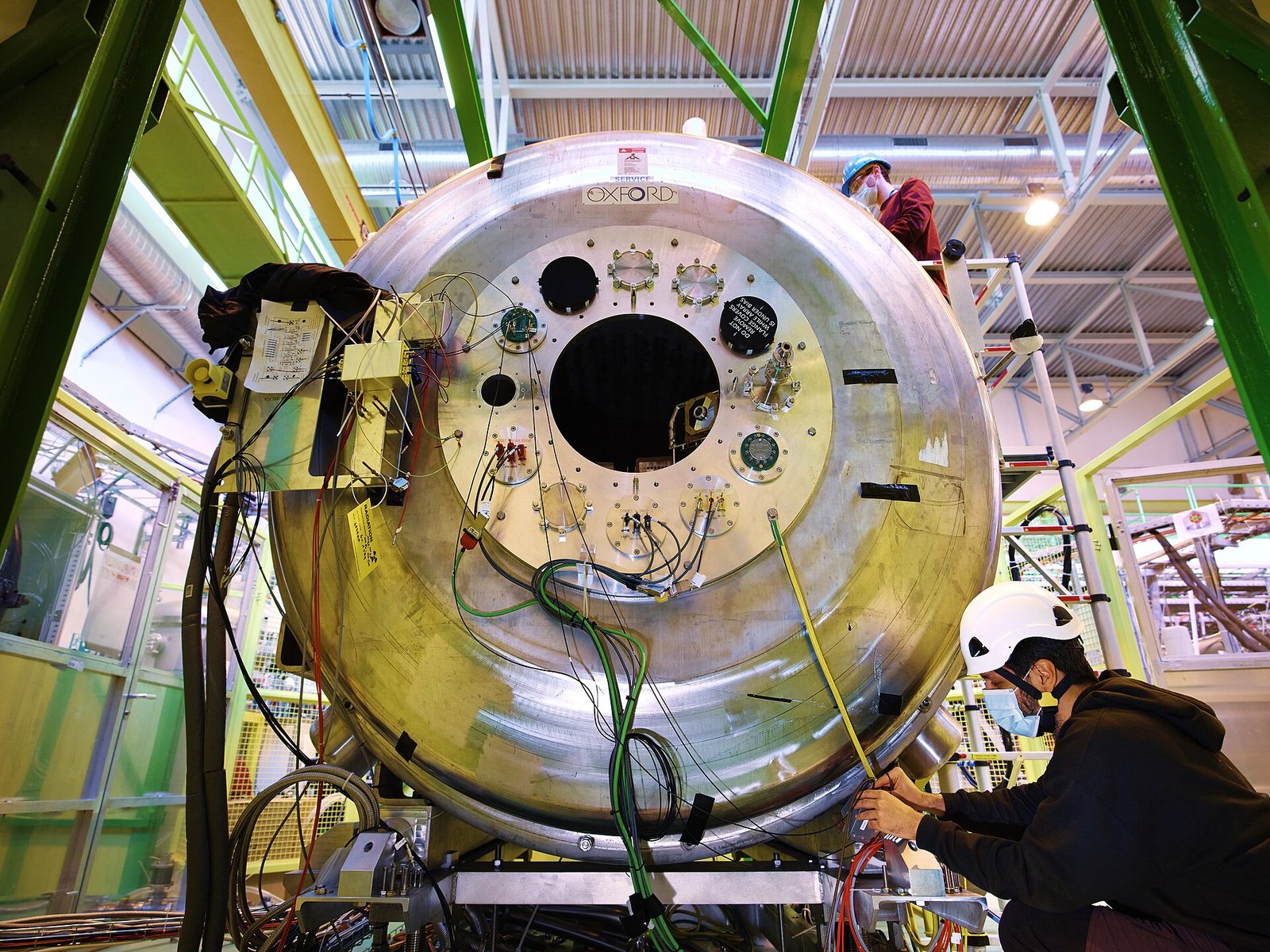
ISS Magnet · Ordan, Julien Marius · CC BY 4.0 · Wikimedia Commons

这是什么?

The only element cold enough to keep an MRI magnet superconducting, and the only one light enough to escape Earth's gravity for good once released.

为何重要?

Helium is extracted as a by-product of natural gas. When it is vented it is gone from the planet permanently.

Where it is in the Earth

Helium is not a mineral in any conventional sense. It does not crystallise, it does not bond with other elements, and it leaves no trace in rock chemistry the way copper or iron does. Instead, it accumulates as a gas, and it does so because of radioactive decay deep in the Earth's crust. Uranium and thorium, both present in granites and certain other ancient rocks, shed alpha particles as they decay over geological time. An alpha particle is simply a helium nucleus — two protons, two neutrons — and once it captures a pair of electrons from its surroundings it becomes a helium atom. That atom is chemically inert and extraordinarily small, so it migrates slowly upward through rock until something stops it.

What stops it is the same thing that traps natural gas: an impermeable cap rock — typically a dense shale, evaporite, or tight carbonate — arching over a porous reservoir. Helium collects in the pore spaces of that reservoir alongside methane and other gases. The key geological requirement is that the cap rock must be tight enough to hold a molecule even smaller than hydrogen, and the geological setting must be old enough for meaningful volumes to have accumulated. This is why the most productive helium provinces sit on ancient stable platforms — the mid-continent United States, the Siberian craton, the great gas fields beneath the Qatar peninsula — where thick sequences of source rock have had hundreds of millions of years to generate helium and where structural geology has provided the right traps. Younger, tectonically disturbed terrains rarely hold it in economic concentrations because the cap rocks have been fractured and the gas has long since seeped away.

A useful recent addition to the picture is the discovery that the East African Rift system can deliver large helium accumulations through a different mechanism: volcanic heat accelerates degassing from ancient crustal rocks, and the helium migrates into shallow sedimentary traps. Tanzania's discovery showed that not all prospective provinces are already known, and that geologists are still refining their understanding of where the gas can concentrate.

Getting it out

Helium is never mined in isolation. Because it occurs as a component of natural gas — usually a small fraction of the total gas stream — it is recovered at whatever point natural gas is being produced and processed. There is no helium mine in the way there is a copper mine. The primary operation is a gas well, drilled and completed using conventional petroleum techniques, and the helium is extracted as a by-product of that operation. The natural gas field is developed for its methane content; the helium comes along because it is there.

The concentration of helium in the raw gas stream — its grade, in the language of mining — varies considerably between fields. Ordinary natural gas contains only trace amounts, far too little to be worth separating. The fields that produce commercial helium contain materially higher concentrations, though the exact percentages differ by location and are not uniform even within a single reservoir. What matters economically is that the concentration must be high enough that the cost of separating helium from the other gases is recovered in the value of the helium sold. Fields that sit just below that threshold may become viable if the gas is being processed anyway for other reasons, or may never be developed specifically for helium at all.

Because helium production is tied to natural gas production, the rate at which helium is extracted is not set by helium demand alone. When natural gas output at a host field falls — because the reservoir pressure drops, because methane prices make production uneconomic, or because a facility is shut for maintenance — helium output falls with it. This dependency is structural and cannot be engineered away without developing dedicated helium wells, which remain uncommon.

What pulls on it

The single largest use of helium is cooling the superconducting electromagnets inside magnetic resonance imaging (MRI) scanners. A superconducting magnet carries electrical current with no resistance, but only when it is kept below a critical temperature that, for the alloys used in MRI, requires immersion in liquid helium. The global installed base of MRI machines is large and growing, particularly as middle-income countries expand their health infrastructure, so this demand is persistent and relatively insensitive to price. Hospitals cannot simply switch off their magnets or substitute another coolant without replacing the machine entirely.

The semiconductor industry is the second major consumer, in two distinct ways. Helium is used in the process chambers where silicon wafers are etched and deposited upon, because its inertness and thermal conductivity help control temperature precisely without contaminating the substrate. It is also used to detect leaks in equipment and pipelines, a role that exploits its small atomic radius — helium passes through the finest imperfection that a larger molecule would not. As semiconductor manufacturing has moved toward ever smaller feature sizes and more demanding process conditions, the gas-phase requirements of fabrication have grown. The processing plants listed in the accompanying table — TSMC's Fab 18 in Taiwan and Samsung's Pyeongtaek campus — are representative of the high-volume chip fabs that depend on a reliable helium supply.

Uses in data centres and in emerging fields such as hard-disk drive manufacturing and certain aspects of AI infrastructure add further demand, though these remain smaller in aggregate than medicine and semiconductors. What would have to change for demand to fall sharply is either the commercial availability of MRI magnets that do not require liquid helium coolant — a technology that has been demonstrated at small scale but not yet deployed widely — or a significant shift away from superconducting magnets in medical imaging. Neither appears imminent. In the other direction, demand could rise sharply if novel superconducting technologies — for power transmission, quantum computing, or particle physics — move from laboratory to commercial scale.

正确读取数据。 Reported in million cubic metres of gas, not tonnes. Crude helium, refined Grade A gas, and liquid helium at 4.2 K.

Helium Production

Helium Productionmillion cubic meters 2025 (估计值) 全球合计 190.0 million cubic meters

USGS Mineral Commodity Summaries 2026 · Reported in million cubic metres of gas, not tonnes. · 来源 ↗

横向滚动表格以查看其余列。

国家/地区产量 占全球份额
United States 81.00 42.6%
Qatar 63.00 33.2%
Russia 18.00 9.5%
Algeria 11.00 5.8%
Canada 6.00 3.2%
Poland 3.00 1.6%
China 3.00 1.6%
South Africa s
全球合计 190.0100%

"未披露"表示美国地质调查局(USGS)为避免泄露单个企业数据而对该数字进行了保密处理——并不意味着数值为零。各国行数之和不一定等于世界合计,原因在于来源对每个数字单独进行四舍五入处理,且并不总是单独列出"其他国家/地区"一行。

储量持有方

"储量"是一个严格的术语。它是指已知矿床中,按当前价格和当前技术,在经济上可行的可采部分——而非地下所有存量。当价格上涨或新工艺出现时,储量增加;当价格下跌时,储量减少。

Helium Reserves

Helium Reservesmillion cubic meters 2025

USGS Mineral Commodity Summaries 2026 · 来源 ↗

国家/地区储量占全球份额
United States 8,500
Algeria 1,800
Russia 1,700
South Africa 400.0
Poland 24.00
Qatar Large
China Not applicable
Canada Not applicable
全球合计 Not applicable100%

其加工与精炼地点

工厂类型 阶段国家/地区角色
Samsung Pyeongtaek Campus 半导体晶圆厂组件 South Korea输入
TSMC Fab 18, Tainan 半导体晶圆厂组件 Taiwan输入
终端市场其在彼处的用途重要性
Medicine & Health Cooling superconducting MRI magnets 定义
Semiconductors Cooling and leak detection 重要
Data Centres & AI Used in some drive designs and in chip manufacturing 至今

某项技术的需求用量

"强度"是指单位产品所含某种材料的用量。此处为参考区间——实际用量因制造商和年型而异,且随着工程师不断探索减量化设计,所有数值均呈下降趋势。
技术数量 报价基准
Leading-Edge Logic Chip Consumed as gas, not incorporated. 痕量 per 300 mm waferProcess cooling and leak detection

Indicative range compiled from published technology studies and chemistry; verify against a manufacturer specification before use. 在物料计算器中按任意规模运行这些数据 →

材料

所有材料 关键矿产 稀土 电池材料 矿石矿物 元素周期表 筛选器

地层

矿山与矿床 加工与精炼 国家/地区 地图

经济体

溯源记录 供应链 终端市场 技术 企业 材料计算器

了解

了解术语表 数据问答AI智能体 研究与数据开放 API 资讯★ 已保存

关于我们

关于我们联系我们 方法论数据来源 编辑方针 隐私政策使用条款 免责声明