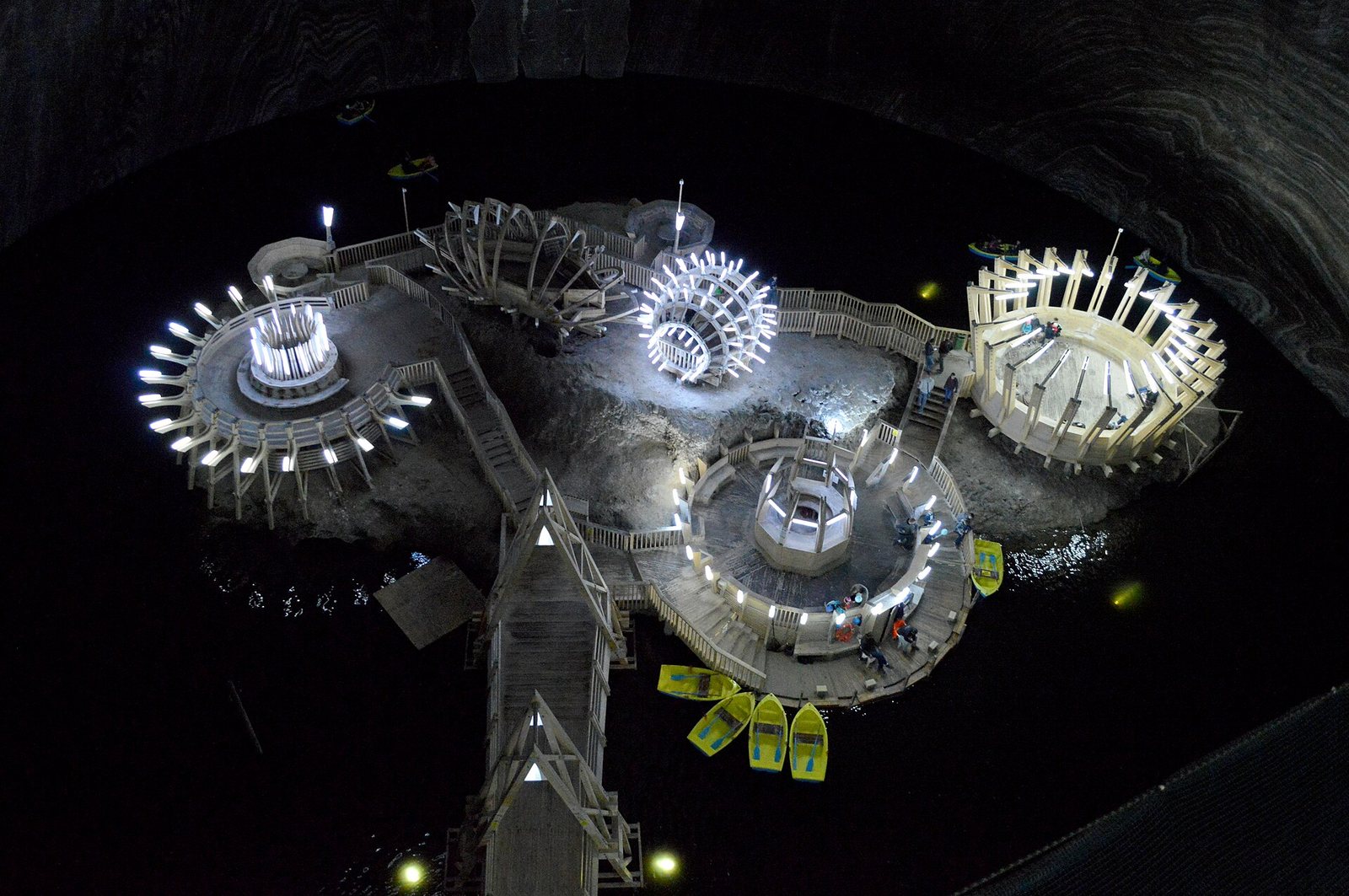
Đây là gì?
Sodium chloride — the seasoning on a table, and the feedstock for the chlorine and caustic soda that most of the chemical industry begins with.
Tại sao điều này quan trọng?
Chlor-alkali chemistry from salt underpins PVC, water treatment, paper and pharmaceuticals. Food use is a small fraction of it.
Where it is in the Earth
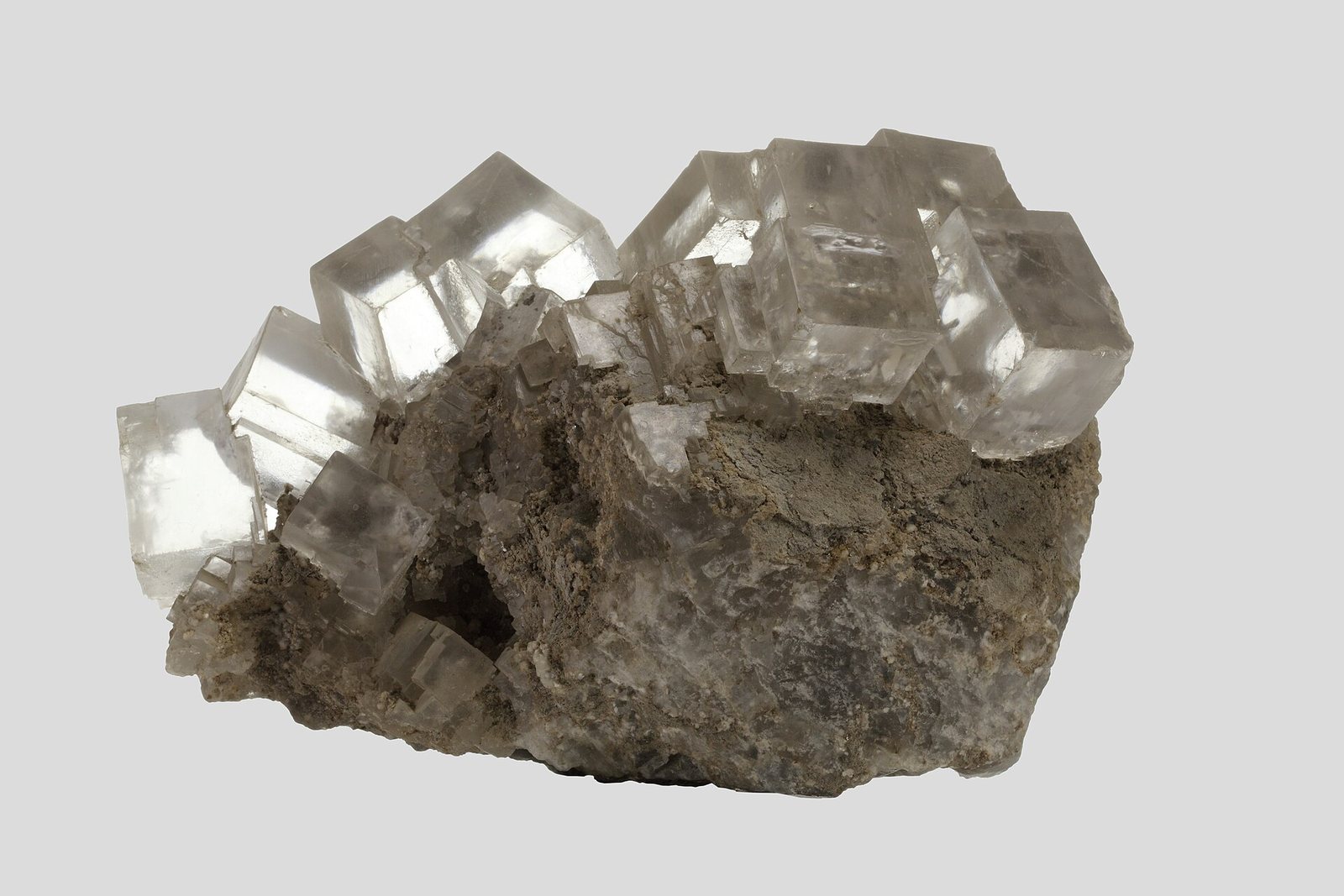
Salt — mineralogically halite, a simple compound of sodium and chlorine — forms wherever a body of seawater or a saline lake becomes enclosed and then evaporates. As the water column drops, minerals precipitate in a broadly predictable sequence: carbonates first, then sulfates, and finally chlorides including halite. Because this process has operated repeatedly across geological time, thick halite beds are found on every continent, buried beneath younger sediments at depths ranging from near the surface to several kilometres down. The deposits sit where they sit because ancient seas once sat there: the great salt basins of North America, Europe and China all trace back to enclosed marine embayments of Permian, Triassic or Devonian age.
Once buried, halite behaves unusually for a rock. It flows slowly under pressure, a property called plasticity, and because it is less dense than most overlying sediments it tends to rise through them over millions of years, forming diapirs — dome-shaped intrusions that push upward like slow columns of rising dough. These salt domes are geologically important for two reasons: they can trap oil and gas in the surrounding rocks, and they are themselves minable either by conventional underground methods or by dissolving the salt in place with injected water. Where evaporite sequences reach the surface or shallow depths in arid regions, surface expressions such as salt flats and playas also become economically exploitable.
A separate but equally significant source is present-day evaporation of seawater or brine from saline lakes. Coastal solar salt works and inland brine fields are not geological deposits in the conventional sense — they are ongoing industrial processes that replicate the original geological mechanism. Australia, India, Chile and Mexico all draw heavily on this route, using large shallow ponds and solar energy to do what ancient basins once did over geological time.
Getting it out
Salt reaches the surface through three distinct methods, and the choice between them is dictated almost entirely by the physical form of the deposit. Where halite beds are thick and pure enough to justify underground access, conventional room-and-pillar mining is used: galleries are cut through the solid rock salt, leaving substantial pillars standing to support the roof. Because halite is the product itself rather than a host rock carrying some minor constituent, the concept of ore grade as normally understood — a percentage of wanted material in unwanted host — barely applies. A good rock salt mine is extracting material that is already close to pure sodium chloride. What matters instead is the thickness and lateral continuity of the bed, the depth of cover, and the absence of insoluble impurities such as anhydrite or clay that would require separation downstream.
Where deposits are accessible from surface in arid environments, open excavation or solar evaporation ponds are preferred. Solar salt operations flood shallow basins with seawater or natural brine, allow evaporation over months, and harvest the crystallised salt mechanically. The capital cost of the solar resource — land and ponds — is high, but the energy cost is essentially zero, which makes this route competitive for bulk, lower-purity salt. Waste movement in the traditional mining sense is minimal: the salt is the landscape being worked, not something extracted from it.
The third route is solution mining, also called brine production. Fresh water is injected through a borehole into an underground halite deposit, dissolves the salt, and the resulting saturated brine is pumped back to surface. The brine may be sold directly to chemical plants — chlor-alkali producers in particular are often co-located with or piped from brine fields — or evaporated to recover dry salt. Solution mining leaves a void underground, and the geometry of that void requires careful management to prevent surface subsidence, which is the sinking of ground above the worked-out cavern. For chemical-grade applications demanding high purity, solution mining followed by vacuum evaporation is the dominant route because it allows impurities to be removed before crystallisation.
What pulls on it
The tables on this page show salt's end markets, and the pattern they reveal is one that surprises most readers encountering it for the first time: the food industry, which most people associate instinctively with salt, accounts for a relatively small share of total consumption. The dominant use globally is chemical feedstock, specifically the production of chlorine and sodium hydroxide through the electrolysis of brine, a process known as chlor-alkali. These two co-produced chemicals are foundational to an enormous range of industrial processes: PVC and other chlorinated plastics, water treatment, paper bleaching, aluminium production, soap manufacture and the synthesis of a large proportion of pharmaceutical intermediates all depend on one or both of them. Demand for salt in this channel therefore moves with the fortunes of the broader chemical industry rather than with population or food trends.
The second large pull on salt is road de-icing, a use that is almost entirely a function of winter severity and road network density in cold-climate countries. Because snowfall is variable from year to year, de-icing demand fluctuates considerably, and salt producers in North America and northern Europe plan and hold inventory accordingly. This is a price-sensitive, logistics-intensive market where transport cost often exceeds the cost of the salt itself, which is why production tends to cluster close to consuming regions rather than following the lowest-cost deposit.
An emerging and genuinely new demand signal comes from sodium-ion battery technology, where sodium chloride figures as a source of the sodium used in cathode materials and electrolytes. The material intensity figures shown on this page indicate the quantity of salt required per unit of battery capacity in this application. Whether this channel grows to significance in the overall salt balance depends on how widely sodium-ion technology is adopted relative to lithium-ion chemistry in energy storage. At present it is a small fraction of total demand, but it represents a qualitatively different kind of customer — one whose requirements for purity and traceability differ substantially from those of a highway authority buying bulk rock salt.
Nguồn gốc của nó trong đá
Tất cả khoáng vật quặng →Đây là các khoáng sản thực sự mang lại salt. Một mỏ khoáng chỉ là thân quặng khi một trong số chúng có hàm lượng đủ cao để bù đắp chi phí khai thác.
Ai sản xuất nó
Xem trên bản đồ →Mine production
Mine productionthousand metric tons 2025 (ước tính) Tổng toàn cầu 270,000 thousand metric tons
USGS Mineral Commodity Summaries 2026 · Gross weight of all grades including rock salt, solar salt and brine. · nguồn ↗
Cuộn bảng sang ngang để xem các cột còn lại.
| Quốc gia | Sản lượng | Tỷ phần thế giới |
|---|---|---|
| China | 56,000 | 20.7% |
| United States | 40,000 | 14.8% |
| India | 30,000 | 11.1% |
| Other countries | 28,000 | 10.4% |
| Germany | 15,000 | 5.6% |
| Canada | 13,000 | 4.8% |
| Australia | 12,000 | 4.4% |
| Chile | 9,000 | 3.3% |
| Turkey | 8,300 | 3.1% |
| Mexico | 7,000 | 2.6% |
| Russia | 7,000 | 2.6% |
| Brazil | 6,600 | 2.4% |
| Netherlands | 5,400 | 2.0% |
| France | 4,500 | 1.7% |
| Iran | 4,200 | 1.6% |
| Poland | 4,100 | 1.5% |
| Spain | 4,000 | 1.5% |
| Pakistan | 3,100 | 1.1% |
| Bulgaria | 2,700 | 1.0% |
| United Kingdom | 2,600 | 1.0% |
| Saudi Arabia | 2,400 | 0.9% |
| Egypt | 2,300 | 0.9% |
| Belarus | 2,000 | 0.7% |
| Italy | 1,900 | 0.7% |
| Tổng toàn cầu | 270,000 | 100% |
"Withheld" có nghĩa là USGS đã ẩn số liệu để tránh tiết lộ dữ liệu của một công ty riêng lẻ — không có nghĩa là bằng không. Tổng các hàng theo quốc gia không phải lúc nào cũng bằng tổng toàn cầu vì nguồn làm tròn từng số liệu một cách độc lập và không phải lúc nào cũng tách riêng dòng "các quốc gia khác".
Giá
average unit value of bulk, pellets and packaged salt, free on board (f.o.b.) mine and plant, dollars per metric ton: Vacuum and open pan salt
Trung bình nămdollars per metric ton
Cơ sở: average unit value of bulk, pellets and packaged salt, free on board (f.o.b.) mine and plant, dollars per metric ton: Vacuum and open pan salt. Trung bình năm theo công bố trong USGS Mineral Commodity Summaries 2026 · nguồn ↗. Đây là mức trung bình hàng năm tham khảo, không phải báo giá thị trường trực tiếp.
average unit value of bulk, pellets and packaged salt, free on board (f.o.b.) mine and plant, dollars per metric ton: Solar salt
Trung bình nămdollars per metric ton
Cơ sở: average unit value of bulk, pellets and packaged salt, free on board (f.o.b.) mine and plant, dollars per metric ton: Solar salt. Trung bình năm theo công bố trong USGS Mineral Commodity Summaries 2026 · nguồn ↗. Đây là mức trung bình hàng năm tham khảo, không phải báo giá thị trường trực tiếp.
average unit value of bulk, pellets and packaged salt, free on board (f.o.b.) mine and plant, dollars per metric ton: Salt in brine
Trung bình nămdollars per metric ton
Cơ sở: average unit value of bulk, pellets and packaged salt, free on board (f.o.b.) mine and plant, dollars per metric ton: Salt in brine. Trung bình năm theo công bố trong USGS Mineral Commodity Summaries 2026 · nguồn ↗. Đây là mức trung bình hàng năm tham khảo, không phải báo giá thị trường trực tiếp.
average unit value of bulk, pellets and packaged salt, free on board (f.o.b.) mine and plant, dollars per metric ton: Rock salt
Trung bình nămdollars per metric ton
Cơ sở: average unit value of bulk, pellets and packaged salt, free on board (f.o.b.) mine and plant, dollars per metric ton: Rock salt. Trung bình năm theo công bố trong USGS Mineral Commodity Summaries 2026 · nguồn ↗. Đây là mức trung bình hàng năm tham khảo, không phải báo giá thị trường trực tiếp.
Công dụng của nó
Tất cả thị trường đầu ra →| Thị trường đầu ra | Chức năng của nó ở đó | Tầm quan trọng |
|---|---|---|
| Grid Storage | Sodium-ion cathode and electrolyte | Quan trọng |
Một công nghệ cần bao nhiêu
| Công nghệ | Đại lượng | Báo giá | Cơ sở |
|---|---|---|---|
| Sodium-Ion Battery | 30.00–60.00 kg | per 75 kWh equivalent | Sodium source |
Indicative range compiled from published technology studies and chemistry; verify against a manufacturer specification before use. Chạy các con số này ở bất kỳ quy mô nào trong máy tính vật liệu →