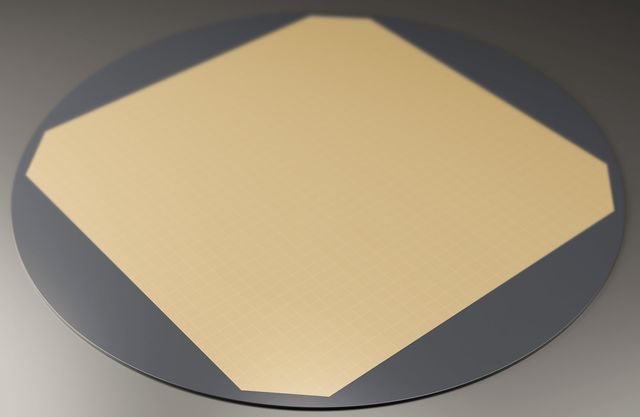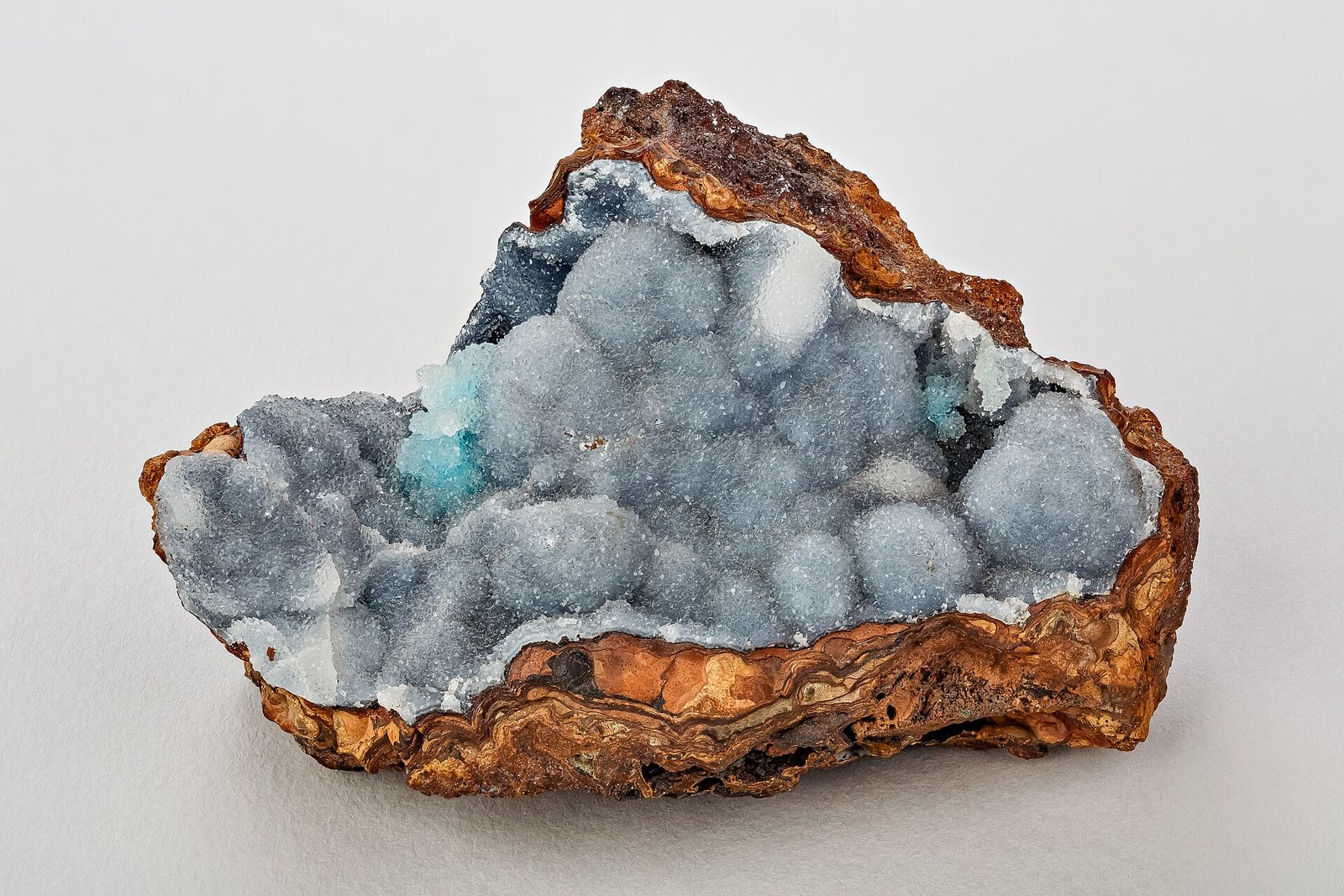
Что это такое?
Quartz sand so free of other elements that it can be melted into the crucible a silicon crystal is grown inside.
Почему это важно?
Very few deposits on Earth are clean enough. The crucible touches molten silicon for days, so any impurity in it ends up in the chip.
Where it is in the Earth
Quartz is one of the most common minerals in the Earth's crust — ordinary sand on any beach is mostly quartz — but high-purity quartz is something far rarer. The distinction lies not in the mineral itself but in how free it is of trace elements: iron, aluminium, titanium, lithium, and a handful of others that, even at concentrations measured in parts per million, will ruin a semiconductor-grade product. Getting quartz that clean requires a particular chain of geological events that very few places on Earth have experienced.
The starting point is usually a pegmatite, a coarse-grained igneous rock that forms when the last, water-rich fraction of a cooling granite magma crystallises slowly at depth. Because crystallisation is slow and the melt is fluid, atoms have time to sort themselves into large, well-ordered crystals rather than the fine-grained jumble of ordinary granite. Certain pegmatites — particularly those that have been subjected to hydrothermal reworking, where hot mineral-laden water has percolated through the rock — develop quartz veins and pods that are exceptionally pure. The hydrothermal fluids can dissolve and flush away many of the contaminating elements, or they can deposit quartz incrementally in a form that never incorporated them in the first place.
A second geological requirement is that the deposit must have survived subsequent geological events without being badly contaminated. Weathering, which breaks rock down at the surface, can both help and hinder: it removes some host-rock material and liberates quartz grains, but it also introduces iron oxides and clay minerals that coat grain surfaces. The deposits that end up being commercially workable tend to be ones where primary purity was high enough that even after surface weathering, the quartz still meets or comes close to meeting specification after processing. This combination — the right igneous ancestry, the right hydrothermal history, and the right weathering profile — is uncommon, which is why the global supply of feedstock-grade material comes from a small number of locations.
Getting it out
High-purity quartz deposits are mined by open-pit methods in most cases. The rock or weathered sand is close enough to the surface that underground workings would add cost without proportionate benefit, and the volumes involved, while not large by the standards of bulk commodities, do not require the precision of an underground operation. Where the deposit is a weathered pegmatite, the quartz may already be partially disaggregated — broken into grains by natural weathering — so relatively little energy is needed to liberate it from the surrounding material.
What makes high-purity quartz mining unusual is the care taken to avoid introducing contamination during extraction itself. Conventional mining uses steel equipment extensively, and steel introduces iron. Some operations use different materials for surfaces that contact the ore, or accept that a cleaning step later in processing will remove surface iron picked up during mining. The grade of the ore — meaning here the proportion of grains that are clean enough, and the concentration of problematic trace elements within those grains — varies across a deposit, so selective extraction, taking only the better zones, is common. This means that more material is moved and discarded relative to what a bulk-commodity mine would leave behind, because the economic penalty for processing off-grade material through an expensive purification circuit and then rejecting it at the end is high.
The concept of waste in this context is somewhat different from, say, a copper mine. There is no sulfide waste with acid-drainage problems, and the overburden is ordinary rock. The waste is mainly quartz that simply is not pure enough — material that would be perfectly saleable as industrial silica for glass or foundry sand but cannot meet semiconductor specifications. The boundary between product and waste therefore moves depending on the specification being filled, and the same deposit can simultaneously supply several different quality tiers.
What pulls on it
Almost all demand for high-purity quartz flows from the semiconductor industry, and within that industry the dominant application is the crucible in which silicon crystals are grown. The Czochralski process — the method by which the large cylindrical silicon ingots used for most semiconductor wafers are produced — involves suspending a seed crystal in a bath of molten silicon held inside a fused-quartz crucible at very high temperature for an extended period. The crucible is in direct contact with molten silicon throughout, and any element that dissolves out of the crucible wall enters the silicon melt and potentially the crystal. Because the performance of a finished semiconductor device depends on the crystal being extraordinarily uniform and free of defects, the quartz in the crucible must be as pure as the process demands. A crucible is consumed in a single crystal-growth run and cannot be reused, so demand scales directly with the number of ingots pulled.
Beyond crucibles, fused quartz made from high-purity feedstock is used for other components inside semiconductor fabs — diffusion tubes, reaction chambers, wafer carriers — that must withstand high temperatures without contaminating the wafers they hold. Solar-cell manufacturing, which also uses Czochralski or related crystal-growth methods for monocrystalline silicon, draws on similar material, though the purity requirements for solar silicon are somewhat less stringent than for logic or memory chips. The growth of semiconductor fabrication capacity over recent years has pulled demand for high-purity quartz upward, and any expansion in crystal-growth capacity translates with reasonable directness into demand for crucibles and therefore feedstock.
A sharp change in demand could come from a shift in crystal-growth technology. If the industry moved substantially toward silicon produced by methods that do not use quartz crucibles, demand for high-purity quartz feedstock would fall. Conversely, any acceleration in fabrication capacity, whether driven by consumer electronics, automotive semiconductors, or other electronics, would increase demand. The material sits close enough to the base of the semiconductor supply chain that demand for it reflects the aggregate direction of silicon-based electronics manufacturing rather than any single product category.
Turning ore into product Уровень 3
The gap between run-of-mine quartz and a material a semiconductor fab will accept is closed through a sequence of physical and chemical steps, each targeting a different class of contaminant. The first stage is comminution — crushing and milling to break the rock into grains of a controlled size — followed by screening and classification to separate grains that are too coarse or too fine. Grain size matters because the downstream customers are melting the quartz into shaped ware, and consistent granulometry (the distribution of grain sizes) controls how the melt behaves. Throughout comminution, the choice of mill lining and grinding media is constrained by the need to avoid introducing iron, chrome, or other metallic contamination; high-purity operations often use ceramic or silica-lined equipment rather than steel.
Physical separation steps follow. Magnetic separation removes grains that carry iron-bearing mineral inclusions — small crystals of magnetite, ilmenite, or iron-stained feldspar trapped inside or on the surface of quartz grains. Froth flotation, in which reagents selectively attach to non-quartz mineral surfaces and carry them away in a foam, can remove feldspars and micas that magnetic separation misses. Attrition scrubbing — agitating the grains vigorously against one another in a water slurry — abrades surface coatings and opens up grain boundaries where impurity minerals are concentrated. After each step, the reject fraction carries away a proportion of the trace-element load, but it also carries away some quartz, so recovery (the share of the original quartz that ends up in the final product) is always less than one hundred percent, and every upgrade step that improves purity tends to reduce yield.
The final and most demanding stage is acid leaching. The cleaned grains are contacted with a hot acid solution — the specific reagents and conditions are proprietary to individual producers and not publicly disclosed — that dissolves residual surface contamination and attacks fluid inclusions: microscopic pockets of ancient water or mineral-laden fluid trapped inside the quartz crystal during its formation. Fluid inclusions are a particular problem because they can contain a range of elements in concentrations far above what is acceptable in the bulk grain. After leaching, the material is rinsed, dried, and graded against specification. The specification for semiconductor-grade quartz is typically defined in terms of maximum allowable concentrations of a list of elements, measured by techniques such as inductively coupled plasma mass spectrometry. Producers publish their own grade designations — the IOTA series is a well-known commercial example — rather than referencing a single universal standard, which is one reason published quality descriptions are not directly comparable across suppliers.
Substitution and recycling Уровень 3
For the core application — the Czochralski crucible — there is no practical substitute in commercial use. The crucible must be transparent or translucent to allow optical monitoring of the melt, must survive sustained contact with molten silicon without itself melting or deforming, and must not introduce contaminants at levels that affect crystal quality. Fused quartz, made from high-purity SiO2, satisfies all of these simultaneously. Other refractory materials exist that can withstand comparable temperatures, but none combines the thermal, optical, and chemical-purity properties that the process requires in a form that can be manufactured at scale. Research into alternative crucible materials has occurred over the decades, but commercial crystal-growth practice has remained committed to fused quartz.
For other fused-quartz components in semiconductor equipment — tubes, chambers, carriers — there is somewhat more room. Silicon carbide and certain advanced ceramics can substitute for some components in some process steps, and this substitution does occur at the margins where the particular properties of fused quartz are not the binding constraint. However, these alternatives are generally more expensive to fabricate and are not interchangeable across all applications. The result is that substitution away from fused quartz in semiconductor manufacturing is partial and application-specific rather than a general trend.
Recycling is limited by the nature of the application. A crucible that has been through a crystal-growth cycle is contaminated with silicon and with whatever has dissolved into it from the melt; it cannot simply be cleaned and reused as a crucible. Some fused-quartz fabricators reclaim and reprocess broken or off-specification ware by re-melting it, but the impurities introduced during use mean that recycled material generally cannot meet the purity specification for a new crucible. Other fused-quartz components that have not been in contact with silicon melts may be more amenable to reclaim, but the volumes are not large relative to primary production. The result is that the industry is substantially dependent on primary feedstock, and the supply of primary high-purity quartz sand is the effective constraint on the supply of crucibles.
Where the chain is fragile Уровень 4
The published production data for high-purity quartz is sparse. As the data block for this page notes, several producers treat their output figures as proprietary, so the global supply picture cannot be assembled from official statistics in the way that, say, copper or aluminium production can. This opacity is itself a risk feature: market participants, policymakers, and researchers are working with an incomplete picture of how much material is produced, where, and at what specification. The USGS and equivalent national geological surveys have limited data to work with, and what is published reflects the voluntary disclosures of a small number of companies rather than a comprehensive census.
The deposit base is geographically concentrated. The geological conditions that produce workable high-purity quartz are not evenly distributed, and a significant share of global supply of feedstock-grade material has historically come from a small number of deposits. This means that disruption at a single major source — whether from operational, logistical, or regulatory causes — has a disproportionate effect on the global supply available to crucible manufacturers. The fused-quartz ware manufacturers who take the sand feedstock and convert it into crucibles are themselves concentrated in a small number of countries, so the concentration of risk is compounded through the supply chain rather than diversified at the fabrication stage.
Lead times add a further dimension of fragility. Qualifying a new deposit or a new supplier against semiconductor-grade specifications is a lengthy process. Crystal-growth equipment manufacturers and their customers validate feedstock through extended production trials, because the consequences of a contamination event — loss of a crystal-growth run, or worse, yield loss discovered only after wafer processing — are costly. A new source of high-purity quartz cannot be brought into use quickly even if the geological resource is known to exist, because the qualification process imposes a delay that is measured in years rather than months. This means that even if an alternative supply were identified and brought to production, it would not be available to the market on a timeline that would be useful during a short-term disruption. The price data shown on this page — with the step change visible between 2022 and 2023 for both grade categories — is consistent with a market that is not well buffered against supply tightness, though the causes of any specific price movement are not documented in the data available here.
Откуда берётся в породе
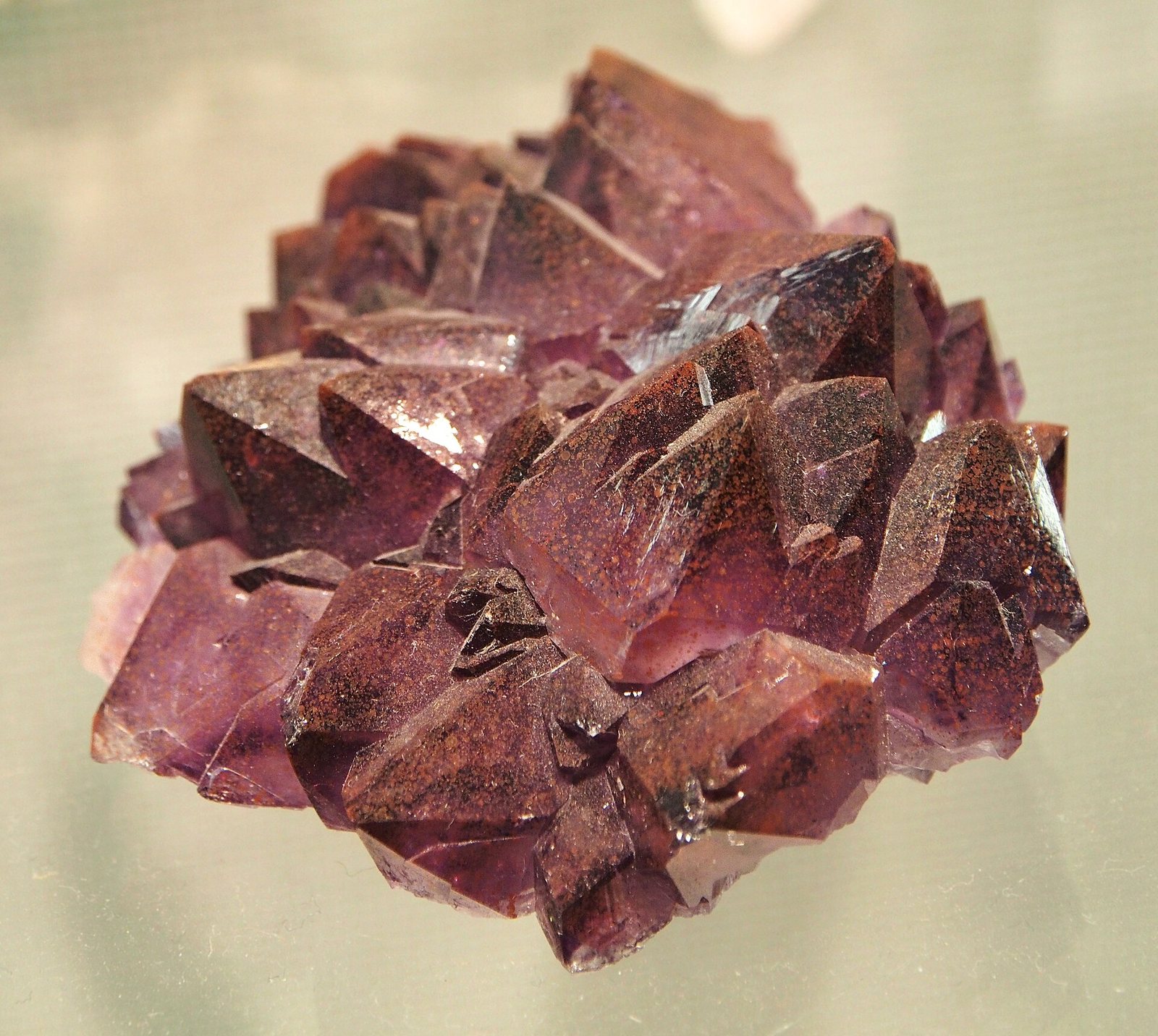
Все рудные минералы →Это минералы, которые реально содержат high-purity quartz. Залежь является рудным телом лишь в том случае, если концентрация одного из компонентов достаточна, чтобы окупить добычу.
Цена
as-grown cultured quartz, dollars per kilogram
Среднегодовое значениеdollars per kilogram
Основание: as-grown cultured quartz, dollars per kilogram. Среднегодовые значения в том виде, в каком опубликованы в USGS Mineral Commodity Summaries 2026 · источник ↗. Приведены справочные годовые средние значения, а не котировки текущего рынка.
lumbered quartz, dollars per kilogram
Среднегодовое значениеdollars per kilogram
Основание: lumbered quartz, dollars per kilogram. Среднегодовые значения в том виде, в каком опубликованы в USGS Mineral Commodity Summaries 2026 · источник ↗. Приведены справочные годовые средние значения, а не котировки текущего рынка.
Где перерабатывается и рафинируется
| Предприятие | Тип | Стадия | Страна | Роль |
|---|---|---|---|---|
| TSMC Fab 18, Tainan | Производство полупроводников | Компонент | Taiwan | Входные данные |
| Hemlock Semiconductor Polysilicon Plant | Химический завод | Рафинирование | United States | Входные данные |
Для чего применяется
Все конечные рынки →| Конечный рынок | Что он делает там | Значимость |
|---|---|---|
| Semiconductors | Crucibles for crystal growth | Определение |
Сколько этого материала требует технология
| Технология | Количество | Котируется | Основание |
|---|---|---|---|
| Leading-Edge Logic Chip Consumption is per ingot, not per wafer. | следовые количества | per 300 mm wafer | Consumed as crucible during crystal growth |
Indicative range compiled from published technology studies and chemistry; verify against a manufacturer specification before use. Запустите эти расчёты в любом масштабе в калькуляторе материалов →
Проследить через границы
Все маршруты →Куда фактически направляется партия этого материала — каждая страна, каждый хранитель и что остаётся на каждом этапе.
A quarry in North Carolina to the chip in your phone The most valuable sand on Earth, and almost all of it comes from one small district.