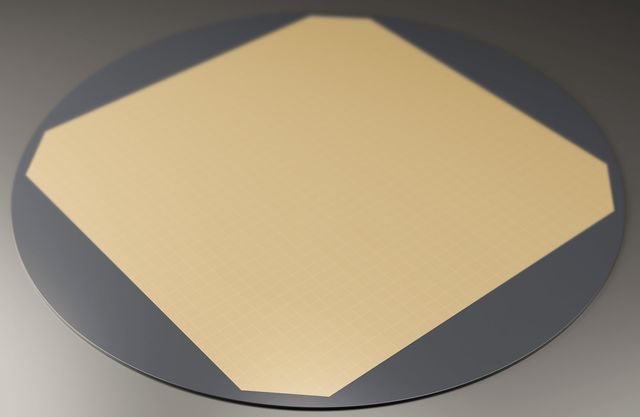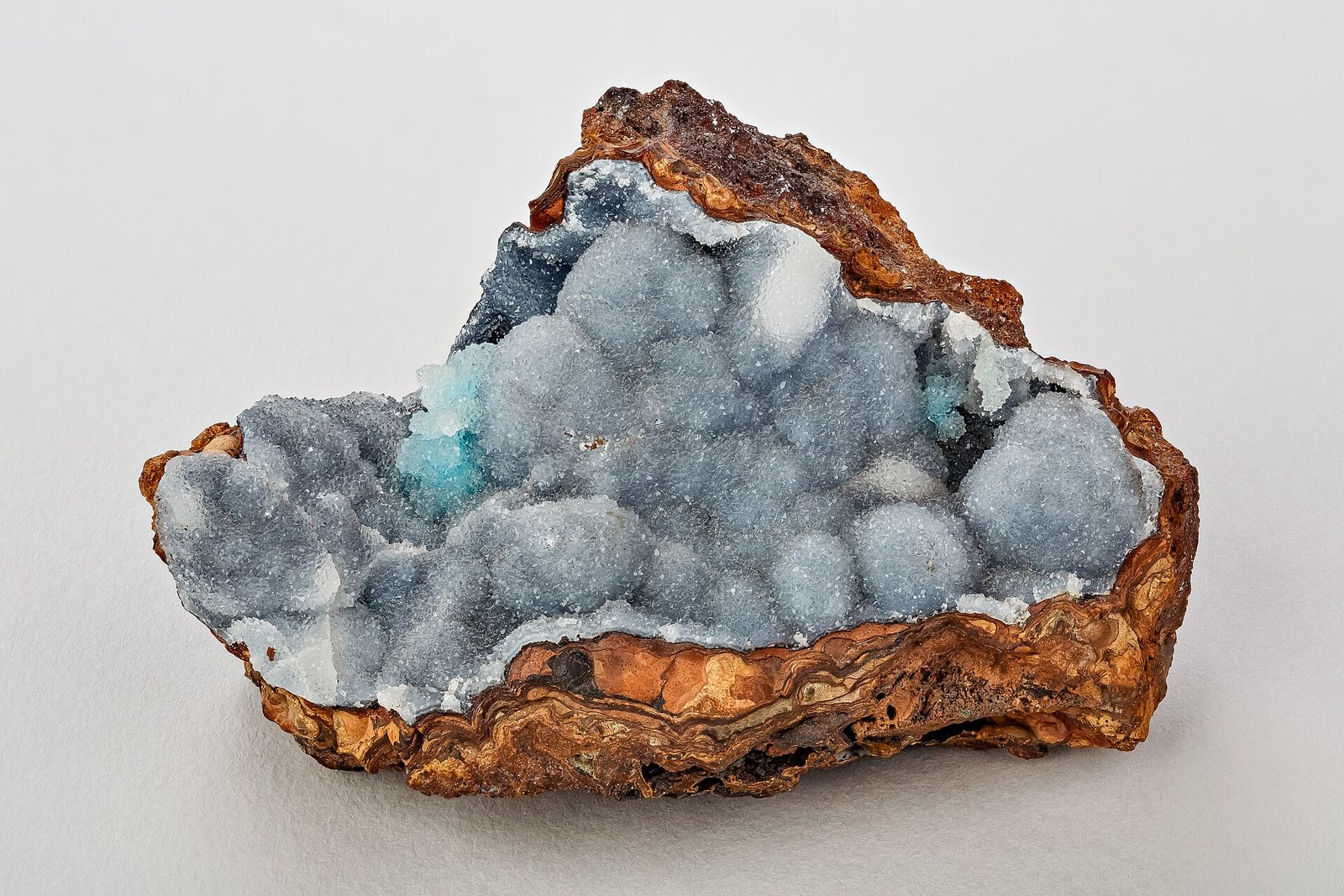
यह क्या है?
Quartz sand so free of other elements that it can be melted into the crucible a silicon crystal is grown inside.
यह क्यों महत्वपूर्ण है?
Very few deposits on Earth are clean enough. The crucible touches molten silicon for days, so any impurity in it ends up in the chip.
Where it is in the Earth
Quartz is one of the most common minerals in the Earth's crust — ordinary sand on any beach is mostly quartz — but high-purity quartz is something far rarer. The distinction lies not in the mineral itself but in how free it is of trace elements: iron, aluminium, titanium, lithium, and a handful of others that, even at concentrations measured in parts per million, will ruin a semiconductor-grade product. Getting quartz that clean requires a particular chain of geological events that very few places on Earth have experienced.
The starting point is usually a pegmatite, a coarse-grained igneous rock that forms when the last, water-rich fraction of a cooling granite magma crystallises slowly at depth. Because crystallisation is slow and the melt is fluid, atoms have time to sort themselves into large, well-ordered crystals rather than the fine-grained jumble of ordinary granite. Certain pegmatites — particularly those that have been subjected to hydrothermal reworking, where hot mineral-laden water has percolated through the rock — develop quartz veins and pods that are exceptionally pure. The hydrothermal fluids can dissolve and flush away many of the contaminating elements, or they can deposit quartz incrementally in a form that never incorporated them in the first place.
A second geological requirement is that the deposit must have survived subsequent geological events without being badly contaminated. Weathering, which breaks rock down at the surface, can both help and hinder: it removes some host-rock material and liberates quartz grains, but it also introduces iron oxides and clay minerals that coat grain surfaces. The deposits that end up being commercially workable tend to be ones where primary purity was high enough that even after surface weathering, the quartz still meets or comes close to meeting specification after processing. This combination — the right igneous ancestry, the right hydrothermal history, and the right weathering profile — is uncommon, which is why the global supply of feedstock-grade material comes from a small number of locations.
Getting it out
High-purity quartz deposits are mined by open-pit methods in most cases. The rock or weathered sand is close enough to the surface that underground workings would add cost without proportionate benefit, and the volumes involved, while not large by the standards of bulk commodities, do not require the precision of an underground operation. Where the deposit is a weathered pegmatite, the quartz may already be partially disaggregated — broken into grains by natural weathering — so relatively little energy is needed to liberate it from the surrounding material.
What makes high-purity quartz mining unusual is the care taken to avoid introducing contamination during extraction itself. Conventional mining uses steel equipment extensively, and steel introduces iron. Some operations use different materials for surfaces that contact the ore, or accept that a cleaning step later in processing will remove surface iron picked up during mining. The grade of the ore — meaning here the proportion of grains that are clean enough, and the concentration of problematic trace elements within those grains — varies across a deposit, so selective extraction, taking only the better zones, is common. This means that more material is moved and discarded relative to what a bulk-commodity mine would leave behind, because the economic penalty for processing off-grade material through an expensive purification circuit and then rejecting it at the end is high.
The concept of waste in this context is somewhat different from, say, a copper mine. There is no sulfide waste with acid-drainage problems, and the overburden is ordinary rock. The waste is mainly quartz that simply is not pure enough — material that would be perfectly saleable as industrial silica for glass or foundry sand but cannot meet semiconductor specifications. The boundary between product and waste therefore moves depending on the specification being filled, and the same deposit can simultaneously supply several different quality tiers.
What pulls on it
Almost all demand for high-purity quartz flows from the semiconductor industry, and within that industry the dominant application is the crucible in which silicon crystals are grown. The Czochralski process — the method by which the large cylindrical silicon ingots used for most semiconductor wafers are produced — involves suspending a seed crystal in a bath of molten silicon held inside a fused-quartz crucible at very high temperature for an extended period. The crucible is in direct contact with molten silicon throughout, and any element that dissolves out of the crucible wall enters the silicon melt and potentially the crystal. Because the performance of a finished semiconductor device depends on the crystal being extraordinarily uniform and free of defects, the quartz in the crucible must be as pure as the process demands. A crucible is consumed in a single crystal-growth run and cannot be reused, so demand scales directly with the number of ingots pulled.
Beyond crucibles, fused quartz made from high-purity feedstock is used for other components inside semiconductor fabs — diffusion tubes, reaction chambers, wafer carriers — that must withstand high temperatures without contaminating the wafers they hold. Solar-cell manufacturing, which also uses Czochralski or related crystal-growth methods for monocrystalline silicon, draws on similar material, though the purity requirements for solar silicon are somewhat less stringent than for logic or memory chips. The growth of semiconductor fabrication capacity over recent years has pulled demand for high-purity quartz upward, and any expansion in crystal-growth capacity translates with reasonable directness into demand for crucibles and therefore feedstock.
A sharp change in demand could come from a shift in crystal-growth technology. If the industry moved substantially toward silicon produced by methods that do not use quartz crucibles, demand for high-purity quartz feedstock would fall. Conversely, any acceleration in fabrication capacity, whether driven by consumer electronics, automotive semiconductors, or other electronics, would increase demand. The material sits close enough to the base of the semiconductor supply chain that demand for it reflects the aggregate direction of silicon-based electronics manufacturing rather than any single product category.
यह चट्टान में कहाँ से आता है
सभी अयस्क खनिज →ये वे खनिज हैं जो वास्तव में वहन करते हैं high-purity quartz. कोई निक्षेप अयस्क निकाय तभी बनता है जब उसमें से कोई एक तत्व इतनी मात्रा में संकेंद्रित हो कि उसे खोदकर निकालने का व्यय वसूल हो सके।
मूल्य
as-grown cultured quartz, dollars per kilogram
वार्षिक औसतdollars per kilogram
आधार: as-grown cultured quartz, dollars per kilogram. में प्रकाशित वार्षिक औसत USGS Mineral Commodity Summaries 2026 · स्रोत ↗. ये संदर्भ वार्षिक औसत हैं, लाइव बाज़ार भाव नहीं।
lumbered quartz, dollars per kilogram
वार्षिक औसतdollars per kilogram
आधार: lumbered quartz, dollars per kilogram. में प्रकाशित वार्षिक औसत USGS Mineral Commodity Summaries 2026 · स्रोत ↗. ये संदर्भ वार्षिक औसत हैं, लाइव बाज़ार भाव नहीं।
इसे कहाँ प्रसंस्कृत और परिष्कृत किया जाता है
| संयंत्र | प्रकार | चरण | देश | भूमिका |
|---|---|---|---|---|
| TSMC Fab 18, Tainan | अर्धचालक फैब | घटक | Taiwan | इनपुट |
| Hemlock Semiconductor Polysilicon Plant | रासायनिक संयंत्र | शोधन | United States | इनपुट |
इसका उपयोग किसलिए होता है
सभी अंत-बाज़ार →| अंतिम बाज़ार | यह वहाँ क्या करता है | महत्त्व |
|---|---|---|
| Semiconductors | Crucibles for crystal growth | परिभाषित करना |
किसी तकनीक को इसकी कितनी आवश्यकता है
| प्रौद्योगिकी | मात्रा | उद्धृत | आधार |
|---|---|---|---|
| Leading-Edge Logic Chip Consumption is per ingot, not per wafer. | अनुरेख | per 300 mm wafer | Consumed as crucible during crystal growth |
Indicative range compiled from published technology studies and chemistry; verify against a manufacturer specification before use. सामग्री कैलकुलेटर में इन संख्याओं को किसी भी पैमाने पर चलाएँ →
इसे सीमाओं के पार अनुसरण करें
सभी यात्राएँ →इस सामग्री की एक खेप वास्तव में कहाँ जाती है — प्रत्येक देश, प्रत्येक अभिरक्षक, और हर चरण में क्या पीछे छूट जाता है।
A quarry in North Carolina to the chip in your phone The most valuable sand on Earth, and almost all of it comes from one small district.