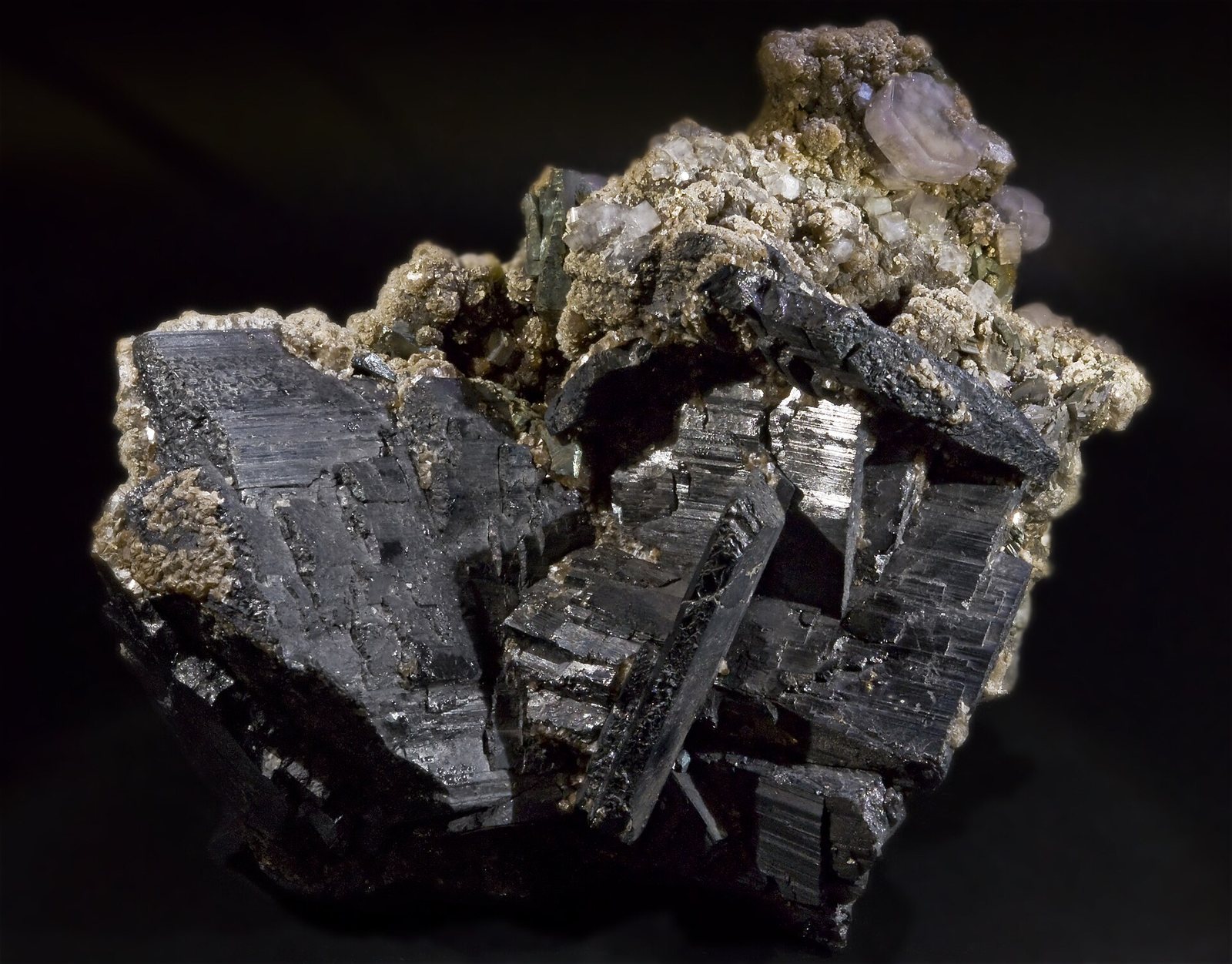
Что это такое?
The metal with the highest melting point of them all — you can heat it to 3,400 C before it turns liquid.
Почему это важно?
Tungsten carbide is what cuts, drills and mills every other metal. Industrial capacity depends on it in a way that is easy to overlook.
Where it is in the Earth
Tungsten does not spread itself evenly through the crust. It concentrates into economic deposits through a specific set of geological circumstances, most of which involve heat and chemistry working together over long timescales. The most important setting is the contact zone between a cooling granite intrusion and the surrounding limestone or carbonate rock. As the intrusion cools, hot fluids carrying dissolved tungsten, calcium and other elements migrate outward and react with the carbonate. The result is a skarn — a zone of chemically altered rock — in which the mineral scheelite (calcium tungstate) crystallises in quantities large enough to mine. Skarns account for much of the world's tungsten output.
The other principal deposit type forms when tungsten-bearing hydrothermal fluids — essentially hot, mineralised water circulating through fractures in the rock — cool and deposit the mineral wolframite along veins. Wolframite is an iron-manganese tungstate and tends to form in and around granite bodies, often alongside tin, molybdenum and bismuth. These vein deposits can be narrow but rich, and they are the classic form of tungsten mineralisation associated with the granites of southern China, the Iberian Peninsula and parts of Southeast Asia. The geographical pattern of tungsten deposits around the world therefore follows the distribution of old granitic terranes and the limestone sequences that surround them, which is why China, with its enormous extent of such geology, holds reserves far larger than any other country.
A useful distinction to carry through the rest of this page: scheelite tends to show up in skarns associated with calc-silicate metamorphic belts, while wolframite is more typical of high-temperature hydrothermal veins. Both are tungstates — salts of tungstic acid — but they respond differently to processing, which matters when the ore leaves the mine.
Getting it out
Because tungsten ore bodies are often steep, irregular and relatively small in lateral extent, underground mining is the dominant extraction method. Miners follow the vein or skarn body downward, using methods such as stoping — excavating the ore in a controlled sequence of rooms or slices — while leaving enough intact rock to support the surrounding ground. The ore itself makes up only a small fraction of the total rock that must be handled; the rest, called waste or gangue, is moved and stored. This ratio of waste to ore, called the strip ratio in open-pit operations or expressed as dilution underground, is a central economic variable at any tungsten mine.
Ore grade matters enormously because tungsten concentrations are reported in units of WO₃ — tungsten trioxide equivalent by weight — per tonne of rock. Economic grades are typically low by the standards of base metals; the ore contains a small proportion of tungsten mineral surrounded by a large volume of unremarkable rock. Moving and processing that surrounding rock has a cost, and when ore grades fall below a threshold that varies with the price of tungsten concentrate, mines close. This sensitivity explains why capacity outside China has been prone to care-and-maintenance closures during periods of low prices. Some scheelite is also recovered as a by-product of mining for other metals, particularly tin and copper, which changes the economics considerably: the tungsten recovery cost is shared with the primary product.
Open-pit mining does occur where ore bodies are wide enough and shallow enough to make it practical, though this is less common than in commodities such as iron ore or copper. In either configuration, the extracted ore must be crushed and processed promptly, since there is no value in stockpiling low-grade rock indefinitely. The mining method is therefore chosen primarily by the geometry and depth of the deposit, and only secondarily by other considerations.
What pulls on it
The single largest use of tungsten worldwide is in cutting and wear-resistant tooling, where it appears as tungsten carbide — a compound of tungsten and carbon that is extraordinarily hard. Cemented carbide, sometimes called hardmetal, binds tungsten carbide grains together with a metal binder, usually cobalt, to produce inserts, drills, end mills and other cutting tools used to machine steel, aluminium and other materials. Without these tools, manufacturing as it is currently practised would not function. Almost every metal component that requires a precise shape passes through a cutting tool at some stage, and tungsten carbide is the material those tools are most commonly made from.
Beyond cutting tools, tungsten appears in a range of demanding applications where its extreme density or melting point is specifically required. In defence, its density makes it suitable for kinetic energy penetrators — projectiles that rely on mass rather than explosive force. In aerospace and other precision applications, small tungsten alloy components serve as counterweights and vibration dampers. The semiconductor industry uses tungsten in contacts and vias — the tiny conducting pathways that connect layers within a microchip — because tungsten can be deposited uniformly into very small features and withstands the high temperatures of chip fabrication.
Demand would shift materially only if the nature of manufacturing changed substantially. A broad move away from metal cutting — through additive manufacturing at sufficient scale and precision, for instance — could reduce tool consumption, but this transition has been gradual and incomplete. Growth in semiconductor content per device, combined with continuing demand from defence procurement, provides a counterweight to any softening in conventional machining. Neither the composition of end-use demand nor the rate of its growth is something the tables alone convey; what matters is that the uses are structurally embedded in industrial processes that do not change quickly.
Откуда берётся в породе
Все рудные минералы →Это минералы, которые реально содержат tungsten. Залежь является рудным телом лишь в том случае, если концентрация одного из компонентов достаточна, чтобы окупить добычу.
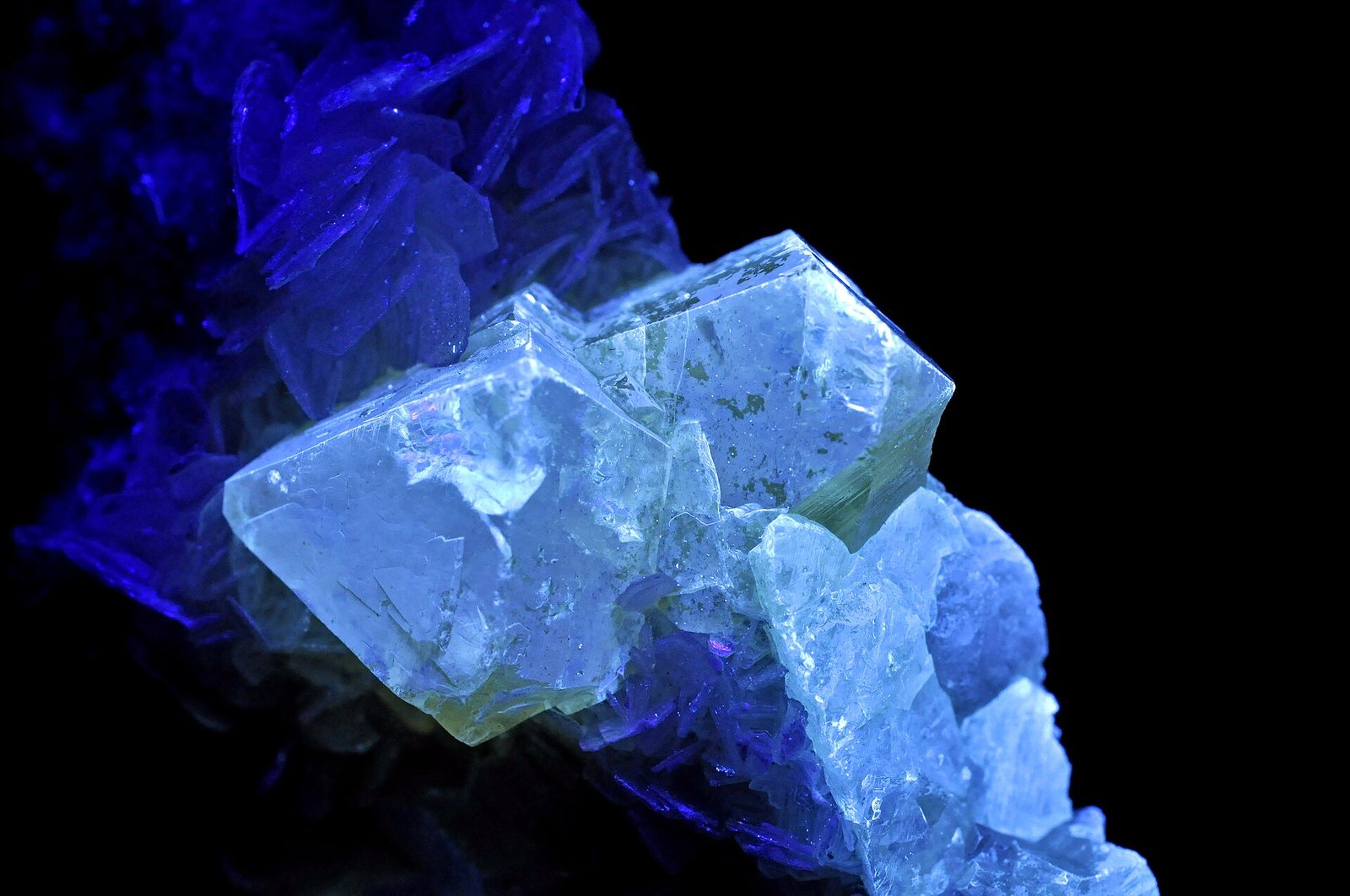
Scheelite
The skarn tungsten mineral. Its bright blue fluorescence under UV light is a standard field prospecting tool.
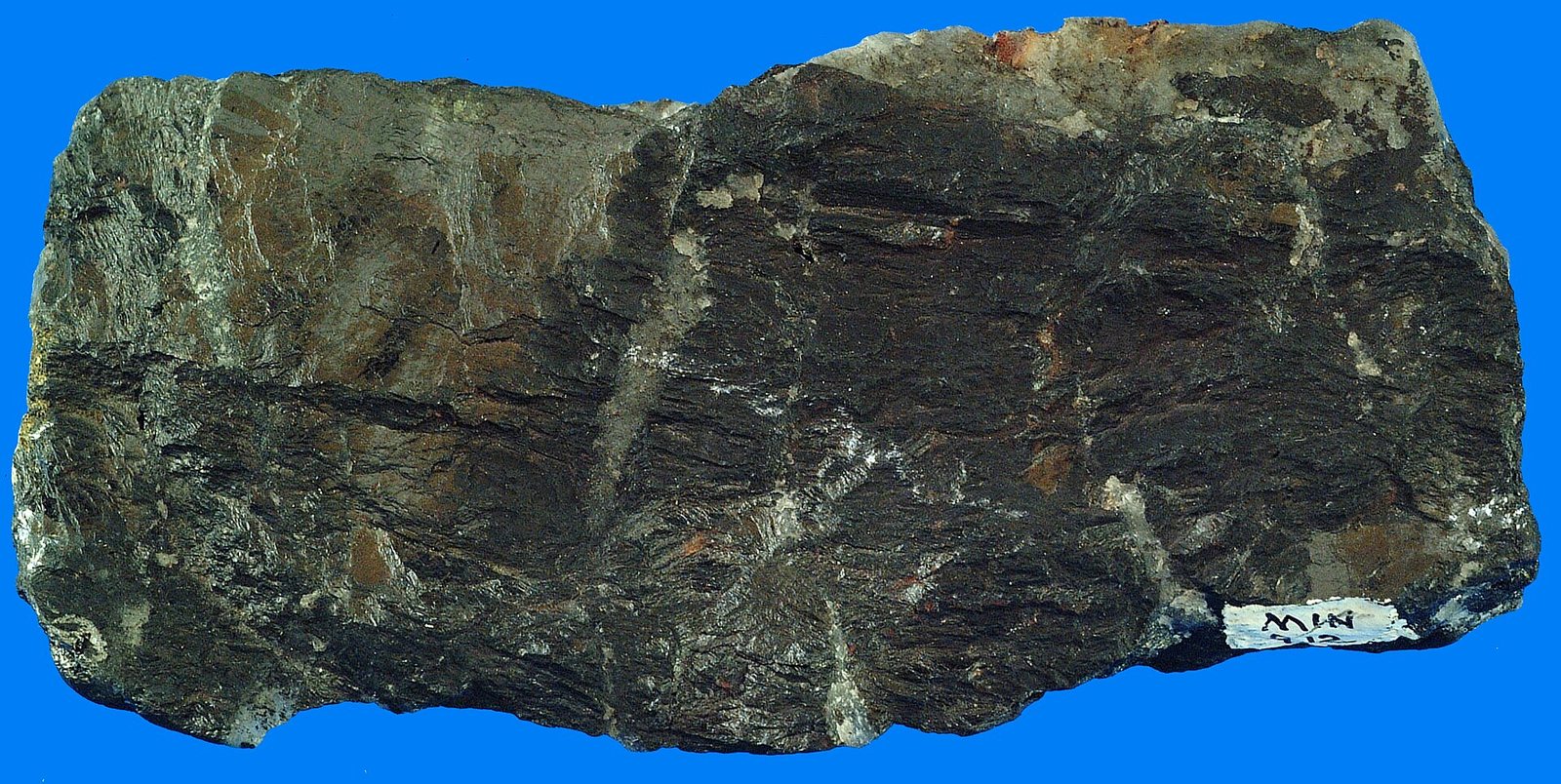
Wolframite
One of two tungsten ores; the classic vein mineral of granite-hosted systems.
Кто производит
Посмотреть на карте →Mine production
Mine productionmetric tons 2025 (оценочный) Мировой итог 85,000 metric tons
USGS Mineral Commodity Summaries 2026 · Mine production of contained tungsten, from wolframite and scheelite ore. · источник ↗
Прокрутите таблицу вправо, чтобы увидеть остальные столбцы.
| Страна | Производство | Доля мирового |
|---|---|---|
| China | 67,000 | 78.8% |
| Vietnam | 3,000 | 3.5% |
| Other countries | 2,400 | 2.8% |
| Kazakhstan | 2,400 | 2.8% |
| Korea, North | 2,000 | 2.4% |
| Russia | 2,000 | 2.4% |
| Bolivia | 1,700 | 2.0% |
| Rwanda | 1,300 | 1.5% |
| Australia | 1,000 | 1.2% |
| Austria | 840.0 | 1.0% |
| Spain | 800.0 | 0.9% |
| Portugal | 700.0 | 0.8% |
| United States | Zero | — |
| Мировой итог | 85,000 | 100% |
«Withheld» означает, что USGS скрыл данные во избежание раскрытия сведений об отдельной компании, — это не равнозначно нулю. Суммы по строкам стран не всегда совпадают с мировым итогом, поскольку источник округляет каждый показатель независимо и не всегда выделяет строку «прочие страны» отдельно.
Кто располагает запасами
Reserves
Reservesmetric tons 2025
USGS Mineral Commodity Summaries 2026 · источник ↗
| Страна | Запасы | Доля мирового |
|---|---|---|
| China | 2,500,000 | 53.2% |
| Other countries | 950,000 | 20.2% |
| Australia | 570,000 | 12.1% |
| Russia | 400,000 | 8.5% |
| Vietnam | 170,000 | 3.6% |
| Spain | 66,000 | 1.4% |
| Korea, North | 29,000 | 0.6% |
| Austria | 10,000 | 0.2% |
| Portugal | 3,400 | 0.1% |
| Rwanda | Not applicable | — |
| United States | Not applicable | — |
| Bolivia | Not applicable | — |
| Kazakhstan | Not applicable | — |
| Мировой итог | >4,700,000 | 100% |
Источник публикует этот мировой итог как интервальную оценку, а не точное значение, поэтому доли в последнем столбце также являются интервальными оценками.
Цена
concentrate, average in-warehouse Rotterdam, dollars per dry metric ton unit of tungsten trioxide
Среднегодовое значениеdollars per dry metric ton unit
Основание: concentrate, average in-warehouse Rotterdam, dollars per dry metric ton unit of tungsten trioxide. Среднегодовые значения в том виде, в каком опубликованы в USGS Mineral Commodity Summaries 2026 · источник ↗. Приведены справочные годовые средние значения, а не котировки текущего рынка.
Где перерабатывается и рафинируется
| Предприятие | Тип | Стадия | Страна | Роль |
|---|---|---|---|---|
| Samsung Pyeongtaek Campus | Производство полупроводников | Компонент | South Korea | Входные данные |
| TSMC Fab 18, Tainan | Производство полупроводников | Компонент | Taiwan | Входные данные |
Для чего применяется
Все конечные рынки →| Конечный рынок | Что он делает там | Значимость |
|---|---|---|
| Semiconductors | Contacts and vias | Определение |
| Aerospace & Defence | Penetrators and counterweights | Важно |
Сколько этого материала требует технология
| Технология | Количество | Котируется | Основание |
|---|---|---|---|
| Leading-Edge Logic Chip Grams per wafer. | следовые количества | per 300 mm wafer | Contacts and vias |
Indicative range compiled from published technology studies and chemistry; verify against a manufacturer specification before use. Запустите эти расчёты в любом масштабе в калькуляторе материалов →
Экспортный контроль
| Страна | Контроль | Применяется к |
|---|---|---|
| China | Export licensing requirement for materials and technologies | Antimony (2024), bismuth (2025), synthesized diamond (2025), gallium (2023), germanium (2023), graphite (2023), indium (2025), magnesium materials (2024), molybdenum (2025), rare earths (2025), silver (2026), tellurium (2025), tungsten (2025), and items related to lithium batteries and artificial graphite anode materials (2025). ↗ |
| Russia | Export ban | Steel waste and scrap, tungsten scrap, and enriched uranium (2022). ↗ |
USGS Mineral Commodity Summaries 2026, table 4 — controls in effect as of January 2026, excluding controls since lifted.