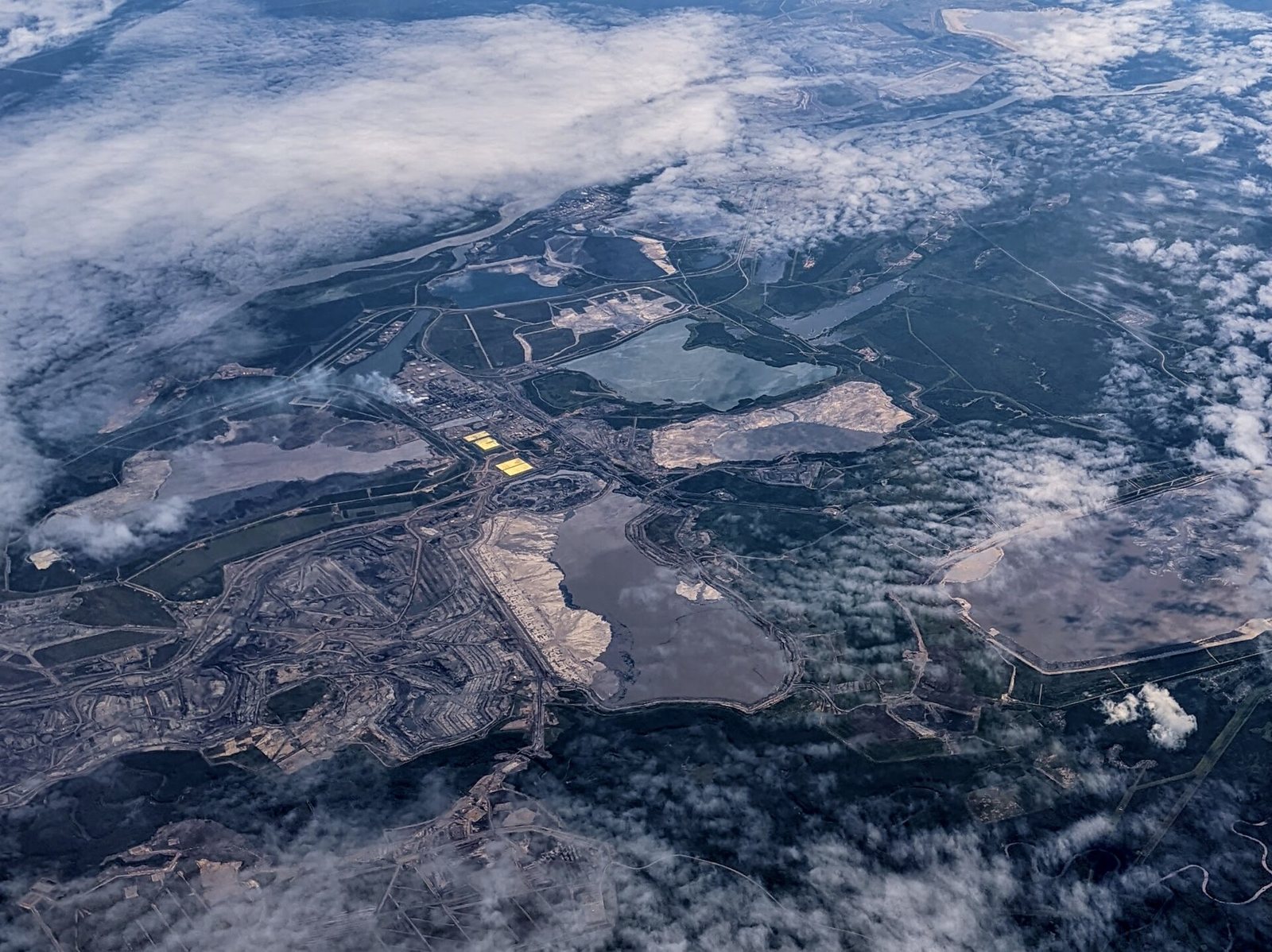
Was ist das?
Sand soaked in oil so thick it will not flow — it has to be mined like ore or heated underground before it can move through a pipe.
Warum ist das wichtig?
Oil sands are the clearest example of the mining-energy overlap: giant shovels and trucks, ore grades quoted in percent bitumen, and a processing plant at the end.
Where it is in the Earth
Bitumen does not form where it is found. It begins as conventional crude oil — a fluid hydrocarbon generated when organic-rich sedimentary rocks, buried deep enough to reach temperatures between roughly one hundred and one hundred and fifty degrees Celsius, break down over geological time. That process, which geologists call the oil window, produces oil that then migrates upward and laterally through permeable rock until it encounters some barrier: a fold, a fault, an impermeable cap rock. In ordinary circumstances the oil stays trapped there as a conventional reservoir. Oil sands are what happens when that trap fails, or never fully sealed, and the oil continues migrating until it reaches the surface or the near-surface, where it meets groundwater, bacteria, and the open atmosphere.
At those shallow depths, the lighter fractions of the crude oil evaporate or are consumed by bacteria over millions of years. What remains is bitumen — the heaviest, most carbon-rich fraction, a near-solid at room temperature that behaves more like cold tar than liquid oil. It coats individual sand grains and sits in the pore spaces between them, which is why the deposit is called an oil sand rather than a conventional reservoir. The host rock is typically a quartz-rich sandstone or loose sand of Cretaceous age, meaning it was laid down roughly sixty-five to one hundred and forty-five million years ago in shallow marine or river-delta environments. The world's largest accumulations formed along the margins of ancient inland seas where both organic supply and the right migration geometry coincided.
The Athabasca deposit in northeastern Alberta is by far the largest single accumulation, sitting in a basin where Cretaceous sands were buried shallowly enough that biodegradation had full effect, yet extensively enough that enormous volumes of bitumen survived. Other significant deposits exist in Venezuela's Orinoco Belt, and smaller accumulations appear in Kazakhstan and elsewhere, but the Canadian deposits are the most developed and the ones that define global understanding of the resource. The depth of burial matters enormously: where the oil sands lie close enough to the surface for daylight to reach them within practical reach of a dragline or shovel — generally within about seventy to eighty metres — open-pit mining is possible. Deeper deposits must be reached by other means.
Getting it out
The two methods used to extract bitumen reflect that depth constraint. Where the deposit is shallow enough, operators remove the overlying soil and rock — the overburden — and mine the oil sand directly, exactly as one would mine a metallic ore. Giant electric or diesel shovels load the sand into trucks of exceptional size, and those trucks carry it to a crusher and then to a processing facility nearby. The proportion of bitumen in the sand — the grade — is quoted in weight percent, just as a copper grade would be quoted in percent copper. A typical mined oil sand might carry a bitumen content in the range of ten to twelve percent by weight, which means that for every tonne of sand moved, the great majority is waste mineral that must be handled, processed through a water-based extraction plant, and then deposited in tailings ponds. The ratio of material moved to product recovered places oil sands mining firmly in the same economic category as low-grade open-pit metal mines.
For deposits buried too deeply for surface mining, the industry uses a technique called Steam-Assisted Gravity Drainage, usually abbreviated to SAGD and pronounced like the word. Two horizontal wells are drilled through the bitumen formation, one above the other. High-pressure steam is injected through the upper well, heating the bitumen until it becomes fluid enough to flow. It then drains by gravity to the lower well, which pumps it to the surface. SAGD leaves the land surface largely undisturbed compared with open-pit mining and generates no tailings ponds, but it demands large volumes of water converted to steam, and the energy cost of generating that steam is a defining feature of the economics and the environmental footprint. Natural gas is the primary fuel used, which means SAGD bitumen production is coupled, in energy terms, to the gas market.
A further consideration for both methods is the nature of the product that leaves the mine or wellpad. Raw bitumen is too viscous to move through a pipeline at ambient temperature. It must either be diluted with a lighter hydrocarbon — typically condensate, a natural-gas liquid — to produce what the industry calls dilbit (diluted bitumen), or it must be upgraded at a processing facility into synthetic crude oil. These are distinct traded products with different qualities and different markets, and the tables elsewhere on this page distinguish between them. The choice between selling dilbit and investing in an upgrader is one of the central capital decisions in the industry.
What pulls on it
Bitumen and the synthetic crude produced from it serve essentially the same end market as conventional crude oil: they are refined into transportation fuels, primarily diesel and gasoline, along with jet fuel, heating oil, and the full range of petrochemical feedstocks. The demand for oil sands output is therefore not distinct from the demand for oil in general. What separates oil sands from conventional supply is their position in the cost curve — they are among the higher-cost barrels to produce — which means they are pulled on most strongly when global oil demand is high enough and conventional supply constrained enough to justify the additional cost.
Heavy, high-sulfur crude is specifically valued by refineries that have invested in the processing units — cokers, hydrotreaters — needed to handle it. These are large, long-lived capital assets, and refineries built to process heavy feedstocks tend to seek out heavy feedstocks preferentially because doing so maximises the return on that investment. North American refineries along the Gulf Coast represent the largest concentration of heavy-oil refining capacity outside Venezuela, and they have historically been significant buyers of Canadian dilbit and synthetic crude. The pipeline infrastructure connecting Alberta to those refineries is therefore a material factor in how much oil sands production can reach its highest-value market.
For demand to change sharply downward, the most direct mechanism would be a sustained reduction in global liquid fuel consumption, particularly in road transport, where electrification is progressing at different rates in different markets. Because oil sands are relatively high on the cost curve, a world of lower overall oil demand would tend to curtail oil sands output before it curtailed output from lower-cost conventional fields. For demand to change sharply upward, the counterfactual is a tightening of conventional supply without a commensurate rise in alternatives — a scenario in which the scale of the resource, even at higher extraction cost, would make it the marginal barrel of necessity.
Turning ore into product Ebene 3
For mined oil sands, the first processing step is liberation: the bitumen must be separated from the sand grains that carry it. This is done through hot-water extraction, a process in which the mined sand is mixed with hot water and a small quantity of caustic soda in large rotating vessels called tumblers or conditioning drums. The agitation and heat cause the bitumen to detach from the sand grains and form a froth that floats to the surface of a separation vessel. That froth — bitumen froth — still contains water and fine solids and must pass through further solvent-based froth treatment to produce a clean bitumen stream. The sand, water, and fine clay particles that remain form a slurry discharged to tailings ponds, where the coarse sand settles quickly but the fine clay particles can remain in suspension for years or decades. Managing those fine tailings is one of the largest unresolved technical challenges in the industry.
Whether the feedstock comes from a mining operation or from SAGD wells, the recovered bitumen faces the same downstream question: what to sell. Bitumen in its natural state has a high sulfur content and a high concentration of heavy metals, particularly nickel and vanadium, and it is deficient in hydrogen relative to conventional crude oil. Upgrading addresses this by cracking the large hydrocarbon molecules into smaller ones — using either thermal processes such as delayed coking or catalytic hydrocracking — and adding hydrogen to produce a lighter, lower-sulfur synthetic crude oil that conventional refineries can process without modification. Upgrading is capital-intensive and energy-intensive; it also produces a by-product coke, a solid carbon residue from the coking process, which has its own disposal and marketing considerations. Operators who choose not to upgrade sell dilbit at a discount to synthetic crude, with that discount reflecting the cost that the refinery accepting the dilbit will incur to handle its heavier, more sulfurous character.
The losses and costs in the processing chain are distributed across several points. Hot-water extraction does not recover all the bitumen in the feed: some remains attached to fine clay particles and exits with the tailings. Froth treatment recovers more, but solvent losses and operating costs accumulate here. Upgrading introduces further conversion losses and requires a continuous supply of hydrogen, typically produced by steam methane reforming of natural gas, adding another feedstock dependency. The cumulative energy intensity of the full chain — mining or SAGD, extraction, upgrading — is substantially higher per barrel of product than for conventional crude oil, a fact that bears directly on greenhouse gas emissions accounting and on the relative cost of the resource when energy prices rise.
Substitution and recycling Ebene 3
As a source of liquid hydrocarbons for transportation and petrochemicals, bitumen and its upgraded derivatives compete with every other form of crude oil. The relevant substitutes are therefore conventional crude oil, extra-heavy oil from other basins, and at longer time horizons, non-oil energy carriers for transport such as electricity, hydrogen, and synthetic fuels. Within the crude oil market, the substitution is essentially continuous: refineries adjust their crude slates based on relative prices and qualities, and a refinery capable of running dilbit can run other heavy crudes if the price relationship justifies it. The constraint on substitution is refinery configuration — not every refinery can process every crude — and pipeline and shipping logistics.
From the demand side, the structural substitute for oil as a transportation fuel is electrification of vehicles. This substitution operates over long timescales because it requires changes in vehicle fleets, electricity generation, and charging infrastructure, none of which turn over quickly. For petrochemical uses — plastics, lubricants, asphalt — the substitution pathways are less clear and in some cases do not yet exist at industrial scale. Bitumen itself, in its heavy undiluted form, has a direct non-energy use in road paving and roofing, where it competes with alternative binders but occupies a well-established position.
Recycling, in the sense that applies to metals, does not apply to bitumen or the fuels derived from it: combustion is the primary end use, and the carbon in the fuel leaves as carbon dioxide. Used motor oil and refinery by-products can be re-refined, but this is a marginal flow relative to primary production. The absence of a recycling loop means that demand for primary bitumen is not moderated by secondary supply in the way that demand for, say, aluminium is partially offset by scrap. This distinguishes oil sands from most of the metallic materials discussed elsewhere on this site.
Where the chain is fragile Ebene 4
The concentration of the world's developed oil sands resource in a single political jurisdiction — Canada, and within Canada almost entirely in Alberta — is the most straightforward geographic risk in the supply chain. The resource itself is not contested in the way that some critical mineral deposits are, but the infrastructure connecting it to markets is limited and has been the subject of prolonged regulatory and political dispute. Pipeline capacity has at various points constrained how quickly production could grow regardless of operator willingness to invest, and the regulatory process for new pipeline approvals in North America has lengthened substantially over the past two decades. This is a lead-time and optionality risk rather than a resource-availability risk: the bitumen is in the ground in large quantities, but getting additional volumes to market requires infrastructure decisions made many years in advance.
The by-product structure of oil sands processing creates secondary exposure. Upgrading produces petroleum coke, a high-carbon solid that has markets as a fuel and as a carbon source for aluminium smelting, but whose demand is sensitive to environmental regulations in importing countries. If petroleum coke markets tighten — through emissions restrictions on its use as a fuel, for instance — the economics of upgrading shift, potentially redirecting production toward dilbit sales and away from synthetic crude, changing the quality of the product reaching refineries. The sulfur and heavy metals removed during upgrading also require disposal or sale, adding further by-product dependencies.
Published figures for oil sands reserves illustrate a reporting complexity that is worth understanding. Canadian reserves are reported under the framework of the Canadian Oil and Gas Evaluation Handbook and are treated by some international bodies as proved reserves comparable to conventional oil reserves, while others classify portions of the resource differently depending on assumptions about future technology and price. The volume of bitumen in place is very large, but the fraction considered economically recoverable under any given set of assumptions is sensitive to the cost of natural gas (used for steam and hydrogen), the price of oil, and the regulatory cost of tailings management and greenhouse gas emissions. When these input assumptions shift, published reserve numbers can change substantially without any change in the physical resource, which is a source of apparent inconsistency between different agencies' figures and between figures published in different years.
Bergwerke, die es fördern
Alle Minen →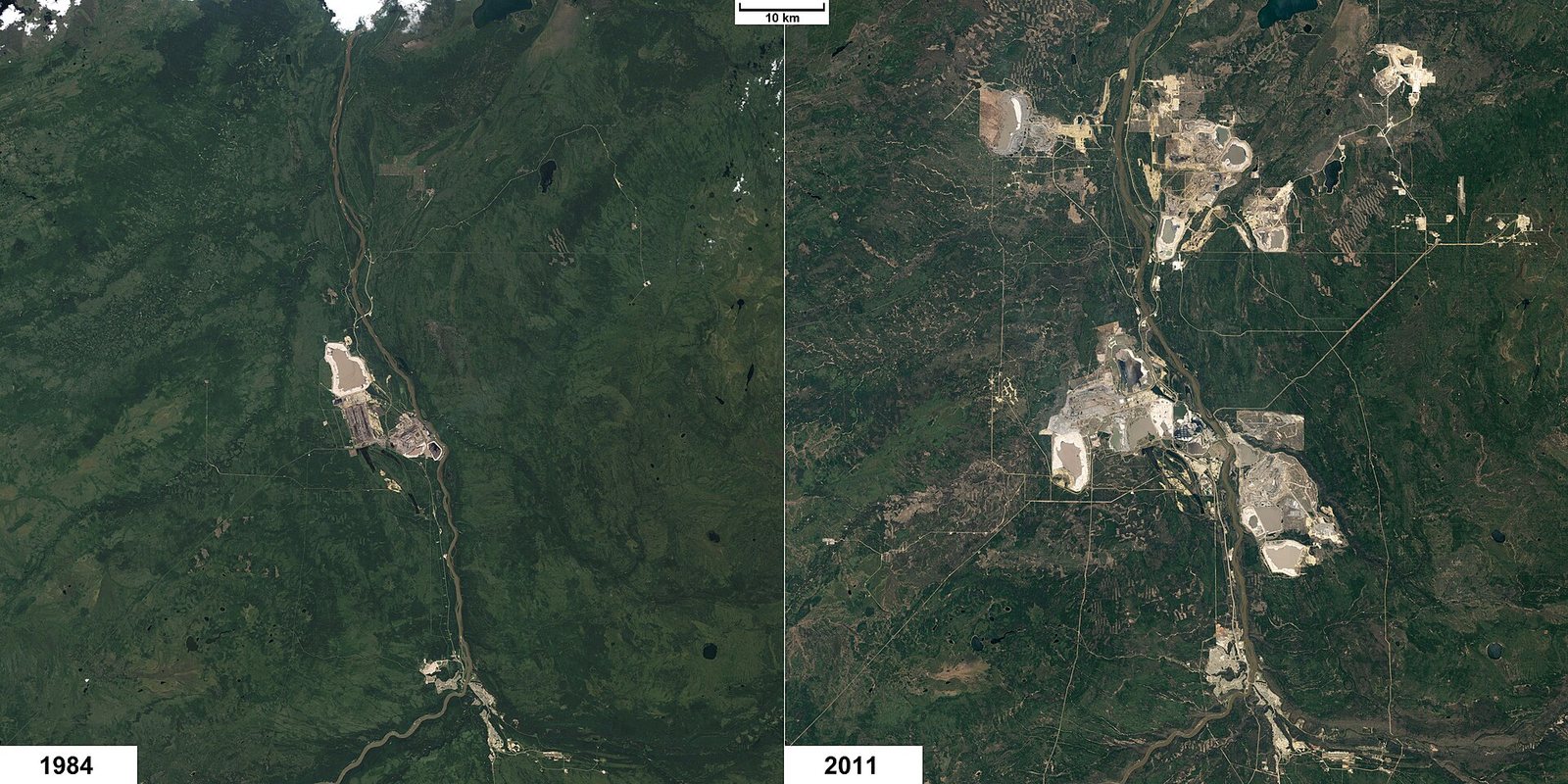
Athabasca Oil Sands (Mildred Lake / Aurora) →
Grenzenübergreifend verfolgen
Alle Routen →Wo eine Sendung dieses Materials tatsächlich hingeht — jedes Land, jeder Verwahrer und was bei jedem Schritt zurückbleibt.
Alberta oil sands: mined like ore, refined like oil The only oil in the world that is dug up with a shovel and graded like an orebody. Venezuelan extra-heavy crude to diesel, asphalt and aluminium anodes Oil so thick it will not flow down a pipe, and cannot be refined by most refineries on Earth.