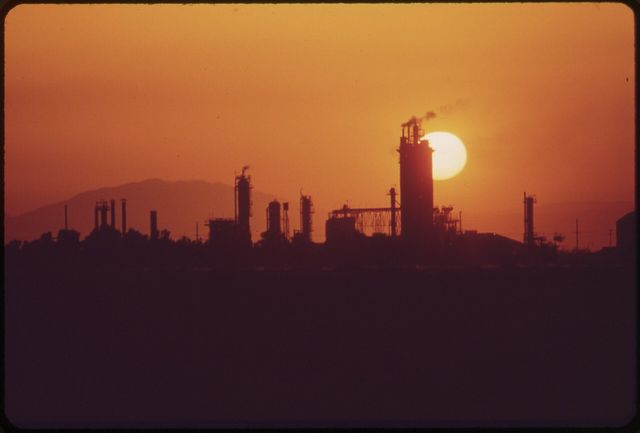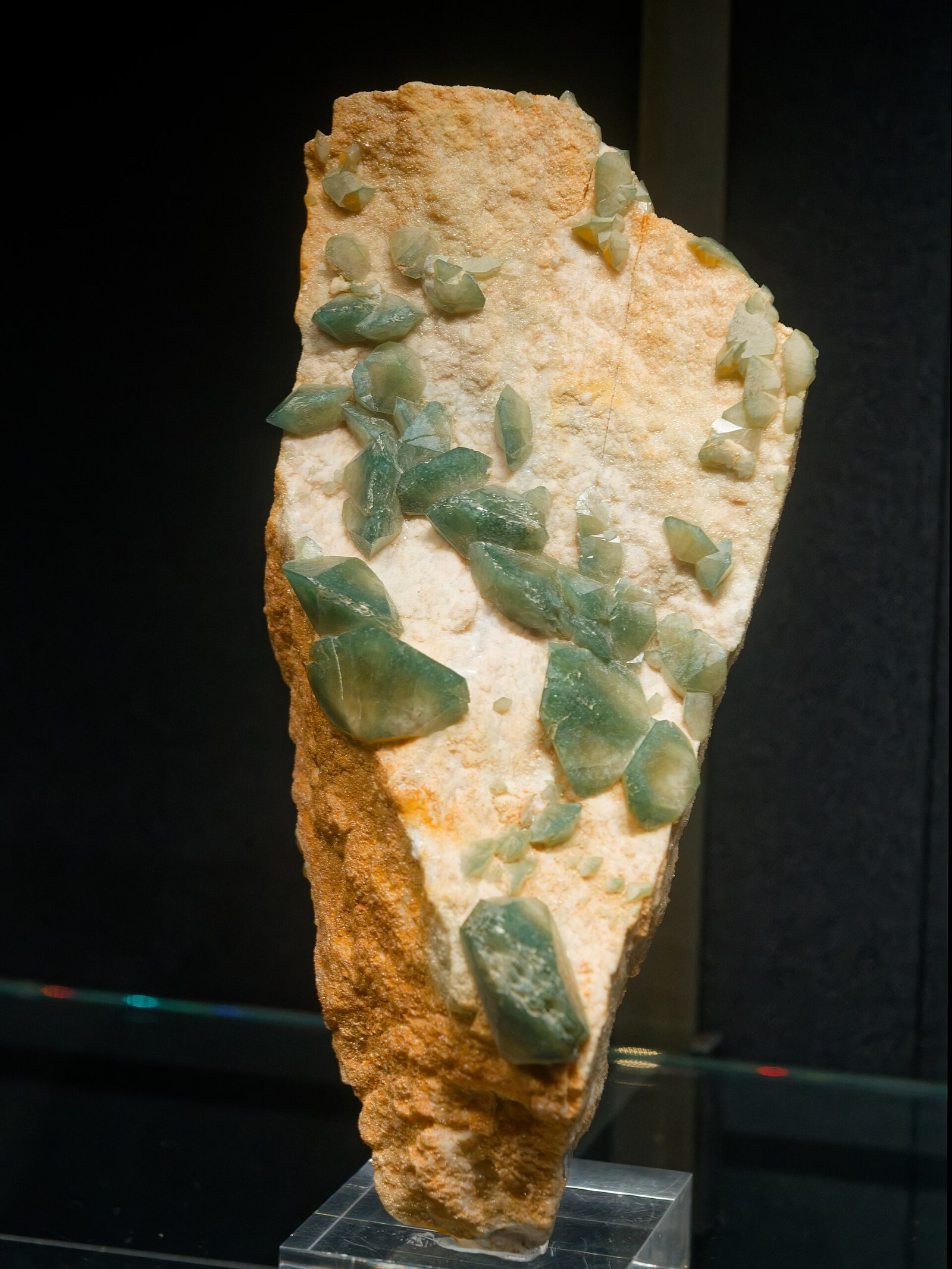
Đây là gì?
Rock full of the element phosphorus — the P in fertiliser, and now the P in the LFP batteries used in most new electric cars in China.
Tại sao điều này quan trọng?
No plant grows without phosphorus and there is no synthetic substitute. The same rock now also feeds the cheapest, safest lithium-battery chemistry.
Where it is in the Earth
Phosphorus is not rare in the Earth's crust, but usable concentrations of it are. The mineral that carries it is apatite, a calcium phosphate that forms in several geological settings. The vast majority of the world's mined phosphate rock comes from a specific type of sedimentary deposit called phosphorite, which formed when ancient, shallow seas created the right conditions for phosphorus to precipitate out of seawater and accumulate on the seafloor over millions of years. Cold, nutrient-rich ocean currents upwelling along continental margins brought phosphorus up from the deep and delivered it to shallow shelf environments where organic matter accumulated, decayed, and slowly recrystallised into the fine-grained carbonate-fluorapatite that makes up most commercial deposits. This explains why the great sedimentary phosphate fields of Morocco, the Middle East, and North Africa all lie in a broad belt that traces the edge of an ancient ocean called the Tethys Sea.
The other main geological setting is igneous: phosphate concentrated in intrusive rock bodies called carbonatites, which form when unusual, carbonate-rich magmas cool slowly at depth. These are the dominant deposit type in Russia, Brazil, Finland, and South Africa. Igneous apatite tends to be higher grade in phosphorus but often carries iron, rare earth elements, and other minerals alongside it, which complicates processing. A third, minor setting is guano — the accumulated excrement of seabirds and bats on oceanic islands — which was historically important but now represents only a small fraction of global supply.
The distribution of reserves in the tables makes the geological story plain. Morocco's reserves dwarf every other country's precisely because the Anti-Atlas and surrounding regions sit atop an extraordinarily thick, laterally continuous sequence of Cretaceous and Eocene marine phosphorites. The gap between Morocco's reserve figure and the rest of the world is not a quirk of reporting; it reflects a genuinely exceptional geological endowment. Countries like the United States, Jordan, and Egypt also owe their deposits to the same ancient marine system, while Russia and Brazil represent the igneous carbonatite province.
Getting it out
Almost all phosphate rock is won by open-pit mining, and the reason is straightforward: the sedimentary beds that host most of the world's reserves are broad, flat, and relatively shallow. Stripping away the overlying rock and soil — the overburden — and then excavating the ore in benches is more practical and far less expensive than sinking underground workings for a commodity sold at the prices the tables show. The ore is typically soft enough to be excavated directly by large shovels and scrapers without blasting, which simplifies operations and reduces cost. Draglines, a type of large excavating machine that casts a bucket forward on a cable and drags it back filled, are particularly common in the Florida and Morocco deposits.
Grade is expressed as the percentage of phosphorus pentoxide, written P₂O₅, in the rock. This is a chemical convention: analysts measure how much of the rock would convert to P₂O₅ if fully oxidised, and report that as a proxy for phosphorus content. Run-of-mine ore from a sedimentary deposit is rarely pure enough to sell directly; it must be upgraded. The ratio of waste moved to ore recovered — the strip ratio — varies by deposit but can be substantial, meaning that for every tonne of marketable rock produced, several tonnes of overburden and gangue (unwanted rock) must be handled. The tonnage figures in the production table are marketable rock after concentration, not raw material dug from the ground, so the actual scale of earth movement at these operations is considerably larger than the numbers suggest.
Igneous deposits, such as those mined in Russia's Kola Peninsula, are typically harder rock and require drilling and blasting, giving them a different cost profile. A small amount of phosphate is also recovered as a by-product from iron ore processing in certain regions, though this is a minor contributor to global supply. There is no significant brine or in-situ recovery of phosphate rock at commercial scale.
What pulls on it
Phosphorus is an essential macronutrient for all living things, and agriculture has always been the foundation of demand for phosphate rock. Plants cannot grow without it, it cannot be manufactured, and it cannot be replaced by any other element in the biochemical roles it plays — most importantly in DNA, cell membranes, and the energy-transfer molecule ATP. This makes the fertiliser industry's demand for phosphate rock essentially inelastic at the level of global food production. As the world's population has grown and diets have shifted toward higher meat consumption — which requires more grain per calorie produced — the total demand for phosphate fertiliser has grown alongside it. Farmers apply phosphate to replace what is removed from the soil in crops, and without that replacement, yields decline over time.
The end-markets table reflects a newer and rapidly growing source of demand: lithium iron phosphate, or LFP, batteries. LFP is a cathode chemistry in which iron phosphate forms the active material. It has become the dominant chemistry in electric vehicles sold in China and in stationary grid storage globally, largely because it is less expensive to produce and avoids the cobalt and nickel that other lithium battery chemistries require. The intensity figure in the table — the quantity of phosphate in a battery pack — indicates that each pack requires a meaningful quantity of processed phosphate, distinct in quality from fertiliser-grade material. As battery production has scaled, this demand segment has grown from negligible to significant within a short period. It competes with agriculture not so much for raw rock as for the higher-quality acid and precursor chemistry that sits downstream of the mine.
For demand to change sharply in either direction, the conditions would have to be unusual. A sustained decline in global food production volumes, or a large-scale shift back to organic farming at industrial scale, would reduce fertiliser demand, but neither is in prospect at any near-term horizon. On the battery side, a shift away from LFP to cathode chemistries that do not use iron phosphate — for example, back to nickel-based cathodes — would reduce that demand segment, and chemistry competition in the battery industry is real. The fertiliser demand, however, is structurally deep and unlikely to move quickly.
Turning ore into product Cấp độ 3
The chain from run-of-mine ore to a product a factory can use has several distinct steps, and where value — and loss — accumulates depends on which step in the chain a producer operates. The first stage is beneficiation: the ore is crushed and ground (comminution), then processed to separate apatite from the silica, clay, carbonate, and other gangue minerals that dilute it. Froth flotation is the dominant technique, in which chemical reagents are added to a water slurry so that air bubbles selectively attach to the apatite particles and carry them to the surface as a froth, while gangue sinks. The concentrate produced typically meets the grade required for phosphoric acid production, expressed as a minimum P₂O₅ percentage. Losses occur here: phosphorus that stays with the gangue or in process water is not recovered. The phosphogypsum tailings that result from later acid production — a calcium sulfate by-product generated in very large volumes — present a long-term disposal challenge that has regulatory and cost implications for producers.
Most phosphate rock concentrate is then reacted with sulfuric acid to produce wet-process phosphoric acid, which is the intermediate that underpins the fertiliser industry. This reaction is highly exothermic and consumes significant quantities of sulfuric acid, making the cost and availability of sulfur an important input variable. The resulting acid is roughly 28–30% P₂O₅ and, once purified, can be further concentrated. For fertiliser applications, this acid is neutralised with ammonia to produce diammonium phosphate (DAP) or monoammonium phosphate (MAP). For battery-grade lithium iron phosphate (LFP) cathode material, a different and more demanding purification route is required: the acid must meet specifications for trace metal contaminants far stricter than fertiliser grades, and additional processing steps — precipitation, filtration, and often a thermal treatment — are needed to produce the iron phosphate precursor that battery manufacturers use. China has developed the most integrated version of this battery-grade supply chain, which connects through to the gigafactory listing in the plants table.
A small but growing share of phosphate is processed via the thermal or electric furnace route, which produces elemental phosphorus rather than phosphoric acid. Elemental phosphorus is the feedstock for certain specialty chemicals and for some precursors used in battery electrolytes and additives. The electric furnace process is energy-intensive and has a substantially higher cost per unit of phosphorus than the wet acid route, which limits it to higher-value end uses where purity requirements justify the expense.
Substitution and recycling Cấp độ 3
In agriculture, there is no substitute for phosphorus itself. No other element performs its biochemical functions in plants, and this is not a limitation of current technology but of fundamental chemistry. What can change is the efficiency with which phosphorus is applied: precision agriculture techniques can reduce over-application, improved crop varieties can take up phosphorus more efficiently from soil, and the use of microbial inoculants can improve phosphorus availability to plant roots. These approaches reduce the quantity of rock needed per tonne of crop produced, but they do not eliminate the need for phosphorus inputs where soils are deficient. In that narrow sense, efficiency is the only substitute available in agriculture, and it operates on the margin.
In the battery sector, substitution is more tractable. LFP competes directly with nickel manganese cobalt (NMC) and nickel cobalt aluminium (NCA) cathode chemistries, none of which use phosphate. The choice between them involves trade-offs in energy density, cycle life, thermal behaviour, and cost, and different markets weight those trade-offs differently. LFP's cost advantage and safety profile have made it dominant in certain segments, but if battery designers move toward higher-energy-density chemistries for applications where weight and range matter most, phosphate demand from that sector would grow more slowly than battery production as a whole. Solid-state battery chemistries under development could also shift cathode material choices, though at what scale and timeline is not established.
Recycling of phosphorus from end uses is technically possible and practiced at small scale — phosphorus is recovered from sewage sludge and food-processing waste in some European countries — but the volumes recovered are modest relative to total consumption. The barriers are economic rather than technical: the phosphorus in sewage is dispersed at low concentration across large water volumes and mixed with other materials, making collection and purification expensive. Agricultural phosphorus that washes into rivers and oceans is essentially unrecoverable with current methods. The recycling rate for phosphorus in fertiliser applications is therefore very low, in contrast to metals such as steel or aluminium where high-concentration scrap streams make recycling economically attractive. Battery phosphate, because it flows through a more controlled industrial system, has somewhat better prospects for end-of-life recovery, but that infrastructure is still early-stage.
Nguồn gốc của nó trong đá
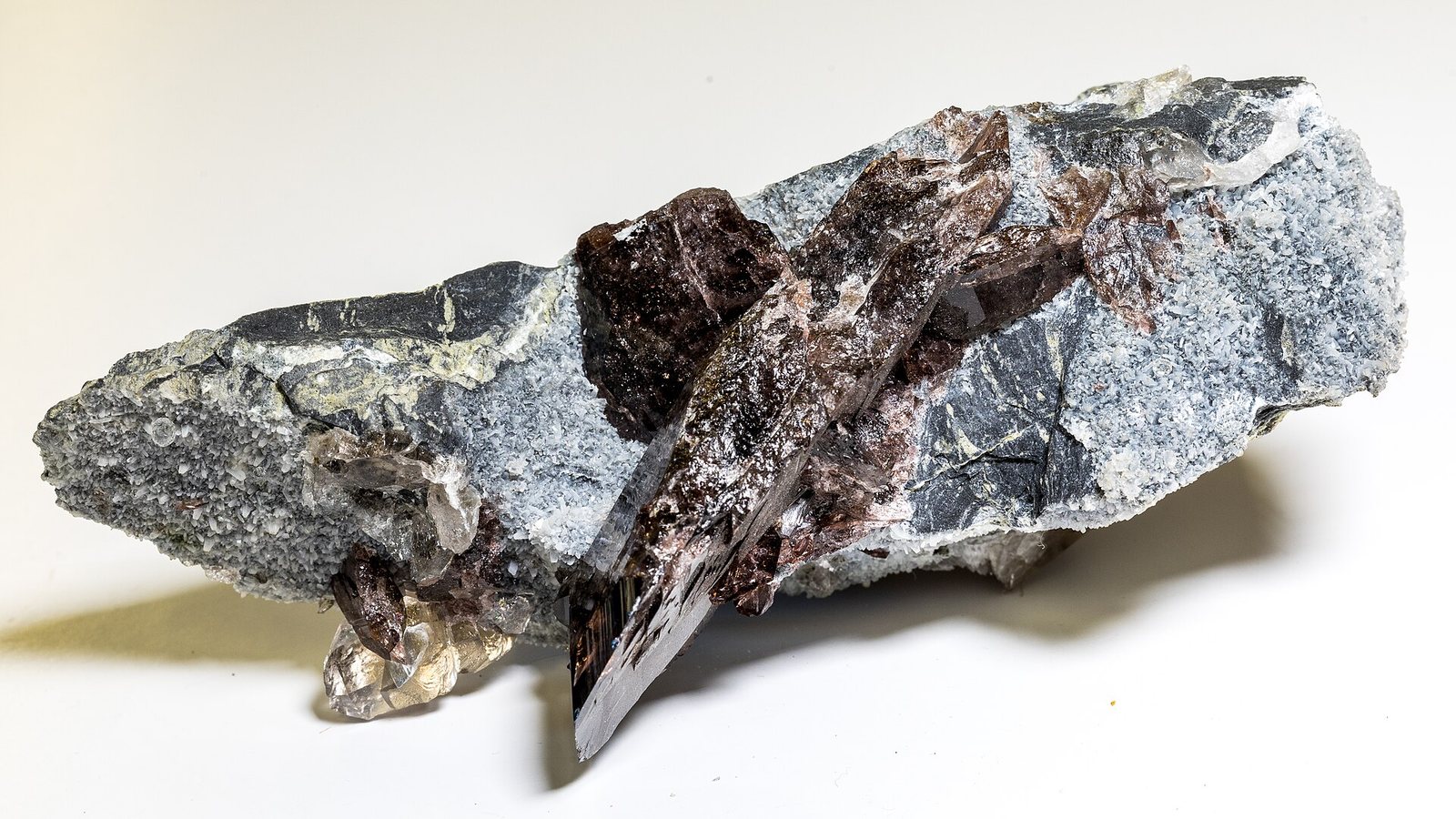
Tất cả khoáng vật quặng →Đây là các khoáng sản thực sự mang lại phosphate rock. Một mỏ khoáng chỉ là thân quặng khi một trong số chúng có hàm lượng đủ cao để bù đắp chi phí khai thác.
Ai sản xuất nó
Xem trên bản đồ →Mine production
Mine productionthousand metric tons 2025 (ước tính) Tổng toàn cầu 250,000 thousand metric tons
USGS Mineral Commodity Summaries 2026 · Tonnages are gross weight of marketable phosphate rock, not contained P2O5. · nguồn ↗
Cuộn bảng sang ngang để xem các cột còn lại.
| Quốc gia | Sản lượng | Tỷ phần thế giới |
|---|---|---|
| China | 110,000 | 44.0% |
| Morocco | 36,000 | 14.4% |
| United States | 20,000 | 8.0% |
| Russia | 14,000 | 5.6% |
| Jordan | 12,000 | 4.8% |
| Saudi Arabia | 10,000 | 4.0% |
| Egypt | 5,500 | 2.2% |
| Brazil | 5,000 | 2.0% |
| Peru | 4,800 | 1.9% |
| Tunisia | 3,300 | 1.3% |
| Vietnam | 3,000 | 1.2% |
| Senegal | 2,800 | 1.1% |
| Australia | 2,500 | 1.0% |
| Israel | 2,400 | 1.0% |
| South Africa | 2,200 | 0.9% |
| Algeria | 2,000 | 0.8% |
| Kazakhstan | 1,900 | 0.8% |
| Togo | 1,600 | 0.6% |
| India | 1,500 | 0.6% |
| Turkey | 1,200 | 0.5% |
| Finland | 980.0 | 0.4% |
| Uzbekistan | 950.0 | 0.4% |
| Syria | 800.0 | 0.3% |
| Other countries | 770.0 | 0.3% |
| Mexico | 450.0 | 0.2% |
| Tổng toàn cầu | 250,000 | 100% |
"Withheld" có nghĩa là USGS đã ẩn số liệu để tránh tiết lộ dữ liệu của một công ty riêng lẻ — không có nghĩa là bằng không. Tổng các hàng theo quốc gia không phải lúc nào cũng bằng tổng toàn cầu vì nguồn làm tròn từng số liệu một cách độc lập và không phải lúc nào cũng tách riêng dòng "các quốc gia khác".
Ai nắm giữ trữ lượng
Reserves
Reservesthousand metric tons 2025
USGS Mineral Commodity Summaries 2026 · nguồn ↗
| Quốc gia | Trữ lượng | Tỷ phần thế giới |
|---|---|---|
| Morocco | 50,000,000 | 68.5% |
| China | 3,400,000 | 4.7% |
| Egypt | 2,800,000 | 3.8% |
| Tunisia | 2,500,000 | 3.4% |
| Russia | 2,400,000 | 3.3% |
| Algeria | 2,200,000 | 3.0% |
| Brazil | 1,600,000 | 2.2% |
| South Africa | 1,500,000 | 2.1% |
| Saudi Arabia | 1,000,000 | 1.4% |
| Finland | 1,000,000 | 1.4% |
| United States | 1,000,000 | 1.4% |
| Jordan | 820,000 | 1.1% |
| Australia | 800,000 | 1.1% |
| Other countries | 800,000 | 1.1% |
| Kazakhstan | 260,000 | 0.4% |
| Syria | 250,000 | 0.3% |
| Peru | 210,000 | 0.3% |
| Uzbekistan | 100,000 | 0.1% |
| Turkey | 71,000 | 0.1% |
| Israel | 60,000 | 0.1% |
| Senegal | 50,000 | 0.1% |
| India | 31,000 | 0.0% |
| Togo | 30,000 | 0.0% |
| Mexico | 30,000 | 0.0% |
| Vietnam | 30,000 | 0.0% |
| Tổng toàn cầu | 73,000,000 | 100% |
Giá
average value, f.o.b. mine, dollars per metric ton
Trung bình nămdollars per metric ton
Cơ sở: average value, f.o.b. mine, dollars per metric ton. Trung bình năm theo công bố trong USGS Mineral Commodity Summaries 2026 · nguồn ↗. Đây là mức trung bình hàng năm tham khảo, không phải báo giá thị trường trực tiếp.
Các mỏ sản xuất khoáng sản này
Tất cả mỏ →
Nơi nó được chế biến và tinh luyện
| Nhà máy | Loại | Giai đoạn | Quốc gia | Vai trò |
|---|---|---|---|---|
| CATL Ningde Plants | Gigafactory | Thành phần | China | Đầu vào |
Công dụng của nó
Tất cả thị trường đầu ra →| Thị trường đầu ra | Chức năng của nó ở đó | Tầm quan trọng |
|---|---|---|
| Electric Vehicles | The cathode in LFP cells | Định nghĩa |
| Agriculture & Food | The P in NPK | Định nghĩa |
| Grid Storage | LFP cathode | Định nghĩa |
Một công nghệ cần bao nhiêu
| Công nghệ | Đại lượng | Báo giá | Cơ sở |
|---|---|---|---|
| LFP Lithium-Ion Battery | 25.00–45.00 kg | per 75 kWh pack | As phosphate in the cathode |
Indicative range compiled from published technology studies and chemistry; verify against a manufacturer specification before use. Chạy các con số này ở bất kỳ quy mô nào trong máy tính vật liệu →