これは何か
A yellow element stripped out of oil and gas to stop it polluting, then turned into sulfuric acid — the most-produced chemical in the world.
なぜ重要なのか
Sulfuric acid leaches copper, nickel and rare earths and makes phosphate fertiliser. Almost all of it comes from fossil-fuel processing, so decarbonisation shrinks its supply.
Where it is in the Earth
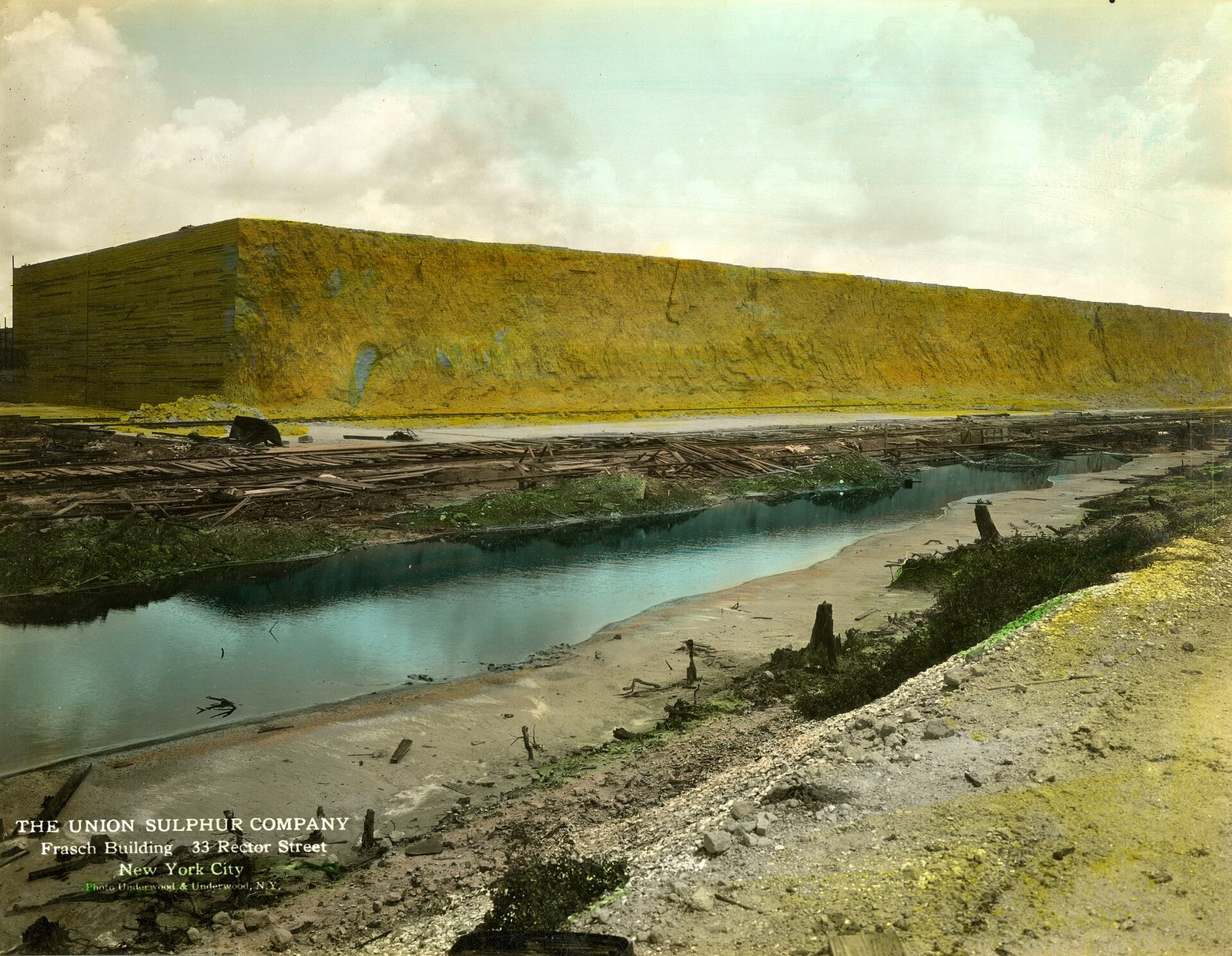
Sulfur is one of the more abundant elements in the Earth's crust and mantle, but the concentrations that matter commercially are almost always the product of specific geological processes rather than simple crustal abundance. The oldest and most familiar source is the native sulfur — meaning pure, elemental sulfur — that accumulates around volcanic vents and in the cap rock above salt domes. Salt domes form when thick beds of ancient evaporite salt, buried under younger sediments, become buoyant and push upward in great columns. As they rise they carry sulfate minerals, principally anhydrite (calcium sulfate), into contact with anaerobic bacteria and with hydrocarbons migrating up from depth. Those bacteria reduce the sulfate, stripping oxygen from it and leaving elemental sulfur behind in porous limestone that sits atop the dome. This is the classical Frasch deposit, named after the extraction method it made famous, and it underlies the Gulf Coast geology that once made the United States the world's leading sulfur producer.
Volcanic environments produce a different style of deposit. Where magma rich in sulfur dioxide vents at or near the surface — around fumaroles and crater lakes — sulfur dioxide reacts with hydrogen sulfide to precipitate native sulfur directly. These deposits can be visually dramatic but are rarely large by industrial standards. A more consequential geological association is with metal sulfide ore bodies: the ores of copper, zinc, lead, nickel and molybdenum are sulfide minerals (chalcopyrite, sphalerite, galena, pentlandite and molybdenite respectively), meaning sulfur is chemically bound to the metal throughout. When those ores are smelted, the sulfur is driven off as sulfur dioxide gas and must be captured. This capture, rather than any mining of sulfur itself, is now how most of the world's smelter-derived sulfuric acid is made.
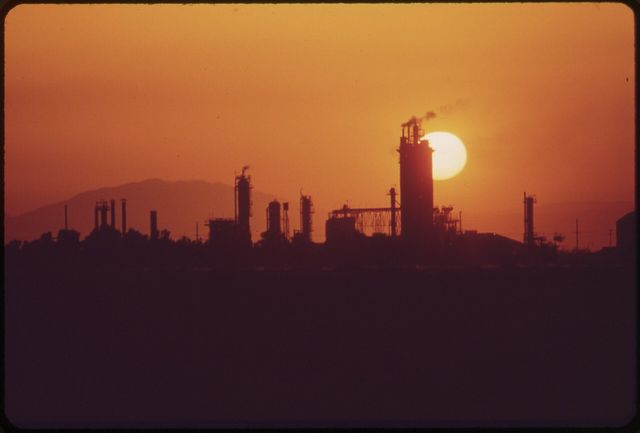
By far the largest modern source, however, is neither volcanic nor sedimentary in the traditional sense. Crude oil and natural gas contain sulfur compounds — mercaptans, hydrogen sulfide, organic sulfides — in concentrations that vary enormously by field. Sour crude and sour gas, the industry terms for high-sulfur feedstocks, must be sweetened before refining or transmission because sulfur compounds corrode pipelines and equipment and produce sulfur dioxide when burned. The hydrogen sulfide separated out in this sweetening process is converted to elemental sulfur by the Claus process, a catalytic sequence that has become the dominant sulfur-producing technology worldwide. The geography of sulfur supply therefore maps almost exactly onto the geography of fossil-fuel processing: the large producers listed in the production table — China, the United States, Russia, Saudi Arabia, the UAE, Canada, Kazakhstan — are large precisely because they process large volumes of oil and gas, not because their territory happens to be geologically sulfur-rich in any traditional sense.
Getting it out
For most of the twentieth century, the word 'sulfur mining' would have called to mind the Frasch process: superheated water pumped underground to melt native sulfur out of salt-dome cap rock, with the liquid sulfur then forced to the surface by compressed air. The method was elegant for its time and required no crushing or flotation, since the product arrived at surface already molten. Frasch operations were common along the Gulf Coast of the United States and in Poland. Those deposits are now largely exhausted or uneconomic, and Frasch production is no longer significant at the global scale. What replaced it was not a new mining method but a change in the nature of the resource itself.
Today, the great majority of sulfur does not come from a mine at all. It is recovered as an unavoidable by-product of oil refining and natural gas processing. At a refinery or gas-processing plant, hydrogen sulfide is separated from the hydrocarbon stream, fed into a Claus unit, and converted to liquid sulfur at roughly 130–150 °C — just above sulfur's melting point of 115.2 °C. The liquid is either stored in heated tanks and shipped molten, or allowed to solidify into formed product (pastilles, granules or large blocks) for easier handling. There is no ore grade in the conventional sense, no overburden to move, and no mill to run. The 'mine' is the refinery or gas plant, and the output of sulfur is determined by how much sour feedstock is processed and how stringent the environmental regulations on sulfur emissions are, not by any decision to produce sulfur per se.
The Athabasca oil sands in Canada illustrate the scale this can reach. Bitumen-saturated sand is excavated by truck-and-shovel in large open pits, upgraded into synthetic crude, and in that process sulfur is separated and stockpiled. Because the sulfur is a by-product of a process driven by energy demand, the producer has limited ability to adjust sulfur output in response to sulfur prices. A small fraction of global supply still comes from mining native sulfur deposits by conventional open-pit methods in countries such as Poland and parts of the Middle East, and from sulfur recovered at metal smelters as a by-product of roasting sulfide concentrates. The practical implication is that most of the world's sulfur supply is, in a meaningful sense, captive: it is produced whether the market wants it or not, because the alternative is to emit sulfur dioxide, which regulations prohibit.
What pulls on it
The single largest use of sulfur, by a considerable margin, is the manufacture of phosphate fertilisers. Phosphate rock — mined primarily in Morocco, China and a handful of other countries — does not dissolve readily in water and cannot be absorbed by plant roots in its raw form. To make it useful, it must be reacted with sulfuric acid to produce superphosphate or phosphoric acid, which are the actual fertiliser ingredients. Because global food production depends on phosphate fertilisers, and because phosphate processing requires sulfuric acid in large quantities, sulfur is indirectly a foundational input to the food supply. The connection is not abstract: a shortage or sharp price spike in sulfur feeds through into fertiliser costs within months.
Beyond agriculture, sulfuric acid is the workhorse leaching agent in hydrometallurgy — the extraction of metals from ores using liquid chemistry rather than heat. Copper in particular is increasingly recovered from low-grade oxide ores by heap leaching with sulfuric acid, a process in which crushed ore is stacked on lined pads and acid is dripped through to dissolve copper, which is then recovered by electrowinning. Nickel and cobalt laterites, rare earth ores and uranium ores are also processed with sulfuric acid. As demand for battery metals grows, so does demand for acid and therefore for sulfur. The intensity figures in the table illustrate this at the system level: vanadium redox flow batteries use between 3.0 and 8.0 tonnes of sulfuric acid per megawatt-hour of storage capacity, because sulfuric acid is the electrolyte in which the vanadium chemistry takes place.
Demand could change sharply in two quite different directions. On the upside, any large expansion of copper, nickel or lithium processing — driven by electrification — increases acid demand. On the downside, a faster-than-expected contraction of oil and gas processing would reduce supply before demand has fallen proportionally, temporarily tightening the market; but a very deep, sustained decarbonisation would eventually reduce the fossil-fuel processing base that generates most of the world's sulfur, potentially creating a structural deficit that no easy substitute can fill. Sulfur is also used in smaller but non-trivial quantities in rubber vulcanisation (the chemical process that gives rubber its elasticity and durability), in pharmaceuticals, in fungicides and in pulp and paper, but these sectors are secondary in scale to fertilisers and hydrometallurgy.
生産者
地図で見る →Production, all forms
Production, all formsthousand metric tons 2025 (推定値) 世界合計 84,000 thousand metric tons
USGS Mineral Commodity Summaries 2026 · All forms, gross weight; recovered (by-product) sulfur dominates. · 出典 ↗
テーブルを横にスクロールすると残りの列が表示されます。
| 国 | 生産 | 世界に占める割合 |
|---|---|---|
| China | 19,000 | 22.6% |
| United States | 8,100 | 9.6% |
| Russia | 7,500 | 8.9% |
| Saudi Arabia | 7,200 | 8.6% |
| United Arab Emirates | 6,300 | 7.5% |
| Other countries | 5,700 | 6.8% |
| Canada | 5,000 | 6.0% |
| Kazakhstan | 4,800 | 5.7% |
| India | 3,700 | 4.4% |
| Qatar | 3,100 | 3.7% |
| Korea, Republic of | 3,100 | 3.7% |
| Japan | 2,700 | 3.2% |
| Iran | 2,100 | 2.5% |
| Chile | 1,400 | 1.7% |
| Kuwait | 1,300 | 1.5% |
| Poland | 1,100 | 1.3% |
| Australia | 900.0 | 1.1% |
| Turkmenistan | 870.0 | 1.0% |
| 世界合計 | 84,000 | 100% |
「非開示」とは、個別企業のデータが特定されないようUSGSが数値を公表しなかったことを意味し、ゼロを意味するものではありません。出典が各数値を独立して丸め処理しており、「その他の国」の内訳を常に示しているわけではないため、各国の数値の合計が世界合計と一致しないことがあります。
価格
average unit value, free on board, mine and (or) plant, dollars per metric ton of elemental sulfur
年間平均dollars per metric ton
基準: average unit value, free on board, mine and (or) plant, dollars per metric ton of elemental sulfur. 以下に公表された年間平均値: USGS Mineral Commodity Summaries 2026 · 出典 ↗. これらは参照用の年間平均値であり、リアルタイムの市況相場ではない。
産出鉱山
全鉱山 →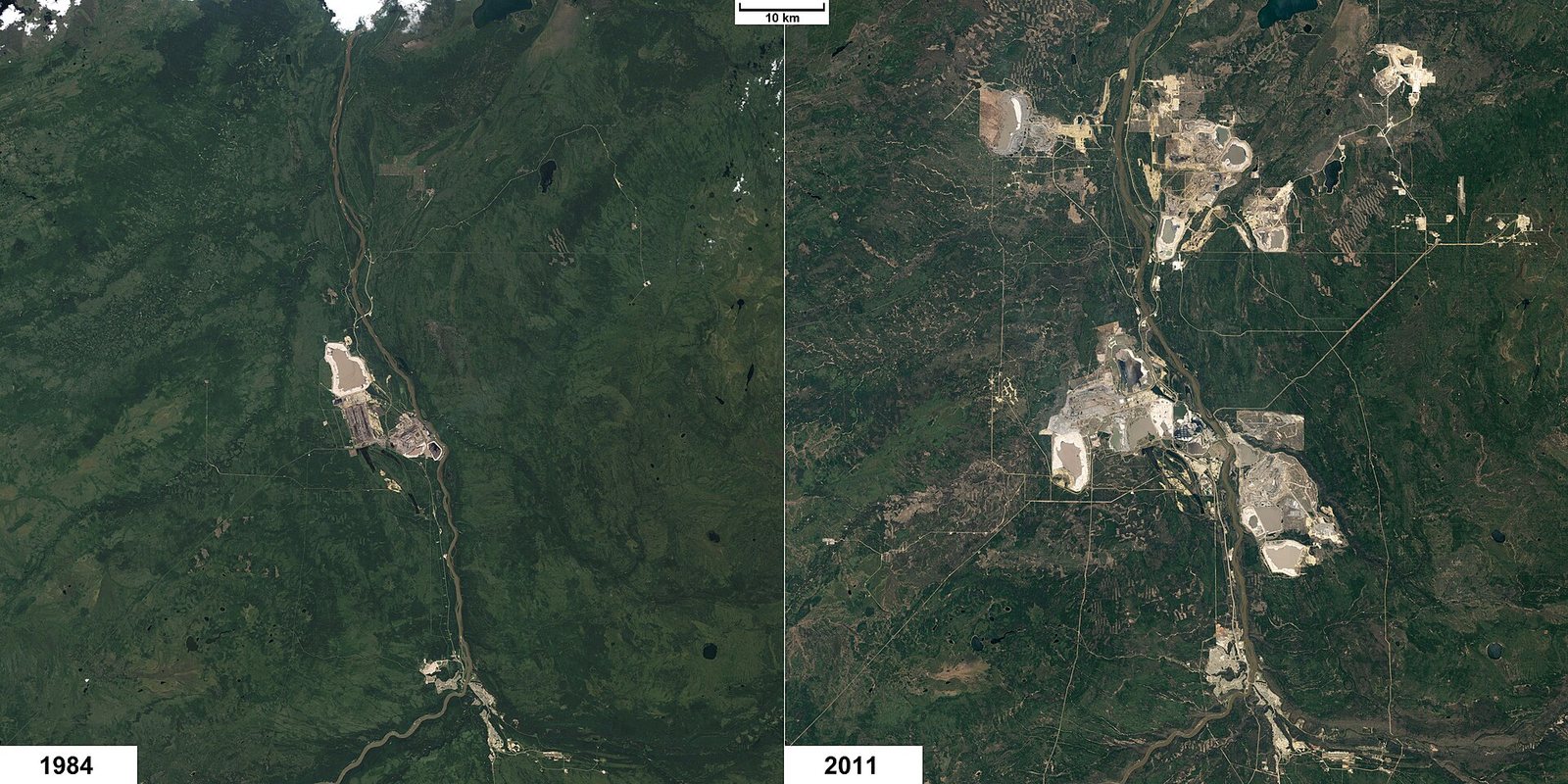
Athabasca Oil Sands (Mildred Lake / Aurora) →
処理・精製が行われる場所
| プラント | 種別 | ステージ | 国 | 役割 |
|---|---|---|---|---|
| Atlantic Copper Smelter, Huelva | 製錬所 | 処理 | Spain | 産出物 |
用途
全エンドマーケット →| 最終市場 | そこでの機能 | 重要度 |
|---|---|---|
| Agriculture & Food | Sulfuric acid to make phosphate fertiliser | 定義 |
技術が必要とする量
| 技術 | 数量 | 建値 | 基準 |
|---|---|---|---|
| Vanadium Redox Flow Battery | 3.00–8.00 t | per MWh of storage | Sulfuric acid electrolyte |
Indicative range compiled from published technology studies and chemistry; verify against a manufacturer specification before use. 素材計算機で任意の規模に換算して実行 →
越境地点をたどる
すべての輸送経路 →この素材の特定の貨物が実際にたどる経路——すべての国、すべての管理者、各工程で残されるもの。
Australian spodumene to a battery, the fast way Eight weeks instead of eighteen months, at the cost of a great deal more energy. Chilean sulfide concentrate to Chinese cathode to a wire Chile mines the most copper in the world. China refines the most. Those are not the same sentence. Venezuelan extra-heavy crude to diesel, asphalt and aluminium anodes Oil so thick it will not flow down a pipe, and cannot be refined by most refineries on Earth.