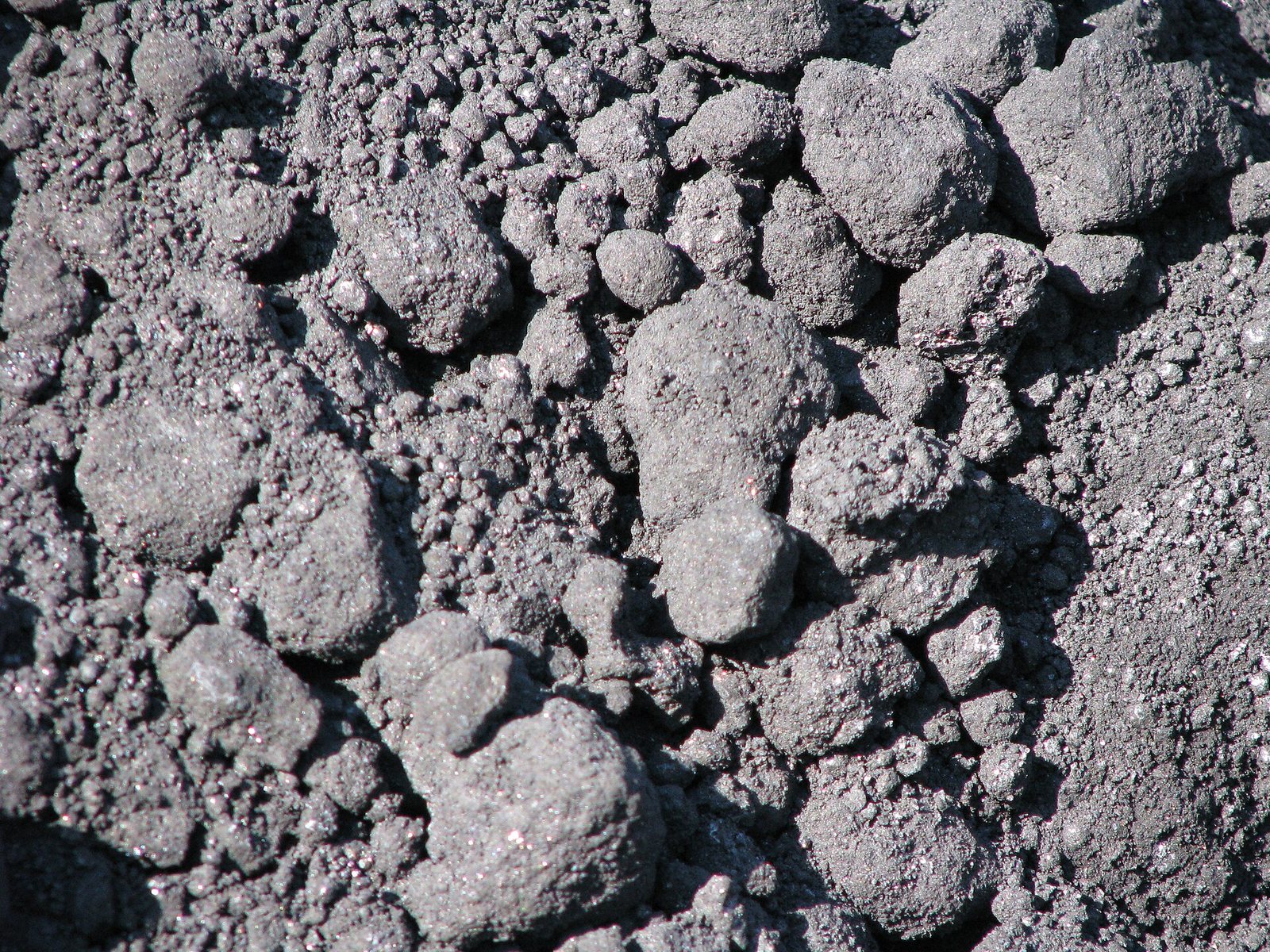
¿Qué es?
The solid carbon left at the bottom of an oil refinery, and the raw material for both aluminium smelter anodes and synthetic battery graphite.
¿Por qué importa?
It is the hidden link between the oil industry and the battery industry — needle coke shortages have directly constrained anode supply.
Where it is in the Earth
Petroleum coke is not a mineral and it does not form in the Earth through geological processes. It is an industrial residue: the solid carbon that remains after the heaviest fractions of crude oil have been thermally cracked and the lighter, more valuable hydrocarbons driven off in an oil refinery. Understanding where petroleum coke comes from therefore means understanding crude oil rather than rock.
Crude oil itself originates from the slow transformation of ancient organic matter — mostly marine microorganisms — buried under sediment and subjected to heat and pressure over millions of years. Different crude oils carry different proportions of heavy, carbon-rich compounds depending on the source rock, burial depth, and whether lighter fractions have migrated away or been degraded over time. Heavy, sour crudes — those with high sulphur content and a high density — tend to yield more of the residual material that eventually becomes petroleum coke, because they contain a greater share of the large, complex hydrocarbon molecules that resist cracking into fuels.
The geographical distribution of petroleum coke production therefore follows the distribution of heavy crude refining capacity, not ore deposits. Regions with refineries configured to process heavy crude, or equipped with coking units designed to extract maximum liquid fuel from the barrel, are where petroleum coke originates. This makes it fundamentally a by-product: no refinery is built to make petroleum coke; it appears as a consequence of making fuels, and its volume and character are determined by the crude slate and the refinery configuration rather than by any decision about coke output.
Getting it out
Petroleum coke is not mined. It accumulates inside the large steel vessels — called coking drums — that form part of a delayed coking unit at an oil refinery. In delayed coking, heated residual oil is fed into one drum while another is being decoked, allowing continuous operation. The coke builds up as a solid mass inside the drum over a cycle of many hours. When a drum is full, high-pressure water jets are used to cut the solidified coke out of the vessel, a process called hydraulic decoking. The broken coke falls into a pit or onto a conveyor below the drum.
What emerges at this stage is called green coke, meaning unprocessed rather than environmentally green. It still contains a significant proportion of volatile hydrocarbons and moisture trapped within its porous structure. Green coke is the primary traded form for fuel uses, where its energy content is what matters. For higher-value applications — making anodes for aluminium smelting, or making the needle coke used in electrodes and battery materials — green coke is only the starting point, and further thermal treatment is required before it becomes a usable product.
Because there is no ore body, there is no strip ratio, no grade variation in the geological sense, and no mine permitting process. The supply constraint is instead the number and type of coking units in operation globally, the quality of crude being processed, and the decisions refineries make about how to configure their operations. A refinery can, within limits, adjust the severity of its coking process, which affects both the quantity and the quality of coke produced, but it cannot easily decouple coke output from its primary business of producing transport fuels.
What pulls on it
Petroleum coke sits across two quite different demand worlds simultaneously, and what pulls on each is driven by entirely different forces. The larger volume by far goes into fuel use — burned in cement kilns, power plants, and industrial furnaces as a substitute for coal, valued for its high carbon and energy content. This market is sensitive to coal prices, environmental regulations on sulphur emissions, and the overall level of industrial activity. In regions where sulphur regulations are strict, high-sulphur fuel-grade coke faces disposal problems and can even become a liability for refineries rather than a saleable product.
The smaller but more scrutinised demand comes from the materials industries. Aluminium smelting consumes calcined anode-grade coke in very large quantities, because every tonne of aluminium produced requires a substantial mass of carbon anode, which is consumed in the electrolytic reduction process. Demand from this route moves with aluminium production volumes, which in turn track construction, transport, and packaging activity globally. The anode-grade market requires consistent quality — sulphur and metals impurities above certain thresholds compromise anode performance and are difficult to tolerate — so not all petroleum coke qualifies regardless of volume.
The demand category attracting most attention in recent years is needle coke for synthetic graphite anodes in lithium-ion batteries. Battery anodes require either natural graphite or synthetic graphite made from needle coke, and synthetic graphite is often preferred in applications demanding consistent performance. Growth in battery production for electric vehicles and energy storage increases demand for needle coke specifically, which is produced by a smaller number of facilities from a more restricted feedstock base than general petroleum coke. A sharp change in demand would follow either a major shift in battery chemistry away from graphite anodes — something actively researched but not yet commercially dominant — or a significant change in the pace of electrification. In the other direction, tightening environmental regulation on fuel-grade coke use, or a structural shift in refinery configurations away from delayed coking, could alter supply volumes in ways that affect all grades simultaneously.
Turning ore into product Nivel 3
The path from green coke to a material that industry can use varies considerably depending on the intended application, and the distinction the data block draws between green coke, calcined coke, and needle coke is not merely commercial — each represents a different degree of thermal treatment and a meaningfully different material.
Calcination is the first major processing step for most non-fuel uses. Green coke is fed into a rotary kiln or rotary hearth furnace and heated to temperatures well above the boiling point of water, driving off residual volatile matter and moisture and rearranging the carbon structure into something more ordered and electrically conductive. The product, calcined coke, is what aluminium smelters use to manufacture the carbon anodes that conduct electricity into the electrolytic cell — the Hall-Héroult process — where alumina is reduced to aluminium metal. The calcination step is energy-intensive, and the quality of the calcined product depends heavily on the properties of the green coke fed in: sulphur content, metals content, and the degree of crystalline order in the carbon structure all carry through from the crude oil source.
Needle coke requires more selective processing still. It is produced from either petroleum-derived feedstocks — specifically the decant oil or clarified slurry oil that comes from fluid catalytic cracking units — or from coal tar pitch. The feedstock is chosen for its low sulphur, low metals content, and its ability to form highly anisotropic, elongated carbon crystallites during coking, which is what gives needle coke its directional properties and low thermal expansion. After coking, needle coke is calcined at higher temperatures than standard anode-grade material. The resulting product is used to make graphite electrodes for electric arc furnaces and, increasingly after further processing into synthetic graphite, as anode active material in lithium-ion batteries. The conversion of calcined needle coke into synthetic graphite involves additional high-temperature graphitisation — typically above two thousand degrees Celsius — which further orders the carbon lattice. Each step narrows the field of acceptable feedstocks and raises both energy consumption and unit cost.
Substitution and recycling Nivel 3
For fuel applications, petroleum coke competes directly with thermal coal and, in some industrial processes, with natural gas. The substitution is straightforward in principle — all three provide heat through combustion — but petroleum coke's higher sulphur content relative to many coals creates a real performance penalty in markets with sulphur emission controls, requiring either expensive flue-gas desulphurisation or accepting regulatory constraints. Where those controls are absent or weakly enforced, fuel-grade coke has historically been competitive on cost. The direction of substitution in this segment has generally run away from petroleum coke as emissions standards tighten, rather than toward it.
For aluminium anode manufacture, the substitutes are more constrained. Coal tar pitch-based binder holds the anode together, but the bulk filler must be a calcined carbon of appropriate structure and purity. Coal-derived calcined anthracite can substitute for petroleum-derived calcined coke in anode manufacture to a degree, but it carries its own impurity profile and is generally considered an inferior substitute for most anode applications. There is no simple drop-in replacement that is both widely available and technically equivalent.
In the needle coke segment, coal tar-derived needle coke — a by-product of coal tar distillation and subsequent coking — competes with petroleum-derived needle coke. The two differ in their impurity profiles and in the consistency of their carbon structure, and the suitability of each depends partly on the downstream graphite electrode or battery anode specification. Recycling of petroleum coke does not occur in any meaningful sense: once consumed in an aluminium anode, the carbon is oxidised and lost; once graphitised into a battery anode, it could in principle be recovered through battery recycling, but the graphite fraction is not typically the focus of lithium-ion battery recycling processes, which prioritise metals. The carbon is generally lost at end of life.
Síguelo a través de las fronteras
Todos los recorridos →Adónde va realmente una partida de este material: cada país, cada custodio y qué queda atrás en cada paso.
Alberta oil sands: mined like ore, refined like oil The only oil in the world that is dug up with a shovel and graded like an orebody. Guinean bauxite to an aluminium window frame Four tonnes of tropical soil, two tonnes of white powder, one tonne of metal — and the metal is made wherever the power is… Venezuelan extra-heavy crude to diesel, asphalt and aluminium anodes Oil so thick it will not flow down a pipe, and cannot be refined by most refineries on Earth.